Access Virus B (1999–2002)
That first twist of the filter knob still hits like a caffeine shot to the cortex—bright, aggressive, and unapologetically digital in the best way.
Overview
Turn on a Virus B and it doesn’t whisper; it announces. The boot-up chirp, the red LEDs flaring to life, the way the oscillators snap into place with a precision that feels almost surgical—this isn’t a synth that hides in the mix. It was built for late-night studio binges and live sets where cutting through a wall of sound mattered more than subtlety. When Access dropped the Virus B in 1999, they weren’t just iterating on the original Virus A—they were responding to a market that had caught fire with trance, hard techno, and anything that needed razor-sharp leads, supersaws that could slice glass, and bass that didn’t just thump but *snarled*. The B model hit that target dead center, but what’s often overlooked is how much it *outgrew* that niche. Beneath the preset-heavy factory library of “Trance Attack” and “Laser Beam 2” lies a synth with real depth, a sound engine that rewards digging, and a real-time control set that makes tweaking feel like sculpting.
Polyphony doubled from the original’s 12 voices to 24, which might not sound like much now but in 1999 was a serious flex—especially for a virtual analog that wasn’t costing five grand. Multitimbrality held strong at 16 parts, making it a legitimate workstation for sequencing entire tracks without external gear. The DSP upgrade wasn’t just about voice count; it opened the door to more complex modulation routing, deeper effects, and a cleaner overall signal path. And yes, the effects—this is where the Virus B starts to feel like a studio in a box. Five simultaneous effects per part? On a hardware VA in 1999? That included things like a 32-band vocoder, stereo delays with tempo sync, and distortion algorithms that could go from warm saturation to full-on digital clipping. It wasn’t just capable—it was *overqualified* for the genre it became famous in.
But here’s the thing collectors and players keep coming back to: the character. The Virus B doesn’t sound like a Nord, doesn’t sound like an Access Virus TI, and sure as hell doesn’t sound like a Roland JP-8000, even though they were all chasing similar territory. It’s brighter than the Nord, colder than the JP, and lacks the later TI’s lush, almost analog-like warmth. The B is clinical in the best way—like a high-resolution photo of a distorted saw wave. It’s not trying to fool you into thinking it’s analog. It’s proud of being digital, and that confidence shows in how it handles modulation. The LFOs are rock-solid, the envelopes snap with precision, and the arpeggiator—though buried in menus—has a swing and flexibility that made it a secret weapon for live performers. You can program rhythmic gate patterns, set note lengths, and even sync the arp to MIDI clock with tight timing that doesn’t drift. It’s not flashy, but it’s *reliable*, and in a live set, that’s worth more than a flashy ribbon controller.
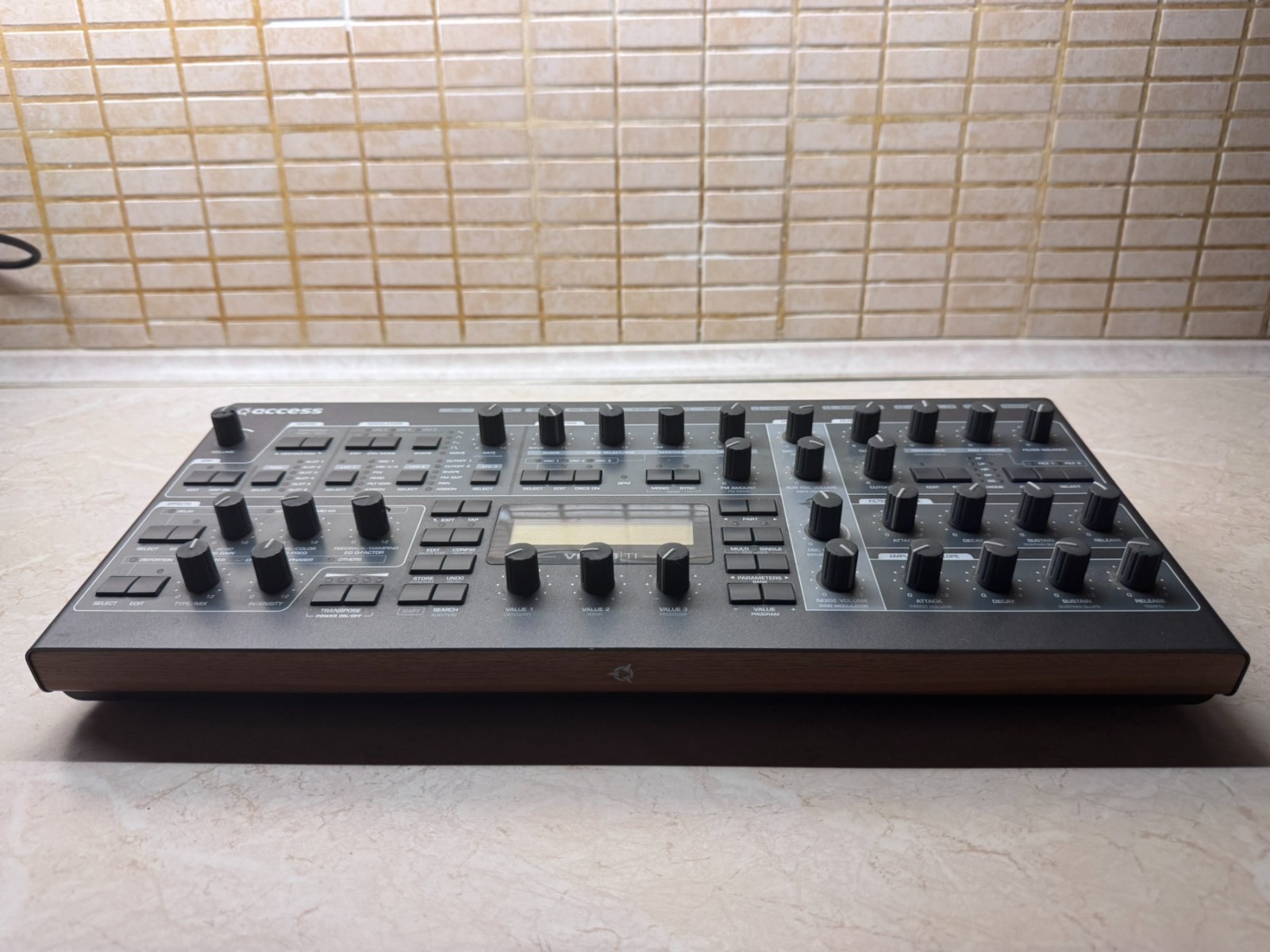
The keyboard version—Virus KB—adds 61 full-size, semi-weighted keys with aftertouch and velocity, plus pitch and mod wheels that feel substantial, not flimsy. The build is solid, with wood end cheeks that give it a slightly more premium feel than the desktop module, though the core circuit board is identical. That’s important: whether you’re buying the rack version or the KB, you’re getting the same sonic engine. No cuts, no compromises. The front panel layout is dense but logical—knobs for filter cutoff, resonance, envelope depth, and LFO rate sit front and center, with dedicated buttons to jump into oscillator, filter, and effects sections. It’s not as immediate as a Nord or a Moog, where every parameter has a knob, but once you learn the menu structure, it’s fast. And unlike the original Virus A, the B dropped the “Easy” and “Expert” mode split, so all parameters are available all the time. No hand-holding, no dumbed-down interface—just full access.
Specifications
| Manufacturer | Access Music GmbH |
| Production Years | 1999–2002 |
| Original Price | $1,995 (KB), $1,495 (Rack) |
| Polyphony | 24 notes |
| Multitimbrality | 16 parts |
| Oscillators | 2 per voice, plus sub-oscillator |
| Waveforms | Saw, square, pulse, 64 digital waveforms |
| Filter Type | 2 multi-mode filters (low-pass, high-pass, band-pass, notch), serial/parallel configuration |
| LFOs | 3 per voice |
| Envelopes | 3 (DAHDSR) |
| Effects | 5 simultaneous per part: reverb, delay, chorus, phaser, distortion, vocoder (32-band), EQ |
| MIDI | In, Out, Thru |
| Audio Inputs | Stereo |
| Audio Outputs | 3 stereo pairs (6 total) |
| Digital I/O | None |
| Keyboard | 61 keys (KB model only), velocity and aftertouch sensitive |
| Display | 2-line LCD |
| Power Supply | Internal (KB), external PSU (Rack) |
| Weight | 12.5 kg (KB), 3.2 kg (Rack) |
| Dimensions (W×H×D) | 980 × 105 × 340 mm (KB), 482 × 44 × 315 mm (Rack) |
| Converter Resolution | 24-bit D/A, 18-bit A/D |
| Arpeggiator | Yes, programmable patterns, swing, tempo sync |
| Patch Memory | 512 user, 512 factory |
Key Features
The Filter Section: Where the Virus Earns Its Name
The twin multi-mode filters are the heart of the Virus B’s aggression. They can be run in series for steep rolloffs and deep resonance sweeps, or in parallel for complex, phasing textures. The resonance is self-oscillating and stays stable even at extreme settings—no wobble, no tuning drift. It’s not as creamy as a Roland IR3109 or as gnarly as a Korg MS-20 filter, but it’s precise, surgical, and cuts through a mix like a scalpel. When you crank the resonance and sweep the cutoff with an envelope, you get that classic “laser blast” sound that defined late-90s trance, but dial it back and use it for subtle movement in pads, and it’s equally effective. The filter modulation matrix is deep: you can route LFOs, envelopes, velocity, aftertouch, or MIDI CCs to cutoff and resonance with full depth control. It’s not as flexible as a Nord’s morphing filters, but it’s more than enough for real-time performance tweaking.
Effects Engine: Studio-Quality Processing Onboard
Most virtual analogs of the era treated effects as an afterthought—maybe a chorus and a reverb, if you were lucky. The Virus B laughs at that. Five effects per part, all running simultaneously, with high-quality algorithms that hold up today. The reverb is spacious without being muddy, the stereo delay can do dotted-eighth repeats that lock into tempo perfectly, and the distortion section is surprisingly musical. It’s not just overdrive—it includes bit-crushing, wavefolding, and tube-style saturation, all of which can be layered. The 32-band vocoder is a standout, especially when paired with the stereo inputs. You can feed in a vocal or another synth and get smooth, intelligible vocoding without needing external processing. And because the effects are part of the multitimbral architecture, you can have different effects chains on different parts—say, a distorted bass, a chorused pad, and a delayed lead, all playing at once without CPU strain.
Real-Time Control: Knobs, Menus, and the KB Advantage
The desktop module is functional, but the KB version is where the Virus B truly shines as a performance instrument. The semi-weighted keyboard has a satisfying action—firm but not stiff—and the aftertouch is responsive, making it great for adding expression to leads and pads. The pitch and mod wheels are tall and rubberized, easy to grab in the dark. But the real limitation is the lack of assignable pads or ribbons. You’re stuck with what’s on the panel: a few buttons, a couple of user knobs (which can’t be assigned to arpeggiator controls, frustratingly), and the standard wheels. That said, the menu system, while not immediate, is logical. Press “Osc,” “Filter,” or “Env,” and you jump straight to that section. Parameters are adjusted with the data wheel and confirmed with “Enter.” It’s not as fast as a Nord or a Virus TI with its endless encoders, but it’s not a chore either. And because the OS can be updated via MIDI, many users kept their units current with the latest features—something rare in hardware synths of this era.
Historical Context
The Virus B arrived at a turning point. The late 90s were all about digital dominance—DAWs were emerging, soft synths were gaining traction, and hardware was under pressure to justify its cost. The Virus A had already made waves, but it was the B that cemented Access as a serious player. While Roland was pushing the JP-8000 and Korg the Z1, Access took a different approach: more polyphony, more effects, more multitimbral parts, and a sound that leaned into digital clarity rather than analog emulation. It wasn’t trying to be warm or vintage—it was *modern*, and that resonated with producers in the trance and techno scenes who wanted synths that could handle complex, layered arrangements without breaking a sweat. The B also benefited from a thriving third-party sound design community. Custom soundsets flooded the internet, expanding the synth far beyond its factory presets. Suddenly, it wasn’t just a “trance machine”—it was a cinematic tool, a pad monster, a bass weapon. Competitors like the Novation SuperNova II offered more hands-on control, but at a much higher price. The Virus B hit the sweet spot: powerful, expandable, and priced to move.
Collectibility & Value
Today, the Virus B trades in a narrow but passionate market. Rack units typically sell between $600 and $900 in good condition, while the KB version commands $1,000 to $1,400—sometimes more if it’s fully serviced and includes the original case. Condition is critical. These units are over 20 years old, and while they’re generally reliable, a few failure points can turn a dream synth into a paperweight. The most common issue is power supply failure in the rack version—the external brick can degrade, taking the internal regulators with it. The KB’s internal PSU is more robust, but not immune. Capacitors on the main board can leak, especially near the audio output stage, leading to channel dropouts or noise. The OLED display on later models is prone to burn-in, though the B mostly uses a standard LCD. Before buying, test every output, check for crackling in the pots and switches, and verify that MIDI In, Out, and Thru all work. A unit that hasn’t been powered in years should be slowly reformed—applying full voltage to dried-out capacitors can cause immediate failure. Recapping isn’t cheap—$200 to $300 at a specialist shop—but it’s often worth it for a synth this capable. Firmware updates are free from Access’s website, and many owners run the latest OS to ensure compatibility with modern setups. If you’re after the classic Virus sound but don’t need the TI’s extras, the B is still a stellar choice—just go in with eyes open.
eBay Listings



As an eBay Partner, we earn from qualifying purchases. This helps support our independent vintage technology research.