Access Indigo 2 (2002)
That moment when the blue LEDs light up and you realize you're holding a full-featured Virus engine in something barely bigger than a laptop.
Overview
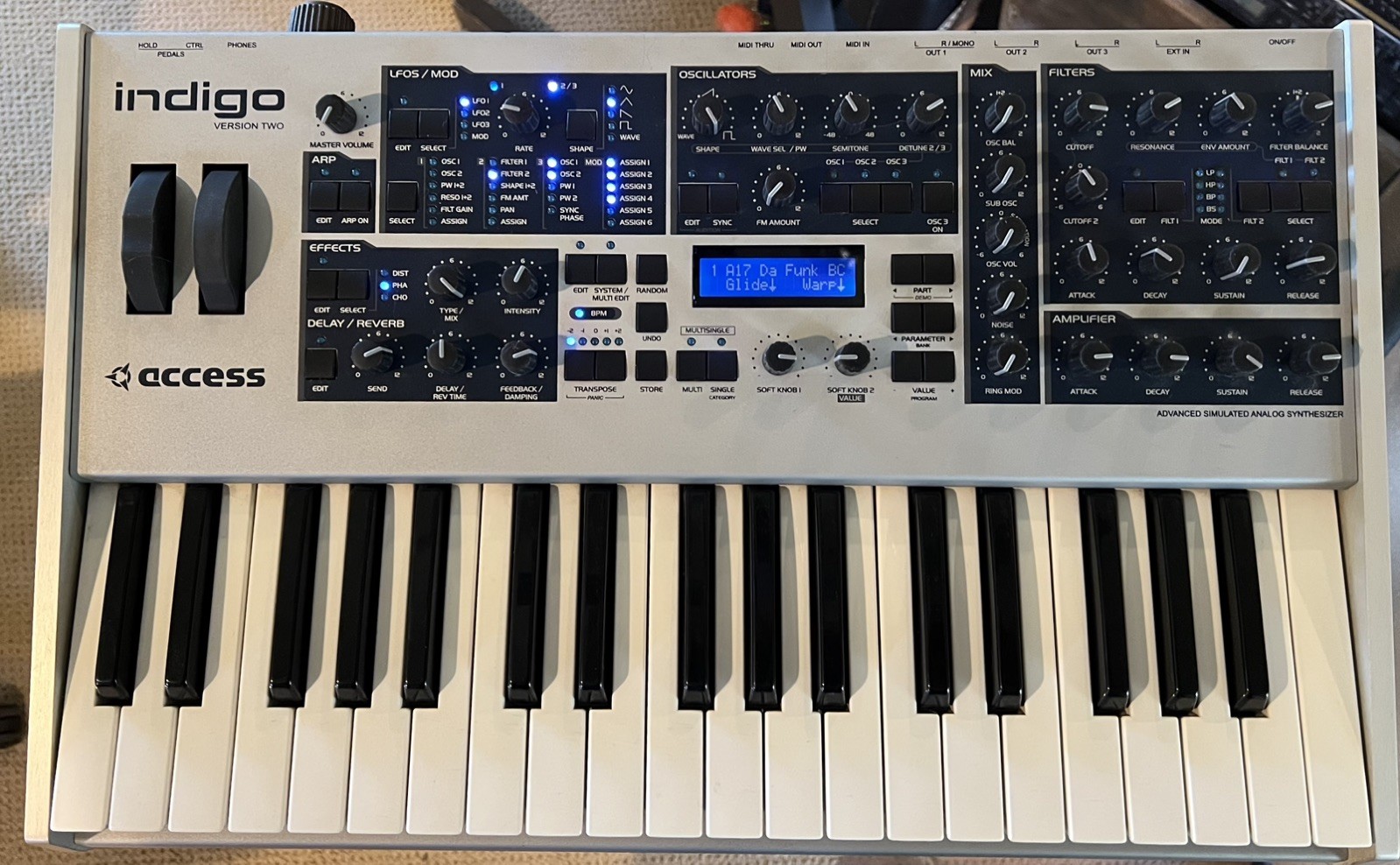
Plug in the Access Indigo 2, power it up, and the front panel ignites in a constellation of bright blue LEDs—like a synth version of a 1980s arcade cabinet crossed with a spaceship control panel. It’s compact, sure, but don’t let the size fool you: this is a full-fat Virus C under the hood, wrapped in a 37-key chassis that feels like it was forged in a German engineering lab and then polished by someone who really, really likes blue. The original Indigo was already a cult favorite, but the Indigo 2 fixed what mattered—most notably, it inherited the Virus C’s upgraded synthesis engine, giving it the same sonic horsepower as its bigger siblings. That means 32 voices of polyphony, three oscillators per voice, and a modulation matrix deep enough to get lost in. It’s not analog, but it doesn’t pretend to be; it’s a virtual analog machine that punches way above its weight in the digital domain, capable of everything from glassy pads that shimmer like ice to basslines so thick they feel like they’re vibrating your ribcage.
What makes the Indigo 2 special isn’t just what it can do—it’s how it feels to use it. The front panel is dense but logical: 32 knobs, 35 buttons, and 69 LEDs give you more hands-on control than most synths twice its size. You’re not buried in menus to tweak the third oscillator or adjust the arpeggiator; those functions now live on the surface, where they belong. That might not sound revolutionary, but if you’ve ever tried programming a sound on the original Indigo, you know how much of a game-changer this is. The interface still has its quirks—some parameters are still tucked behind layers, and the LCD screen is small—but it’s a massive leap forward from earlier Virus models. And yes, the keyboard still feels a bit plasticky and lightweight compared to the flagship Virus Keyboard, but it now includes aftertouch, which is a big deal. Channel pressure opens up expressive possibilities that the original lacked, letting you modulate filters, pitch, or effects in real time with just a bit of finger pressure. It’s not perfect, but it’s expressive—and that’s what matters.
Specifications
| Manufacturer | Access Music |
| Production Years | 2002 |
| Original Price | $2,495 USD |
| Keyboard | 37 keys, velocity and aftertouch sensitive |
| Polyphony | 32 voices |
| Timbrality | 16-part multitimbral |
| Oscillators | 3 per voice (sawtooth, variable pulse, triangle, sine), 1 sub-oscillator, oscillator sync, 64 digital FM spectral waveforms |
| LFOs | 3 per voice, 68 waveforms including S&H, sample-based, and user-defined |
| Filters | 2 independent resonant filters: lowpass, highpass, bandpass, band reject, parallel, split, and serial modes; up to 36dB/octave; includes overdrive/saturation |
| Envelopes | 2 ADSTR (Attack, Decay, Sustain, Time, Release) |
| Modulation Matrix | 6 sources, 9 destinations |
| Arpeggiator | 16 independent arpeggiators with real-time parameter control, swing, note length, and modulatable parameters |
| Vocoder | 32-band programmable vocoder |
| Effects | 98 simultaneous effects: 16 phasers, 16 choruses, 16 distortions, 16 ring modulators, 16 parametric EQs, stereo delay, 32-band vocoder, surround sound processing |
| EQ | 3-band per part (low-shelf, high-shelf, parametric mid with ±16dB gain, 0.28–15.41 Q, 19.69Hz–24kHz range) |
| MIDI | In, Out, Thru; 16 multitimbral parts |
| Memory | 1024 programs (256 user, 768 ROM, 128 multi) |
| Weight | 8.5 kg (18.7 lbs) |
| Dimensions | 600 x 280 x 75 mm (23.6 x 11.0 x 2.95 in) |
| Construction | Aluminum side panels, steel chassis, blue LED-lit front panel |
Key Features
The Virus C Engine in a Lunchbox Frame
The Indigo 2 isn’t just an updated Indigo—it’s a Virus C in disguise. That means it shares the same DSP architecture, oscillator models, and filter algorithms as the standalone Virus C and the later TI series. This was a big deal in 2002, because prior to this, Access’s product line was fragmented: the original Indigo ran on the older Virus B engine, which had fewer voices and less sophisticated effects. By upgrading to the Virus C core, the Indigo 2 became a full member of the top-tier family. That translates to more complex patches, deeper modulation, and a sonic character that’s both precise and aggressive. The oscillators are rich and stable, with FM modes that can generate metallic, bell-like tones or gritty digital noise. The filters—especially the newly modeled “Moog-style” lowpass—add warmth and grit when driven, helping the Indigo 2 avoid the cold, clinical sound that plagues some virtual analogs. It’s not warm in the way a Jupiter-8 is warm, but it’s got a kind of controlled aggression, a digital snarl that can be shaped into something surprisingly organic.
Effects That Actually Matter
Access has always had a habit of inflating their effects count by including modulation parameters as “effects,” which makes spec sheets look impressive but doesn’t reflect real-world usability. The Indigo 2 claims 98 simultaneous effects, and while some of that is marketing fluff (ring mod and boost stages don’t count as full effects in most people’s books), the real win here is the addition of 16 independent 3-band EQs—one for each multitimbral part. That’s huge. Most synths of this era offer global EQ or nothing at all, forcing you to fix tonal balance in the mix. But with per-part EQ on the Indigo 2, you can carve out space for each sound right inside the synth. Need to cut the mud from a bass patch? Boost the presence on a lead? Tame the harshness of a digital square wave? You can do it all without touching your DAW. The mid-band EQ is especially powerful, with a frequency range that dives into sub-bass and climbs into the upper harmonics, and a Q that can go from broad sweeps to surgical precision. It’s not just a convenience—it changes how you program, encouraging you to think about mix integration from the start.
Real-Time Control Without Menu Diving
One of the biggest complaints about early Virus synths was the reliance on LCD menus for essential functions. The Indigo 2 fixes that by putting more controls on the surface. Oscillator 3, the arpeggiator, and key effects parameters now have dedicated buttons or knobs, so you’re not cycling through pages to adjust a filter envelope or change an LFO destination. The modulation matrix is still accessed via the LCD, but it’s visual and intuitive—sources and destinations are laid out in a grid, and you can assign or tweak with just a few button presses. This isn’t just about convenience; it’s about playability. When you’re tweaking a sound live, you don’t want to lose the moment while you hunt for a parameter. The Indigo 2 lets you stay in the flow, making it a favorite among live performers and studio programmers alike. The 16-part multitimbral setup also shines here—each part can have its own arpeggiator, effects, and EQ, making it a powerful centerpiece for entire tracks.
Historical Context
The early 2000s were a transitional period for synthesizers. Analog was still in the wilderness, and digital workstations ruled the pro market. But a niche was opening up for powerful, affordable virtual analogs—machines that could emulate the warmth of analog without the maintenance or price tag. Access wasn’t the first to this space (Roland’s JP-8000 and Korg’s Z1 came earlier), but they refined it. The original Virus, released in 1998, was already a standout for its aggressive sound and deep architecture. By 2002, Access had matured the platform, and the Virus C represented the peak of that evolution. The Indigo 2 arrived just as the market was shifting—musicians wanted compact, powerful synths that could integrate into increasingly computer-based studios. It competed with the Novation Supernova II, the Waldorf Q, and the Roland JP-8080, all of which offered similar polyphony and multitimbrality. But the Indigo 2 had an edge: build quality, a tactile interface, and that unmistakable “Virus sound”—a blend of digital clarity and analog-style saturation that made it a favorite in trance, techno, and industrial music. It wasn’t trying to be retro; it was trying to be the future, and in many ways, it succeeded.
Collectibility & Value
Today, the Access Indigo 2 is a sought-after piece, but not at the stratospheric prices of the TI series. Used units typically sell between $900 and $1,400, depending on condition and firmware version. Units with the latest OS (6.5 or later) are preferred, as they include bug fixes and the “Moog filter” modeling update. Cosmetic condition matters—these were built well, with aluminum side panels and a solid steel chassis, but the blue paint on the front panel can scratch, and the knobs and buttons, while durable, can wear over time. The most common failure points are the power supply and the main DSP board. Some owners report audio dropouts or crashes, often linked to aging capacitors or firmware instability. A full recap (replacing electrolytic capacitors) is a smart investment if buying used, and costs around $150–$200 with labor. The keyboard mechanism is generally reliable, but aftertouch sensors can degrade—test every key if possible. MIDI ports are standard DIN and robust, but check for bent pins. Because the Indigo 2 is fully standalone and doesn’t rely on a computer, it’s a favorite among purists who want hands-on control without a laptop. It’s also relatively compact, making it a practical choice for gigging musicians. If you’re hunting for one, eBay and Reverb are your best bets—listings are infrequent, so patience pays. Avoid units described as “untested” or “for parts”—given the complexity, a non-working Indigo 2 is not a project for the faint of heart.
eBay Listings
As an eBay Partner, we earn from qualifying purchases. This helps support our independent vintage technology research.