4ms SISM (2014–)
A module that turns voltage into clay—bend, flip, split, and blend CV or audio with surgical precision and unexpected musicality.
Overview
You patch in a control voltage, turn a knob, and suddenly it’s upside down—literally. That’s the magic of the 4ms SISM: it doesn’t generate sound, but it reshapes whatever you feed it with a level of control that feels almost alchemical. It’s the kind of module you don’t know you need until you realize how much of modular synthesis is just moving voltages around—scaling them, flipping polarity, offsetting them—and doing it all with separate, clunky modules. The SISM consolidates that grunt work into a single 12HP slab of Eurorack real estate, but it’s not just utility. It sings, distorts, rectifies, and surprises. Patch audio through it, and you’re not just attenuating—you’re carving waveforms, half-wave rectifying with the slice outputs, or creating dynamic panning effects by routing a triangle wave into one channel and letting the +Slice and -Slice outputs "dirty pan" your signal between them.
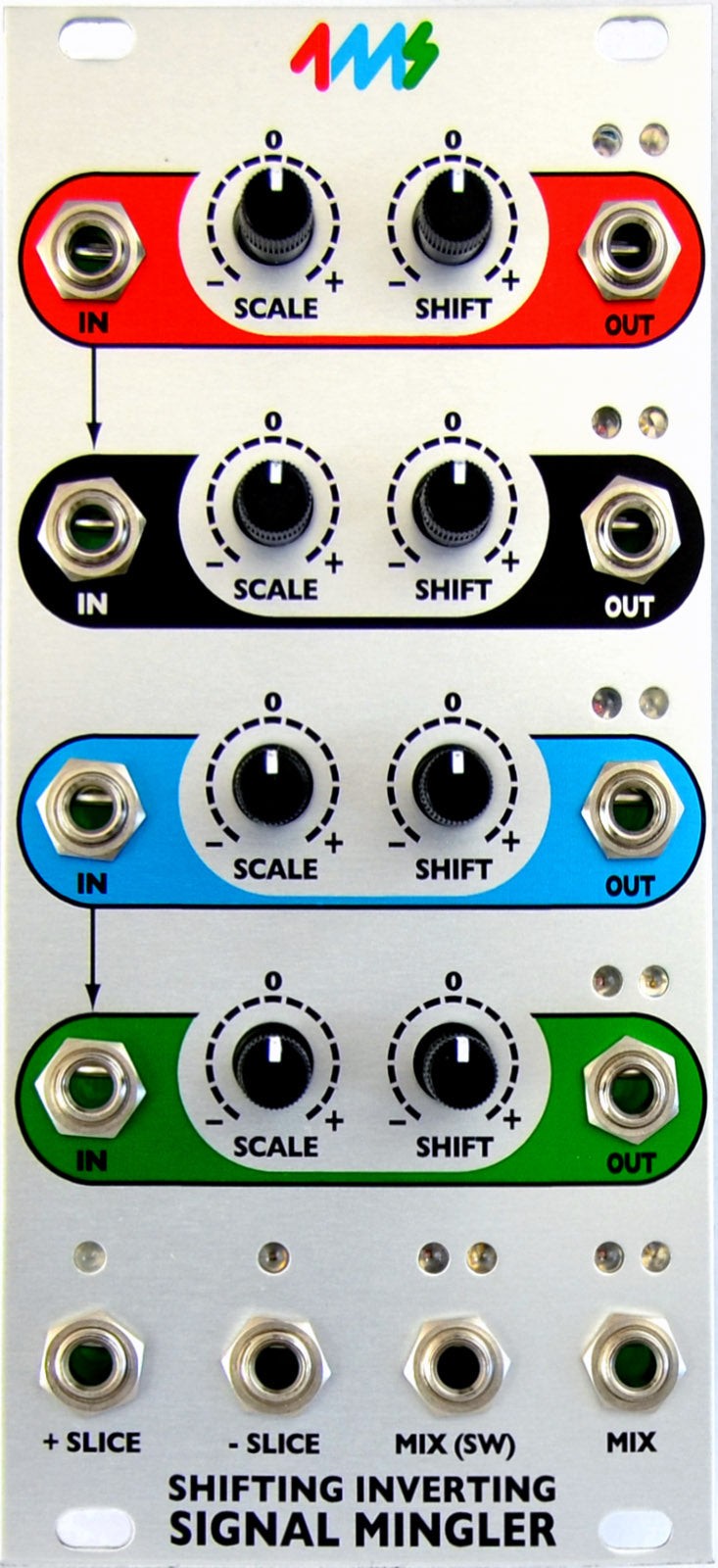
Each of the four channels gives you independent control over two things: Scale and Shift. The Scale knob is an attenuverter—turn it clockwise, and you reduce the signal; turn past noon, and it inverts, flipping positive voltages negative and vice versa. The Shift knob adds DC offset, nudging the entire signal up or down in voltage, which is essential for tuning 1V/oct tracking, biasing wavefolders, or aligning LFOs to modulate only in the positive range. These aren’t small adjustments—they’re transformative. A sine wave creeping into the negative range can be yanked into the positive domain, turning a bipolar LFO into a unipolar one with a twist of a knob. Or take a chaotic random voltage, invert two of its channels, and mix them into the slice outputs to generate entirely new control streams that only fire when the source signal crosses zero.
And then there are the four outputs at the bottom: Mix, Switched Mix, Positive Slice, and Negative Slice. The Mix output sums all four shifted channels. Switched Mix is clever—it only includes channels where nothing is plugged into the individual output jack, so if you’re using a channel to feed another module directly, it drops out of the mix. That’s a subtle but powerful routing trick. The Positive and Negative Slice outputs are where things get weird. Positive Slice sums only the portions of the outputs that are above 0V; Negative Slice does the same for voltages below 0V. This is half-wave rectification on a modular scale, and it’s not just for CV. Run audio through it, and you get gritty, asymmetrical clipping that can turn a clean waveform into something gnarled and pulsing. It’s not a distortion module per se, but it distorts—especially when you’re pushing signals hard and letting the slice outputs carve them up.
It’s also a visual instrument. Fourteen red and blue LEDs pepper the front panel, each tied to a channel or output. Blue means positive voltage, red means negative. Watching them flicker in response to your patches is like having a live voltage oscilloscope—suddenly you can *see* when a signal crosses zero, when it inverts, when it’s being offset. It’s feedback that’s both functional and hypnotic.
Specifications
| Manufacturer | 4ms Company |
| Production Years | 2014– |
| Original Price | $175 |
| Format | Eurorack |
| Width | 12HP |
| Depth | 22mm |
| Power Consumption | 51mA @ +12V, 51mA @ -12V, 0mA @ +5V |
| Channels | 4 |
| Inputs | 4 x 3.5mm jacks (one per channel) |
| Outputs | 4 x 3.5mm jacks (one per channel), plus 4 x 3.5mm mix/slice outputs |
| Mix Outputs | Mix, Switched Mix, Positive Slice, Negative Slice |
| Scale Knob Modes | Bipolar (invert/attenuate), Unipolar (attenuate only), 2x Unipolar (gain up to 2x) |
| Shift Range | ±5V |
| Scale Range | 0 to ±1x (bipolar), 0 to 1x (unipolar), 0 to 2x (2x unipolar) |
| DC Coupling | Yes, 0Hz to 20kHz |
| Normalization | Channels 1+2 and 3+4 normalized on input jacks (jumper-removable) |
| Internal Jumpers | Scale mode per channel, normalization disable |
| Breakout Header | Signal padding for fine voltage tuning (e.g., 1V/oct calibration) |
| LED Indicators | 14 red/blue LEDs for voltage polarity monitoring |
Key Features
Per-Channel Scale and Shift: The Core of Control
Most attenuverters give you gain and inversion. The SISM adds a second dimension: offset. That Shift knob isn’t just a trim—it’s a full ±5V DC offset generator per channel. This is huge when you’re trying to align modulation sources. Say you’ve got a random voltage generator that swings from -2V to +2V, but you want to use it to modulate a filter cutoff that only responds to 0V–5V. Patch it into a SISM channel, turn up the Shift knob, and nudge the entire signal into the positive realm. No need for a separate offset module. And because each channel is independent, you can process four different signals—each scaled, inverted, and offset differently—before sending them to different destinations. It’s like having four tiny, programmable signal conditioners in one module.
The Scale knob’s jumper options add even more flexibility. By default, it’s bipolar: center is off, left is inverted, right is positive. But if you remove the jumper, you can set it to unipolar mode—no inversion, just attenuation from 0 to 1x. That’s perfect for audio mixing, where you don’t want phase cancellation from accidental inversion. Or go further: connect the jumper to ground and you get 2x unipolar mode, where the knob goes from 0 to 2x gain. Now you’re not just attenuating—you’re boosting. That’s rare in utility modules and opens up uses like gain staging for low-output modules or driving inputs harder for saturation.
Slice Outputs: Where Math Meets Music
The Positive and Negative Slice outputs aren’t just mixers—they’re logic engines. They sum only the parts of the signal that are above or below 0V, effectively performing real-time half-wave rectification across four channels. This isn’t just for CV. Patch an audio signal through multiple channels, offset some, invert others, and send the result to +Slice and -Slice. You’ll get two outputs that are dynamically gating each other based on voltage polarity. Use that to modulate VCAs, panning, or filter cutoffs, and you’ve got a self-contained, voltage-driven rhythm generator. One popular trick: feed a slow triangle wave into one channel, then route audio through the others. As the triangle wave crosses zero, it "splits" the audio between the two slice outputs, creating a panning or crossfading effect that’s smooth but slightly asymmetrical—what some users call "dirty panning." It’s not clean, it’s not digital, it’s *analog* and alive.
Normalization and Jumpers: Build It Your Way
The SISM assumes you might want to split a single signal across multiple channels—so Channels 1+2 and 3+4 are normalized on the input jacks. Plug into Channel 1, and the signal also appears at Channel 2. Same for 3 and 4. This is perfect for taking one LFO and sending it to two different destinations, each with its own scale and shift. But if you don’t want that, flip a jumper on the back and they’re independent. Same with the Scale knob: if you’re using the module purely for audio mixing and don’t want the risk of accidental inversion, disable the bipolar mode per channel. These jumpers mean the SISM can morph from a CV mangler to a precision audio mixer, depending on your needs. And the breakout header? It lets you add resistors to fine-tune the signal path—say, to calibrate a 1V/oct CV for perfect tuning. It’s a pro-level feature that most utility modules ignore.
Historical Context
When the SISM launched in 2014, the Eurorack scene was exploding, but utility modules were still catching up. Most racks had a few mixers, maybe an attenuverter, and a slew of random, single-function modules. The SISM arrived as a consolidation tool—a way to reduce clutter while adding new functionality. It wasn’t the first module to mix and offset, but it was one of the first to do it with four independent channels, visual feedback, and the slice outputs. It competed with modules like the Synovatron CV Tools and Fonitronik Attenuverting Mixer, but the SISM’s per-channel shift control and jumper-based flexibility gave it an edge. It also reflected 4ms’s design philosophy: dense, functional, and slightly eccentric. The company had already made waves with the Dual Looping Granular Sampler and the Spectral Multiband Resonator, but the SISM was different—no sound generation, no complex algorithms, just pure signal manipulation. It was a statement: sometimes the most powerful modules are the ones that don’t make sound at all.
At the time, modular users were still figuring out how to manage complex CV routing. The SISM offered a way to clean up patches, reduce cable clutter, and add precision. It wasn’t flashy, but it was necessary. And its timing was perfect—just as more musicians were building larger systems, they needed tools to manage the chaos. The SISM didn’t just respond to that need; it anticipated it.
Collectibility & Value
The SISM has never been rare—4ms has kept it in steady production since 2014—but it’s highly sought after because it solves real problems. Used units typically sell for $120–$150, depending on condition, while new ones still go for $175. It’s not a speculative collector’s item, but a working musician’s tool, so most units on the market are well-used. That’s not necessarily a problem—the circuit is simple and robust, with no moving parts beyond the knobs and jacks. Failures are uncommon, but when they happen, they’re usually related to power or physical damage. The most common issue is misaligned jumpers, especially if a previous owner was experimenting with modes. Always check that the normalization and scale mode jumpers are set as desired before trusting the module in a critical patch.
Another thing to watch: the breakout header. It’s a small pin header on the back, meant for adding resistors to fine-tune voltages. If someone has soldered resistors there, make sure they’re documented or removable. Otherwise, you’re stuck with whatever calibration they chose. Also, inspect the LEDs—while they’re not critical to function, a dead or flickering LED can indicate a deeper issue, especially if multiple are out.
For long-term ownership, the SISM is low-maintenance. No capacitors to degrade, no complex ICs to fail. It’s solid-state and straightforward. The only wear points are the potentiometers, which can develop crackle over time, but they’re standard Alps-style pots and easy to replace. If you’re buying used, power it up and turn all the knobs slowly—listen for noise, watch the LEDs for smooth response. If it passes, you’ve got a module that will likely outlive your current case.
It’s not a flashy centerpiece, but it’s one of those modules that, once you have it, you wonder how you lived without it. It’s not going to appreciate in value, but it will appreciate in utility—every patch you do will find a new use for it.
eBay Listings
![4MS BLACK FACEPLATES : NEW : [DETROIT MODULAR]](https://i.ebayimg.com/images/g/JrgAAeSwL05od8DU/s-l1600.jpg)

As an eBay Partner, we earn from qualifying purchases. This helps support our independent vintage technology research.