4ms SCM Plus (2023–)
One module that combines the Shuffling Clock Multiplier and its breakout, so there is no more daisy-chaining.
Overview
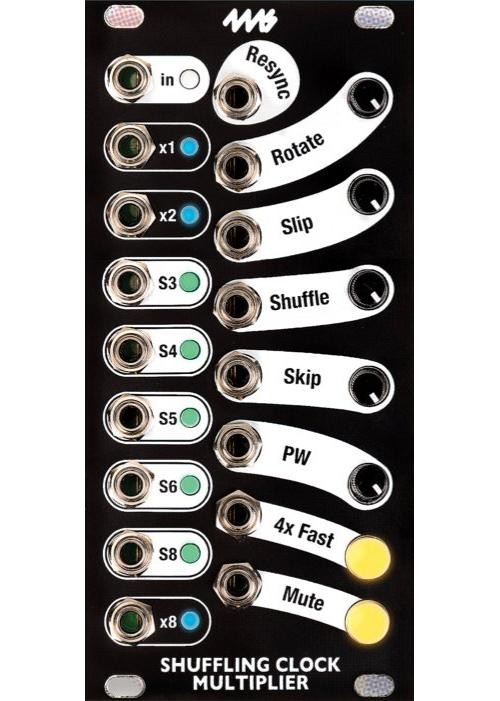
The original 4ms Shuffling Clock Multiplier and the SCM Breakout had to be wired together. That meant patch cables between two modules, drifting CVs, timing glitches when the tempo shifts, and the worry that one power bump would undo your groove. The SCM Plus fixes that. It fuses the timing manipulation of the SCM with the full CV control of the SCMBO in one 12HP panel. It is more stable and more precise than the pair was. You still get eight gate outputs multiplying your clock from x1 to x32. Now there are dedicated knobs and CV inputs for Rotate, Slip, Shuffle, Skip, and Pulse Width, and none of it needs a second module.
It still does the odd thing where a slight Slip CV nudges every third beat forward, or where a rotating Multiply-by assignment sends your hi-hats into a polyrhythmic tangle. It just does it more reliably. Early adopters report fewer hiccups during tempo changes, which the original SCM was notorious for, especially with irregular gate streams. The internal hardware is tighter, the jitter is lower, and the latency is predictable. It is not a sterile metronome. It still has the loose feel, but it won't collapse when you push it into odd time signatures or modulate parameters on the fly.
Specifications
| Manufacturer | 4ms Company |
| Production Years | 2023– |
| Original Price | $185 USD |
| Format | Eurorack |
| Width | 12HP |
| Depth | 24mm (0.95") |
| Power Connector | 16-pin Eurorack power header |
| Power Consumption (+12V) | 52mA max |
| Power Consumption (-12V) | 15mA max |
| Power Consumption (+5V) | 0mA |
| Clock Input Threshold | 2.5V |
| Maximum Clock Input Frequency | 40kHz |
| Clock Output Type | 12V gate |
| Rise/Fall Time | Approximately 1µs |
| Maximum Clock Output Frequency | 40kHz |
| Jitter (x1 output) | Max 30µs at <120 BPM, max 5µs at ≥120 BPM |
| Latency (clock in to x1 out) | 8µs worst-case, 3.5µs typical |
| CV Inputs – Rotate, Slip | Knob attenuates jack; full range 0V to +3.3V |
| CV Inputs – Shuffle, Skip, Pulse Width | Knob offsets jack; full range -5V to +5V |
| Gate Inputs – 4x Fast, Mute | 2.5V threshold; button toggles state |
| Additional Features | Resync input, 4x Fast gate jack, Mute gate jack, Save Clock on power-up, Clock Bus jumper, Free Run jumper, LED dimmer trimpot |
Key Features
The Full SCM Experience, No Patch Cables Required
For years, getting the full Shuffling Clock Multiplier meant buying two modules and linking them with a ribbon cable. The SCM gave you multiplied clocks and basic shuffle. The SCMBO added CV control over Slip, Shuffle pattern, Skip, Pulse Width, and more. The connection was fragile, and the setup ate 8HP total. The SCM Plus puts everything on one panel: five knobs with CV inputs for Rotate, Slip, Shuffle, Skip, and Pulse Width. No tiny ribbon cable, and no signal degradation between modules. The integration is functional too. Parameters respond more cohesively because they run on the same processor, with tighter timing and no external handshakes. You can tweak Shuffle depth while modulating Skip with an LFO and rotating the multiplication factors in real time, and the module keeps up.
Precision Meets Personality
This is not a sterile digital clock divider. The SCM Plus keeps the nervous, slightly off-kilter energy of the original SCM, but with tighter specs. Jitter on the x1 output drops to 5µs at tempos of 120 BPM and above, which is stable enough for tight sequencer syncing. Below that threshold it stays loose enough to feel musical. Latency is minimal and consistent, so chaining multiple timing modules or feeding external gear doesn't mean fighting unpredictable delays. The 40kHz maximum input and output frequencies mean it can handle audio-rate clocks. That opens up rhythmic FM, pulse-width modulation at high speeds, or use as a chaotic clock source for digital oscillators.
Deep Control Without the Complexity
The front panel stays simple. The five main knobs are clearly labeled, each with a CV input below. The 4x Fast button and Mute button have gate inputs for external control, which suits live performance. The Resync input resets all counters with a single trigger, handy when switching patterns or recovering from a timing glitch. The Save Clock feature remembers your last tempo on power-up, so you don't lose it when repatching. A trimpot dims the LEDs. There is also a Clock Bus jumper that lets the module receive tempo data from other 4ms modules over the power bus, and a Free Run jumper that lets it generate clocks without an external input, useful for standalone setups or generative patches.
Historical Context
The original Shuffling Clock Multiplier emerged in the early 2010s and became a favorite among modular users who wanted more than clean divisions. Most clock modules focused on accuracy. The SCM leaned into imperfection, and its Slip and Shuffle functions made grooves that felt human, almost jazzy. But it was limited. You couldn't modulate Shuffle depth or Skip patterns without external gear. The SCM Breakout added CV control and expanded functionality, at the cost of extra space and complexity. The two-module setup became a staple in advanced racks, but it was never elegant. The SCM Plus, released in 2023, consolidates the two, born from user feedback and improved hardware. It offers more features in less space without giving up hands-on control. It competes with other clock multipliers and with rhythmic systems like Pamela's New Adventures or the Pressure Points suite. It focuses on timing manipulation rather than pattern generation.
Collectibility & Value
The SCM Plus is a 2023 release, so it isn't "vintage" in the traditional sense. Priced at $185 new, it costs more than the original SCM ($140) alone, but less than buying the SCM and SCMBO ($120) together would suggest in space and hassle. On the used market, it typically sells for $140-$160 in good condition, reflecting strong demand and low failure rates. There are no known widespread hardware issues: no failing ICs, no flaky connectors, no power-related meltdowns. The most common user complaint is the lack of larger knobs or a more compact layout, which are ergonomic preferences and not reliability concerns. The module uses surface-mount components and a sturdy PCB design, making it less prone to damage from shipping or rack vibration. For buyers, the main thing to check is the LED brightness via the front-panel trimpot. Some units ship with the LEDs dialed up too high, which can be distracting in low-light setups. Otherwise it is plug-and-play with no maintenance required. Given its role as a central timing hub in many racks, it is likely to hold value well, especially as the original SCM and SCMBO become harder to find as a matched pair.
eBay Listings
As an eBay Partner, we earn from qualifying purchases. This helps support our independent vintage technology research.