4ms SCM (2010–2022)
It doesn’t just multiply your clock—it scrambles, slips, and stutters it into something alive.
Overview
You patch in a steady clock, expecting clean multiples, and what comes out feels like it’s breathing—slightly off, just human enough to make your sequence twitch with nervous energy. That’s the 4ms Shuffling Clock Multiplier (SCM), a module that doesn’t just divide or multiply time but warps it with a subtle, almost organic instability. Born in the early 2010s, when Eurorack was shifting from pure tone generation to rhythmic complexity, the SCM arrived as a quiet revolutionary. It wasn’t a sequencer, not a drum module, not even a full clock source—but it became essential for anyone who wanted their rhythms to feel less like machines and more like creatures. Its core function is deceptively simple: take a clock input and output eight multiplied versions, from x1 to x8, with the potential to go up to x32 when paired with its expansion. But the magic lives in the “shuffling” part—those outputs don’t just fire evenly. Some are slipped, some are skipped, some stagger like a drunk drummer hitting the rimshot a hair too late. It’s not quantized randomness; it’s rhythmic personality.
The SCM wasn’t designed for sterile precision. Instead, it leans into controlled chaos, offering subtle timing variations that feel intentional rather than broken. Outputs S3 through S8 deliver these shuffled rhythms, each with a slightly different character—some push the beat forward, others drag it back, creating a sense of swing that’s more nuanced than a simple percentage adjustment. The module’s behavior changes depending on input tempo and pulse width, meaning it responds dynamically to what you feed it. Patch in a slow, fat clock and the shuffle feels lazy, languid. Speed it up, and the staggered pulses start to blur into a jittery, almost glitchy texture. It’s this responsiveness that made it a favorite among experimental composers and live performers who treated timing as a malleable parameter, not a fixed grid.
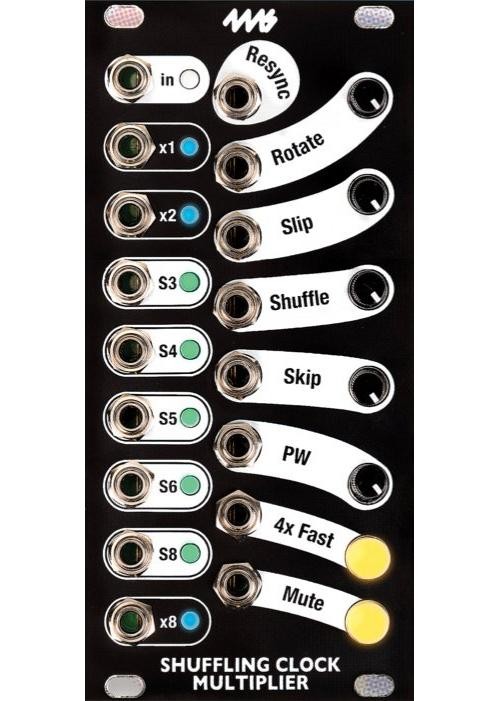
Originally released as a standalone module, the SCM was intentionally minimal—just a few knobs and jacks, no CV control over its core parameters. That simplicity was both its charm and its limitation. The shuffle amount, slip, and skip behaviors were set internally via trimpots, meaning you had to open the module and tweak with a screwdriver if you wanted to change the character of the swing. That hands-on approach fit the DIY ethos of early Eurorack, but as modular setups grew more complex and performance-oriented, users wanted real-time control. That demand led to the development of the SCM Breakout (SCMBO), an 8HP expansion that bolted onto the main module and added front-panel knobs and CV inputs for every major parameter: Shuffle, Slip, Skip, Pulse Width, Rotate, Mute, and even a 4x Fast multiplier boost. Suddenly, the SCM wasn’t just a set-and-forget clock multiplier—it became a dynamic, performable rhythm processor. The combination of SCM and SCMBO became a cult favorite, a two-module powerhouse for generative sequencing and live rhythmic manipulation.
Specifications
| Manufacturer | 4ms Company |
| Production Years | 2010–2022 |
| Original Price | $140 (SCM), $159 (SCMBO) |
| Format | Eurorack |
| Width | 8HP (SCM), 8HP (SCMBO) |
| Depth | 26mm (SCM), 24mm (SCMBO) |
| Power Consumption | +12V: 14mA, -12V: not used, +5V: not used |
| Inputs | Clock In, Resync In, CV Rotate, CV Slip |
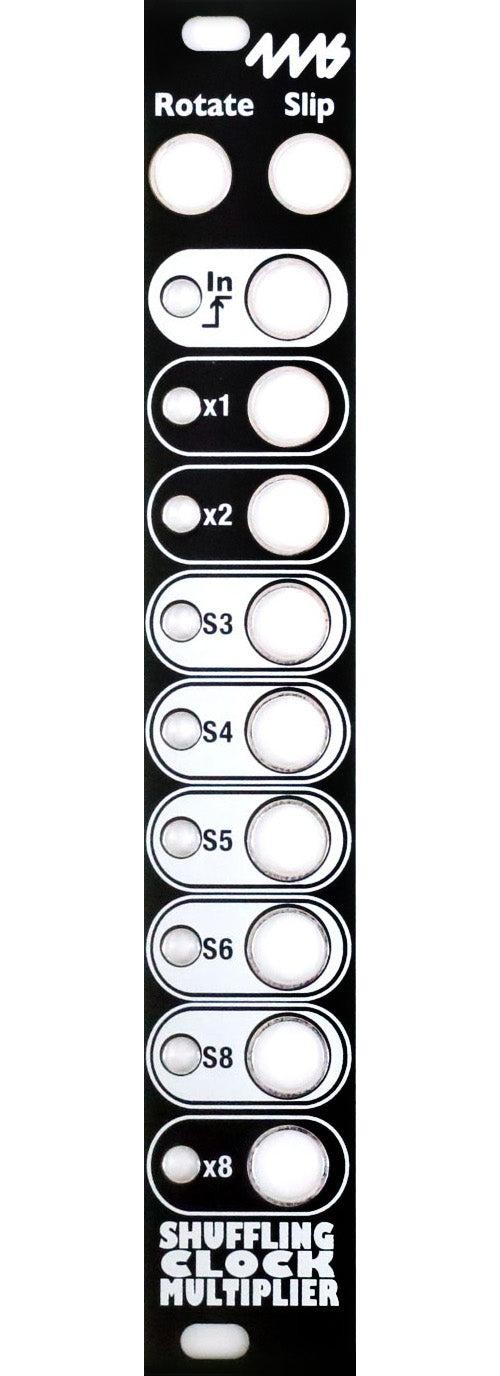
| Outputs | 8 multiplied clock outputs (S1–S8), including shuffled variants |
| CV Control | None on main SCM; full CV via SCMBO expansion |
| Manual Controls | Shuffle, Rotate, Slip (trimpots on SCM; front-panel knobs on SCMBO) |
| Expandability | Connects to SCMBO via 16-pin Doepfer-style ribbon cable |
| Additional Features | Pulse Width control, Skip pattern, Mute, 4x Fast multiplier boost (via SCMBO) |
| Weight | Approx. 100g (each module) |
| Construction | PCB with surface-mount components, aluminum front panel |
Key Features
Shuffled Clock Outputs with Character
The SCM doesn’t just spit out clean divisions—it rethinks what a clock multiplier should do. While S1 and S2 deliver straight x1 and x2 multiples, S3 through S8 are where the personality emerges. These outputs don’t just repeat the input; they stagger the timing in deliberate, slightly unpredictable ways. Some feel like they’re dragging behind the beat, others leap ahead, creating a natural swing that’s more expressive than a metronome with a swing knob. This isn’t randomization—it’s algorithmic variation, baked into the firmware. The result is a sense of motion, like a rhythm section that’s just loose enough to feel alive. It’s particularly effective when clocking multiple sequencers or envelope generators, where the slight timing offsets create a cascading, interlocking groove. Because the shuffle behavior is tied to the input pulse width and tempo, you can modulate the feel just by adjusting your clock source, making it a dynamic element in your patch rather than a static setting.
Expandable via SCM Breakout (SCMBO)
The real evolution of the SCM happens when you add the SCMBO. On its own, the SCM is a fixed-character module—its shuffle, slip, and skip behaviors are set at the factory or adjusted via tiny trimpots on the PCB. The SCMBO transforms it into a fully performable unit, adding front-panel knobs and CV inputs for every major parameter. Now you can sweep the shuffle amount in real time, modulate the skip pattern with an LFO, or trigger a resync from a footswitch. The breakout also adds Pulse Width control, letting you shape the duration of the output gates, and a 4x Fast button that temporarily quadruples the multiplier speed—perfect for sudden accelerations or fill-like bursts. The Mute function doesn’t just silence the outputs; it allows active pulses to finish before cutting off, preserving timing integrity. Connecting the two modules is straightforward: a 16-pin ribbon cable links them directly, drawing no additional power from the bus. The SCM + SCMBO combo became a staple in advanced rhythmic setups, offering a level of control that rivaled standalone sequencers.
Rotate and Slip for Pattern Morphing
Beyond basic multiplication, the SCM introduces two subtle but powerful timing controls: Rotate and Slip. Rotate shifts the phase relationship between the multiplied outputs, effectively rotating which beat starts the sequence. This isn’t just a phase delay—it reorders the rhythmic pattern, creating evolving sequences even when clocked by a static source. Slip, meanwhile, adjusts the timing offset of the shuffled beats, pushing them earlier or later in the cycle. On the base SCM, these are set via trimpots; with the SCMBO, they become dynamic parameters. When modulated, Rotate can make a pattern feel like it’s spiraling forward or backward in time, while Slip introduces a sliding, almost drunken quality to the shuffle. These aren’t effects you’d necessarily notice on a single pass, but over time, they create a sense of organic drift—like a band that’s playing together but not perfectly locked in. It’s this imperfection that gives the SCM its charm, making it a tool for generative music as much as for performance.
Historical Context
The 4ms SCM emerged during a pivotal shift in Eurorack culture. Around 2010, modular synthesis was moving beyond the realm of abstract tones and drone patches into more rhythmic, compositionally structured territory. Artists were no longer just building soundscapes—they were building songs, beats, and sequences. The demand for intelligent clock manipulation grew, and while clock dividers were common, true multipliers with character were rare. The SCM filled that gap with a distinctly analog-digital hybrid approach: it used digital logic to generate precise multiples but introduced timing variations that felt almost analog in their unpredictability. It wasn’t trying to be a perfect timekeeper; it was trying to be a collaborator.
At the time, competitors like Doepfer and Intellijel offered clock utilities, but few embraced rhythmic imperfection as a feature. The SCM stood out by treating timing as a creative parameter, not just a utility. Its design philosophy aligned with the rise of generative music in modular, where systems evolved over time without direct intervention. The addition of the SCMBO in later years reflected the growing expectation for CV control and real-time manipulation in Eurorack. As performers began taking their racks on stage, the ability to tweak shuffle and skip on the fly became essential. The SCM + SCMBO combo became a quiet powerhouse in experimental and live electronic setups, used by artists who valued texture and motion over rigid precision.
Collectibility & Value
As of 2026, the original 4ms SCM and SCMBO are out of production, having been succeeded by the SCM Plus—a single-module integration of both units with improved timing precision. This has shifted the market for the original hardware. Standalone SCM modules in good condition typically sell for $120–$160, while the SCMBO fetches $140–$180, especially if it’s the fully assembled version rather than the DIY kit. Complete sets (SCM + SCMBO) are increasingly rare and can command $280–$350, particularly if they’re NOS (new old stock) or come with the original ribbon cable. The value is driven more by utility than nostalgia—these modules still perform a unique function, and many users prefer the original’s slightly looser timing over the tighter, more digital feel of the Plus version.
Common failures are minimal but worth noting. The ribbon cable connection between SCM and SCMBO can become loose over time, leading to intermittent control or complete dropout of the breakout’s functions. Owners report that gently securing the cable or replacing it with a higher-quality Doepfer-style ribbon can resolve this. The trimpots on the base SCM are surface-mount and delicate; over-tightening during adjustment can damage the PCB. No major firmware issues have been documented, but the module does have an ISP header for reprogramming, suggesting that early units may have received field updates. When buying, check that all outputs fire correctly and that the shuffle patterns are consistent across tempo ranges. Units that have been heavily modded or have missing knobs may be harder to resell, as the 4ms aesthetic—clean panel layout, precise labeling—is part of its appeal.
For those seeking the SCM’s functionality without the hunt, the SCM Plus is a viable alternative at $185, offering the same features in a 12HP module with better timing stability. However, some purists argue that the original’s slight timing wobble—the very thing the Plus was designed to fix—is part of its character. If you’re after that raw, slightly unpredictable groove, the vintage SCM + SCMBO combo remains the gold standard.
eBay Listings


As an eBay Partner, we earn from qualifying purchases. This helps support our independent vintage technology research.