4ms Row Power 40 [RP40] (Discontinued)
It's not flashy, but when a rack stays alive and quiet, the power module is doing its job.
Overview
The 4ms Row Power 40 [RP40] is not something you show off at a synth meetup. It sits in the back of a Eurorack case and feeds clean power to the modules. Made by 4ms Company, this 4 HP power distribution module was designed to deliver regulated, protected power to one or even two full rows of Eurorack gear. You can daisy-chain multiple Row Powers together, all fed from a single DC brick, which makes scaling a setup simple. Each Row Power is independently regulated, so you avoid the cross-talk and voltage sag that can plague cheaper or poorly designed power solutions.
Owners report that the Row Power 40 is "a beast," more than capable of running two 104HP rows. One user noted powering a 3-row system at Meme Antenna with just a single Row Power 40 and found it "totally fine." That kind of headroom is rare in a compact 40W unit. It's built with high-grade components, and each voltage rail - +12V, -12V, and +5V - is separated and protected. The RP40 was one of the go-to solutions for expanding a modular setup before it was discontinued.
It's not perfect. The weak spot isn't the module itself but the external 4MS Power Brick. Multiple users have reported reliability issues - power cutting out when the connector is jostled, or noise bleeding into sensitive audio paths. One person said their brick "introduced a ton of noise that caused many problems." Another admitted they've had no issues with their Row Power 40s, but only after ditching the stock brick entirely. The module gets the praise, and the power supply it relies on mostly doesn't.
The design choices still fit how modular users work. The on/off switch cuts power to the module without disrupting the daisy-chain, so you can hot-swap rows or troubleshoot without rebooting the entire system. The input jacks use a split-pin design meant to grip the barrel plug tightly, but over time that connection can loosen. A common fix, widely shared in forums, is to gently pry open the split pin with a flathead screwdriver so it grips the plug more securely. Some users go further and replace the entire power brick with a Meanwell or Maplin unit, which are known for better build quality and noise performance. There's also a suggestion to use a locking DC extension cable to prevent accidental disconnections.
The Row Power 40 is discontinued. It was part of a broader family that included the RP25, RP30, RP35, and the newer RP45. The RP45 is now the recommended replacement, offering higher output for larger systems. Many builders still seek out the RP40 for its proven performance and compact footprint. There are documented compatibility quirks, like issues reported between the RP40 and the Pittsburgh Synthesizer Box, but these seem to be edge cases rather than widespread failures.
Specifications
| Manufacturer | 4ms Company |
| Module Size | 4 HP Eurorack format module |
| Power Output (Row Power 40) | +12V @ 1.5A, -12V @ 1.3A, +5V @ 1.5A |
| Total Power | 40W (Row Power 40) |
| Power Input | Powered by laptop-style DC power supply: 2.1mm barrel, positive center, 15V-20V. |
| Depth (Row Power 40) | 27mm (1.1") with power connectors installed. |
| Included accessories | 16-to-16 pin power cable, 2 M3 Knurlie screws (Row Power 40, Row Power 30) |
| Weight (Row Power 40) | 0.15 kg |
| Dimensions (Row Power 40) | 16 × 11 × 5 cm |
Key Features
Clean, Regulated Power Rails
Each voltage rail on the Row Power 40 is separately regulated using high-grade components, which helps maintain stable output under fluctuating loads. This separation minimizes cross-talk between rows, which matters when running sensitive analog circuits or digital modules that can introduce noise. One seller called it a "super clean low noise highly capable power supply."
Daisy-Chaining for Scalable Systems
You can daisy-chain multiple Row Power units using a single DC power brick, typically supporting 3 to 5 Row Powers per brick. That makes it easy to expand a system without cluttering the power supply setup. The input and output jacks are both 2.1mm barrel connectors, and the input side uses a split-pin design to ensure a tight connection. This can degrade over time, but it's a small trade-off for the flexibility.
Hot-Swappable Rows and Independent Protection
You can plug or unplug a Row Power 40 without powering down the entire rack. That helps during live sets or soundchecks when you need to swap modules or troubleshoot. Each unit is independently protected, so a short or overload in one row won't take down the rest of the system. The on/off switch only affects the local module and leaves the daisy-chain intact.
Flexible Installation Options
Besides the standard Eurorack panel, the Row Power 40 includes blade tabs and solderable headers for custom installations. If you're building a non-standard case or integrating into a Pod enclosure, these let you route power without relying on the front panel. Modules connect via flying bus cables or the Bus Stick, giving you multiple ways to distribute power depending on case layout and cable management preferences.
Visual Feedback and Physical Design
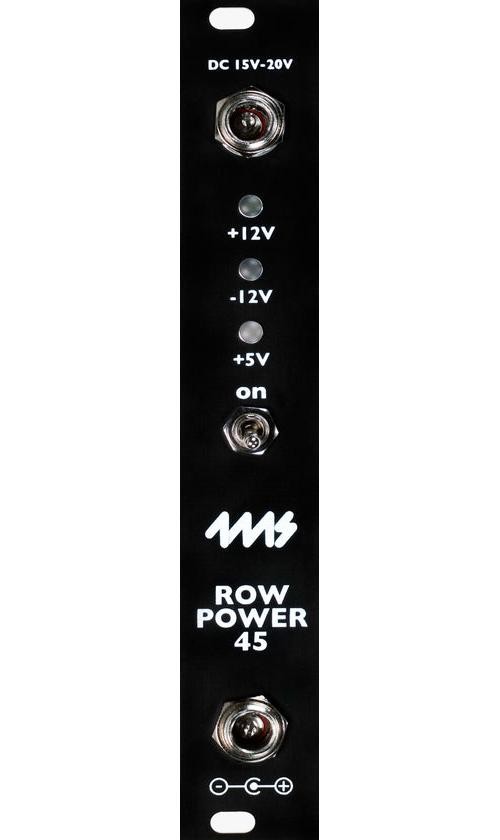
A simple LED indicates when the module is powered. The unit comes in a matte black panel that fits most Eurorack cases. At 27mm deep, it's not the shallowest module, but it fits in most 84HP and larger cases without blocking adjacent modules. The included 16-to-16 pin cable and M3 knurlie screws make installation straightforward, though some users opt for third-party cables for better strain relief.
Collectibility & Value
The Row Power 40 originally sold for $155.00. Since it's discontinued, most sales happen on the secondary market. A used unit in "Excellent" condition was listed for $110 about four years ago, and another Reverb listing from five years ago showed a "New Price" of $135.90, though current pricing data is sparse. The RP35, which is still available, lists at $145.00, suggesting the RP40 might hold similar value if found in working condition.
The biggest concern for buyers is the external 4MS Power Brick, not the module. Common problems include intermittent power loss when the connector is touched and noise injection into the audio path. These issues aren't inherent to the Row Power 40, but they're frequent enough that many owners recommend replacing the stock brick. Solutions include using a Meanwell or Maplin DC supply, or adding a locking DC extension cable to prevent disconnections. There's also a documented incompatibility with the Pittsburgh Synthesizer Box, so users with that gear should proceed with caution.
Maintenance is generally minimal. If the split pin in the input jack has loosened, a quick tweak with a flathead screwdriver can restore a secure connection. No major internal failures have been widely reported. If a unit does fail, 4ms Company has been known to replace them, and there's at least one user report of a damaged unit being replaced and working perfectly afterward.
eBay Listings



As an eBay Partner, we earn from qualifying purchases. This helps support our independent vintage technology research.