4ms Rotating Clock Divider (2008–2020)
Eight clock divisions that shift and swirl under voltage control - like a sequencer for your timing grid.
Overview
You patch in a clock and the whole system starts to feel different. Pitch and timbre aren't doing it. Time is. The 4ms Rotating Clock Divider doesn't just spit out slower pulses from your master clock. It lets you change which division comes out of which jack on the fly, so the /2 output might become /5 and the /4 becomes /1. It's a compositional tool as much as a utility, and it can turn a static sequence into something that evolves and drifts a little unstable.
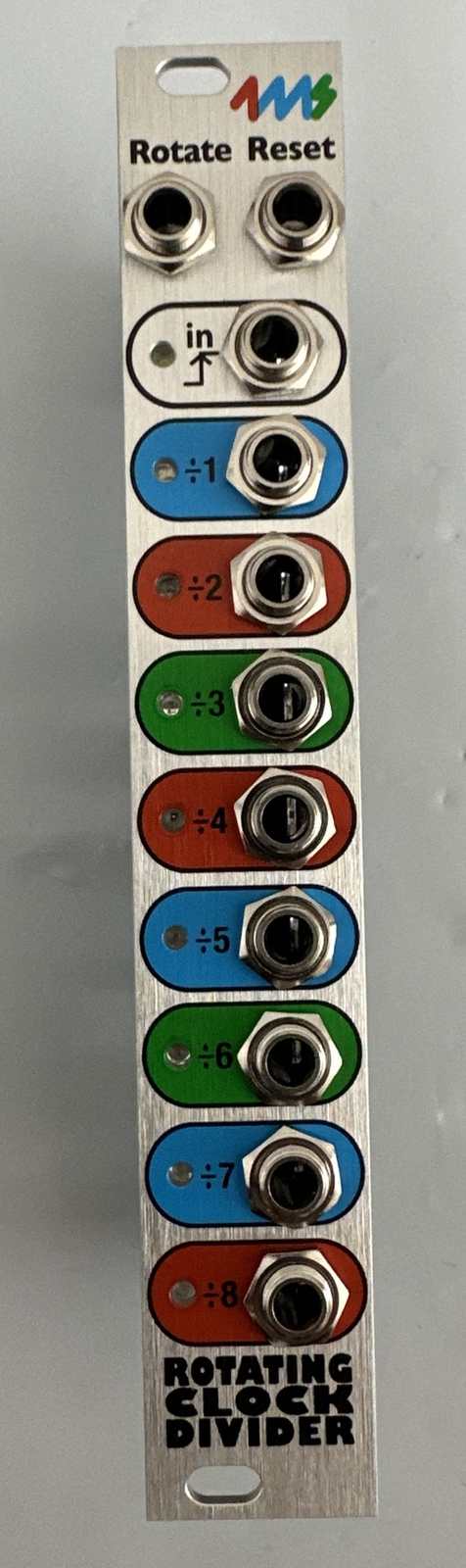
The RCD arrived in the early days of Eurorack's expansion beyond oscillators and filters, when modular users wanted timing tools that did more than divide by two or four. Most clock dividers had fixed outputs. Patch once, forget forever. The RCD introduced dynamic reassignment. Each of its eight outputs normally delivers a division from /1 to /8, but apply a voltage to the Rotate CV input and those division values rotate across the outputs. At 0V, you get /1 through /8 in order. At +1V, maybe it's /2 through /8 and then /1. At +3V, it could be /4 through /8, then /1 through /3. The rotation amount is additive: the formula is Divide-by-(N + R), where R is the rotation value scaled in volts. You can sweep through permutations by hand with a knob or automate it with an LFO, sequencer, or random source, so drum patterns, envelope triggers, or sequencer clocks shift phase in real time.
Rotation isn't all it does. The RCD also gives you control over reset behavior, gate vs. trigger output mode, up/down counting direction, and auto-reset intervals that keep irregular divisions (like /7 or /11) locked into a repeating phrase length. None of this is buried in menus. It's set with physical jumpers on the back of the module or, more conveniently, through the optional Breakout (RCDBO) panel, which adds front-panel switches and extra CV inputs. The base RCD is powerful, but the Breakout is what makes it a full timing brain.
The core is digital, with an AVR microcontroller handling the logic, but the RCD responds like an analog module. Clock inputs are rising-edge triggered and accept signals from 5V to 15V, so it works with nearly any Eurorack, Serge, or Buchla source. The maximum clock rate is 3kHz, which is more than enough for even the fastest audio-rate modulation. Outputs are clean, fast pulses, and the LED on each output shows its current division. LED brightness is only adjustable on factory-built units, not the DIY kit version.
Specifications
| Manufacturer | 4ms Company |
| Production Years | 2008–2020 |
| Original Price | $195 (assembled), $95 (kit) |
| Format | Eurorack |
| Width | 4 HP |
| Depth | 35 mm (1.85") |
| Power Consumption | 33 mA +12V, 4 mA -12V, 0 mA 5V |
| Inputs | Clock (5V–15V, rising edge), CV Rotate (0V–5V), CV Reset (5V–15V trigger) |
| Outputs | 8x Divided Clock (Divide-by-(1+R) to Divide-by-(8+R)) |
| Division Range | /1 to /64 (via jumper settings or Breakout panel) |
| Max Clock Input Frequency | 3 kHz |
| Rotation Control | CV-controlled, 1V per step (0V–5V range) |
| Reset Function | External reset input, optional auto-reset (16/24/32 step) |
| Count Direction | Selectable up or down via jumper or Breakout |
| Output Type | Selectable gate or trigger via jumper or Breakout |
| Expandability | Compatible with RCD Breakout (RCDBO) panel |
| Firmware Updates | User-updatable via AVR ISP (Version 1.1 adds Spread mode) |
| Kit Availability | Yes, beginner-level DIY kit available |
Key Features
The Rotate Function: Rhythmic Mutation in Real Time
The Rotate CV input doesn't change the division values themselves. It reassigns which output jack delivers which division. That's different from voltage-controlled division, where modules like the 4ms QCD let you sweep a single output's division ratio smoothly. The RCD keeps the ratios fixed and rotates their destinations. Say a sequencer is clocked by /3 and a drum trigger sits on /5. Rotating the assignments might suddenly put the sequencer on /7 and the drums on /2, which shifts the groove without touching the master clock. Modulate it slowly and a rising voltage from an LFO can make patterns evolve over minutes, with long structural changes that feel organic rather than abrupt.
It isn't always musical by default. Some users report that full rotation can feel "clunky" or overwhelming, especially when all eight outputs shift at once. Advanced users often patch selectively, using only one or two rotated outputs while keeping the others fixed. Others pair the RCD with logic modules to gate the rotation signal only at phrase boundaries. Treat rotation as a compositional parameter, like changing time signature or accent pattern, and not as an effect.
Breakout Panel: Unlocking the Hidden Depth
The base RCD is capable, but the RCDBO (Rotating Clock Divider Breakout) panel unlocks the rest. Without it, features like auto-reset, gate/trigger selection, and division range limiting are set with tiny jumper pins on the back. That's fine for a one-time setup and impractical for live tweaking. The Breakout adds front-panel switches for all these functions, plus additional CV inputs and manual buttons. It also enables "Spread" mode (via firmware update), which staggers the rotation across outputs for smoother transitions. If you're buying an RCD today, look for a unit with the Breakout, or at least verify the jumpers are accessible.
DIY Kit: Build It Yourself, Learn It Inside Out
4ms has always embraced the DIY ethos, and the RCD kit follows it. At $95, it's a fraction of the cost of the assembled version, and the build is rated beginner-friendly, though it still requires soldering skill and attention to detail. The kit includes everything: PCB, ICs, jacks, resistors, LEDs, and even the front panel. Building it yourself gives you intimate knowledge of the circuit, which helps when troubleshooting or modifying. The kit does lack some features of the factory unit: no clock bus output, no LED dimming, and no 5V power selection. For budget-conscious builders it's a rewarding project. For performers who need reliability and full functionality, the assembled version with Breakout is worth the premium.
Historical Context
The RCD emerged in 2008. Modular was shifting from a niche revival to a full ecosystem, and users no longer wanted only to recreate vintage synth functions. They wanted new tools that could generate complexity, variation, and emergent behavior. The RCD treated timing as a malleable dimension and not a rigid grid. It arrived alongside other generative modules like the Turing Machine and Pressure Points, but while those focused on pitch or gate generation, the RCD worked on time.
It was also part of 4ms Company's broader mission to build "instruments, not just modules." Many utility modules simply pass or modify signals. The RCD invites interaction. This put it in direct contrast to simpler dividers from Doepfer or Intellijel, which prioritized clarity and stability over mutation. The RCD wasn't for everyone, but for those interested in rhythmic exploration, it became a cult favorite.
Its closest sibling is the 4ms QCD (Quad Clock Distributor), which offers four independently voltage-controlled divisions. That's more precise for targeted control, but it lacks the RCD's sweeping, systemic transformation. The QCD suits surgical timing adjustments and the RCD suits holistic rhythmic shifts. Many users end up with both.
Collectibility & Value
As of 2026, the 4ms Rotating Clock Divider is no longer in production, having been phased out in favor of newer timing modules, but it remains highly sought after in the used market. A factory-assembled RCD in good condition typically sells for $250 - $350, while units bundled with the RCDBO Breakout can fetch $400 - $500, especially if they include the updated firmware with Spread mode. DIY kit builds are less valuable at $150 - $200, but can be a smart entry point if you're willing to verify functionality and jumper settings.
The most common failure points are mechanical: damaged jacks from over-tightening or PCB stress from improper mounting. The rotary encoder used for firmware updates (on some versions) can also fail, but this doesn't affect normal operation. Since the module relies on a microcontroller, firmware corruption is possible, though rare. Most units can be reflashed using the open-source code available on 4ms's GitHub. Power issues are uncommon, but always check for cold solder joints if a unit seems erratic.
When buying, prioritize units with accessible jumpers or, ideally, the Breakout panel. Verify that all eight outputs respond correctly to rotation and that the reset function works. LEDs should blink crisply. Dim or flickering lights may indicate a power or grounding issue. Avoid units advertised as "RCD-compatible" or "inspired by" - the real thing has a distinct layout and build quality that's hard to replicate.
For long-term ownership, the main consideration is expandability. The RCDBO panel is now rare, so if you find one, grab it. Firmware updates are still supported by the community, and DIY repairs are feasible thanks to the open documentation. It isn't a fragile vintage artifact. It's a repairable module that ages well, assuming it hasn't been dropped or overheated.
eBay Listings


As an eBay Partner, we earn from qualifying purchases. This helps support our independent vintage technology research.