4ms Pod48X (2022–)
It’s not a synth — but plug four modules into this little black slab and suddenly you’ve got a standalone instrument that fits in a backpack.
Overview
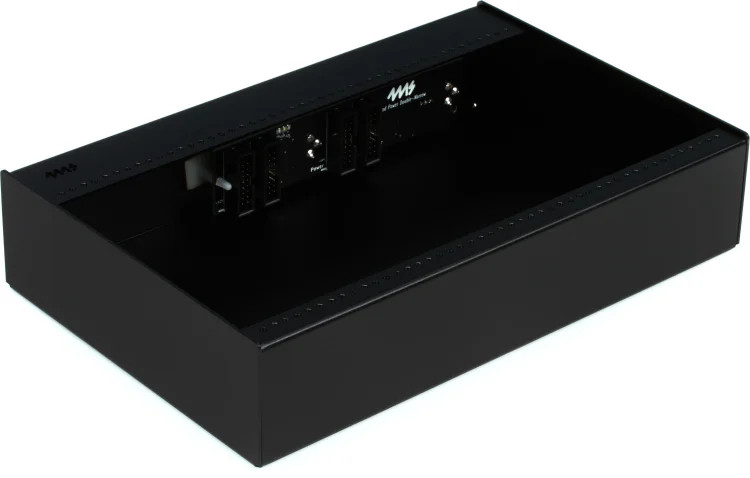
The 4ms Pod48X isn’t going to make noise on its own, but it might be the most practical Eurorack innovation in years. Think of it as a power lunchbox for your favorite modules: compact, all-metal, and ready to turn a handful of circuits into a portable synth or effects rig. Introduced in June 2022, it’s part of 4ms’s “Pods” series — a line of desktop enclosures designed to simplify the chaos of modular. At 48HP wide and 3U tall, it’s small enough to toss in a gig bag, yet serious enough to serve as a permanent home for a curated signal chain. What sets it apart isn’t just the sleek black anodized aluminum build — it’s the fact that everything you need is built in: power, bus board, mounting hardware, and even a few clever extras that make it feel like a complete system out of the box.
This isn’t some bare-bones shell. The Pod48X comes loaded with a built-in power supply that handles up to +12V @ 1.5A, -12V @ 1.0A, and +5V @ 1.0A, fed by a removable 4ms-branded IEC C7 power cord. That means no external brick hunting, no messy adapters — just plug it in and go. And if one Pod isn’t enough? Daisy-chain multiple units together using the power out jack, and run two or three Pods off a single power source. Owners report successfully powering a Palette, two Pod48Xs, and a Pod34X from one adapter without issues — a testament to its scalability and efficient internal design. It’s a system built for modularity, not just in modules, but in form.
Still, it’s not without quirks. With only four power headers on the internal bus board, stuffing this 48HP case to the brim means you’ll need the Multi Power Cable accessory to expand connectivity. Some users have called this underpowered for the form factor — one German review bluntly notes that four power connectors in a 48HP case feels undersized. And while the 51mm internal depth works for most modules, anything with a tall backside might not clear. Plugging in tiny modules — think 2HP logic gates or micro utilities — can be fiddly due to the tight row spacing, which some report as slightly imperfect. But for what it is — a transportable, self-contained Eurorack node — the trade-offs make sense. It’s not meant to replace your 120HP case; it’s meant to escape it.
Specifications
| Manufacturer | 4ms Company |
| Width | 48HP |
| Total Usable HP | 48HP |
| Height | 3 U |
| Internal Depth / Available module depth | 51mm |
| Max Depth | 50.2mm |
| External Dimensions | 9.78" x 6.28" x 2.08" (248.3 x 159.5 x 53 mm) |
| Power supply specifications | +12V @ 1.5A, -12V @ 1.0A, +5V @ 1.0A |
| Power supply input | 100-240V AC, 50/60Hz |
| Power Brick Inclusion | Includes a removable 4ms-branded power cord (IEC C7) |
| Bus board power connectors | Four |
| Screw type | M3 |
| Screw fixation | Rails have M3 threaded strips |
| Included hardware | ten (10) M3x8mm stainless steel screws |
| Hardware compatibility | compatible with M3 Knurlies |
| Scalable | Yes (can be daisy-chained) |
| Lid | No |
| Weight | 2 lbs (~907g) |
| Form factor | Desktop |
Key Features
Self-Contained Power System
The Pod48X eliminates the usual Eurorack power shuffle. Its integrated supply delivers clean, stable voltage across all rails and includes status LEDs on the bus board so you can see at a glance that everything’s live. The power out jack lets you chain multiple Pods — or even integrate with the 4ms Row Power system — making it easy to scale up without cluttering your outlet strip. It runs on universal 100-240V AC, so it’s travel-ready anywhere in the world. And yes, it comes with the right cord — a detail small enough to overlook, but one that saves real frustration when unboxing.
Modular-Ready Construction
Built from black anodized aluminum, the Pod48X feels solid without being heavy — it clocks in at just under two pounds. The rails use M3 threaded strips, so you won’t lose screws in the void behind your modules. Ten stainless steel M3x8mm screws are included, and the case is compatible with M3 Knurlies if you prefer knobbed fasteners. Four adhesive rubber feet keep it stable on any surface. There’s no lid, which keeps the profile low and access instant, but also means your modules are exposed — fine for a studio desk, maybe less so in a dusty basement or crowded gig case.
Expanded Connectivity & Accessories
Inside the box, you get more than just power cables. There’s a 16-to-10, 16-to-16, 10-to-10, and 10-to-16 pin power cable — covering most bus board configurations — plus a flying bus cable with six connectors for distributing power within dense builds. But the real surprises are the two 3.5mm TRS adapters: one for MIDI-to-CV, another for CV-to-MIDI. They suggest a vision where the Pod48X isn’t just a power hub, but a bridge between modular and the rest of your gear. You could, for instance, run a drum machine into a CV-to-MIDI adapter and trigger samples from a modular sequencer — or use MIDI from a keyboard to control a standalone Pod-based synth. It’s a small inclusion, but it opens doors.
Collectibility & Value
The Pod48X isn’t a vintage artifact — it’s been available since June 2022 — but it’s already carved a niche among modular users who value portability and clean integration. New units sell for $155.00, with Thomann listing a price of $150.87, suggesting minor regional variance. A used unit in excellent condition was listed on Reverb for $140 four years ago, but current resale data is sparse — likely because these don’t break often and owners tend to keep them. There’s no record of common electronic failures or required maintenance, which speaks to its simple, robust design.
That said, the limitations are real. The four power connectors are a bottleneck in a 48HP space — fine for a few modules, but tight for dense builds. The 51mm depth, while sufficient for most, can rule out modules with tall components on the back. And the row spacing, while functional, has been noted as occasionally inconsistent, making installation of very small modules a bit of a wrestling match. But for its intended role — a portable, standalone Eurorack node — these are acceptable compromises. As one retailer put it, it’s “perfect for transporting small groups of modules.” Another calls it “perfect for transforming up to four modules into a standalone synth or effect processor.” That’s not marketing fluff. That’s exactly what it does.
eBay Listings


As an eBay Partner, we earn from qualifying purchases. This helps support our independent vintage technology research.