4ms Pingable Envelope Generator (2012–)
A dual envelope generator that follows your clock, but can also morph it and throw it into rhythmic freefall.
Overview
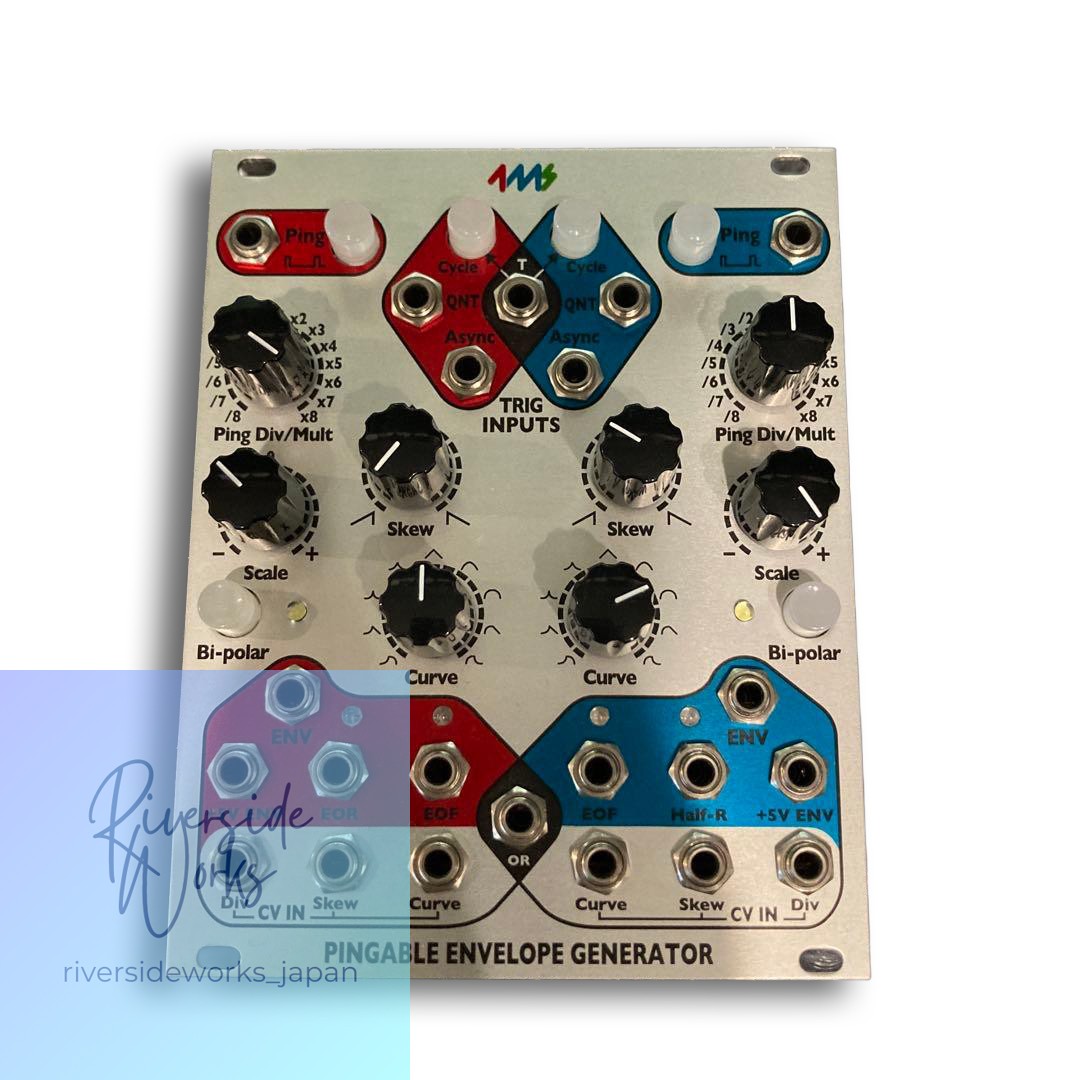
You patch in a clock and hit the tap tempo button twice. Your envelopes now run in time with the rest of your rig, though they aren't rigidly locked down. The 4ms Pingable Envelope Generator (PEG) treats each pulse as a seed, and grows an envelope whose total duration is the space between pings. The time between triggers sets the envelope length, not a knob. Want a snappy decay? Speed up the clock. Need a slow swell that stretches across bars? Slow the pings. This is different from traditional AR or ADSR logic, where timing is internal and fixed. Here the timing is relational. The PEG listens, then answers in kind.
It answers with precision. Each of the two channels runs independently, with full CV control over curve shape, skew, and ping division/multiplication, from 1/8x to 8x the incoming clock rate. One envelope can be a rapid-fire stutter synced to 16ths while the other creeps along at half-time, all from the same clock source. The curve knob morphs the rise and fall between exponential, logarithmic, linear, and interpolated responses. You get punchy clicks or smooth swells without altering the total envelope time. Skew adjusts the balance between rise and fall, again without affecting overall duration. It's good for asymmetrical pulses that feel organic instead of metronomic.
The PEG is also a rhythmic brain. It can cycle continuously (LFO mode), quantize to the next beat, trigger asynchronously, or respond to external gates. The End-of-Rise and End-of-Fall gate outputs give you timing signals for cascading modulation. The Half-Rise option, switchable via jumper, opens up phase-shifting and quadrature possibilities. There's also an analog OR output that takes the higher voltage of the two envelopes, which makes complex, overlapping control voltages that evolve with every ping.
Specifications
| Manufacturer | 4ms Company |
| Production Years | 2012– |
| Original Price | $345.00 |
| Module Size | 20 HP |
| Power Consumption (+12V) | 60mA max (external 5V), 105mA max (internal 5V) |
| Power Consumption (-12V) | 35mA max |
| Power Consumption (+5V) | 40mA max (external 5V), 0mA (internal 5V) |
| Power Connector | 16-pin Eurorack power header |
| Maximum Depth | 1.0" (26mm) with power cable |
| Envelope Outputs | Main (scaled), +5V ENV (fixed 0–5V), OR (analog OR of both channels) |
| Gate Outputs | End-of-Rise (EOR), End-of-Fall (EOF), Half-Rise (jumper-selectable) |
| CV Inputs | Ping Div/Mult, Skew, Curve (per channel) |
| Control Inputs | T (toggle cycle), QNT (quantized trigger), Async (asynchronous trigger) |
| Controls | Ping Div/Mult knob, Curve knob, Skew knob, Scale knob, Bi-polar button, Cycle button, Tap tempo button (per channel) |
| Internal 5V Option | Jumper-selectable (internal generation from +12V or external supply) |
| Included Accessories | 16-to-16 pin power cable, 4 M3 Knurlie screws |
| Firmware Versions | v4.2 (PCB v1.x), v4.3 (PCB v2.x) |
| Weight | Not specified |
| Dimensions | 20 HP x 1.0" depth |
Key Features
The Ping Concept: Envelopes That Sync, Not Just Trigger
Most envelope generators need a gate to start and a release time set by a knob. The PEG does it differently. The "ping" is the metronome that defines the entire envelope's duration. Whether you tap tempo manually or feed it a clock from a sequencer, the time between pings becomes the total envelope cycle. Your decay doesn't end when it feels like it. It ends in lockstep with the rest of your patch. That makes the PEG useful in generative patches, where timing coherence matters. You can divide or multiply the ping clock from /8 to x8, so one channel moves in whole notes while another flutters at 32nd-note subdivisions, all from the same source.
Curve, Skew, and Shape Without Sacrificing Timing
The PEG keeps total envelope time the same regardless of curve or skew adjustments. Turn the curve knob and you change the shape from logarithmic to exponential while the envelope stays locked to the beat. A sharp attack can become a slow fade-in, but the entire envelope still finishes exactly when the next ping arrives. The same goes for skew: you can shift from a quick rise and long fall to a slow rise and snap decay, and the clock alignment holds. That means you can modulate curve and skew with CV in real time, and the textures evolve while staying in time. Want a filter sweep that starts punchy and gradually melts into a smooth swell, all within the same bar? Patch CV into curve and let it evolve.
Modulation Depth and Utility Outputs
Beyond the main envelope outputs, the PEG has a handful of utilities. The Scale knob acts as an attenuating inverter, so you can flip the envelope polarity or scale it down for subtle modulation. The Bi-polar button centers the output around 0V, which is useful for modulating oscillators or VCAs symmetrically. The +5V ENV output is fixed at 0-5V and unaffected by scaling, so it suits modules that expect a standard CV range. The OR output outputs the higher voltage of the two envelopes at any moment. It can drive filters, wavefolders, or even other envelopes. Patch both channels into a VCA and use the OR output to modulate its level, and you get a dynamic, interlocking rhythm.
Historical Context
The PEG emerged in 2012, as Eurorack was shifting from boutique curiosity to full-blown modular renaissance. At the time, envelope generators were mostly straightforward: ADSR, AR, maybe a loop mode. The Make Noise Maths had already redefined what a "function generator" could be, blurring lines between envelope, LFO, and wavefolder. The PEG didn't try to out-math the Maths. It offered something different: rhythmic intelligence. While Maths excelled at abstract, voltage-controlled timing, the PEG embraced the grid. It was built for users who wanted their modulation to feel like part of the beat, not layered on top. With clock-synced LFOs and sequencers becoming standard, the PEG was one of the first envelope generators to treat clock input as a first-class citizen. It didn't just accept clock. It needed it.
4ms, known for designs like the Dual Looping Delay and Spectral Multiband Resonator, positioned the PEG as a "rhythmic modulation powerhouse." It wasn't the cheapest envelope option, nor the most analog-sounding, but it was the most rhythmically fluent. Paired with modules like the 4ms QCD (Quad Clock Distributor), it became the backbone of tightly synced, generative patches. Its firmware was actively developed, with updates improving stability and adding features, which was rare for hardware at the time. Softube later released an officially licensed plugin version.
Collectibility & Value
The PEG has held its value well, with used units typically selling between $280 and $330 depending on condition and firmware version. New-old-stock or mint-condition units can still fetch close to the original $345 MSRP. Unlike some vintage gear that depreciates or becomes obsolete, the PEG remains in high demand because it ties envelope timing directly to rhythmic context. There are no known fatal flaws in the design, but owners report that firmware updates (from v4.2 to v4.3) can resolve minor timing inconsistencies, especially in self-patched feedback loops. The manual includes clear instructions for checking and updating firmware, and 4ms provides the necessary files and guidance.
One quirk: the power jumper. The PEG can generate its own +5V internally or draw it from the power supply. Some skiff-friendly power systems don't provide +5V, so users must set the jumper to internal generation. That increases +12V draw from 60mA to 105mA per module. Check your power supply's +12V headroom if running multiple PEGs or other high-draw modules. The module is solidly built, with no reports of failing pots or jacks, and the PCB layout is clean and serviceable. It's digital at its core, though the outputs are analog, so it's less prone to drift or noise than analog envelope generators. It does need a stable clock source to perform at its best.
When buying used, verify the firmware version and make sure the tap tempo function works reliably. Some early units had inconsistent response if the firmware wasn't updated. Also check that the OR output behaves correctly, though failures here are extremely rare. For live use, the tap tempo buttons are tactile and responsive, but if you rely on external clock, make sure your source is stable. The PEG won't fix a wobbly clock. It will reproduce it, quirks and all.
eBay Listings



As an eBay Partner, we earn from qualifying purchases. This helps support our independent vintage technology research.