4ms SCM Breakout (2010s)
The unassuming 8HP expansion that turns a clever clock multiplier into a full-blown rhythmic chaos engine
Overview
Plug this into your SCM and suddenly, everything breathes differently. You don’t just get more controls—you get deeper access, more modulation paths, and a level of rhythmic manipulation that makes even modern clock modules feel timid. The Breakout doesn’t just expand the Shuffling Clock Multiplier; it unlocks its nervous system. Where the base SCM gives you multiplied clocks and a hint of swing, the Breakout hands you the levers for pulse width, beat skipping, tempo doubling, and muting—all with CV and manual control. It’s not flashy, but in a rack full of sequencers and LFOs, this is the quiet module that makes your patterns feel alive, unpredictable, and human in all the right ways.
Originally sold as a factory-built unit and later only available as a DIY kit, the SCM Breakout was designed to solve a very specific problem: the SCM was brilliant but limited. Its shuffle and slip parameters were fixed or hard to modulate. The Breakout changes that by adding dedicated knobs and CV inputs for Shuffle, Slip, Skip, Pulse Width, 4x Fast, and Mute—each one transforming how the multiplied clocks behave. It’s not a standalone module; it draws power from and connects directly to the SCM via a 16-to-16 pin ribbon cable. You can’t use it alone, but when paired, the two become something greater than the sum of their parts. Think of it like adding expression pedals and aftertouch to a synth that only had velocity before—same engine, entirely new performance language.
Specifications
| Manufacturer | 4ms Company |
| Production Years | 2010s |
| Original Price | $150.00 (factory-built) |
| Module Size | 8HP |
| Depth | 26mm |
| Power Consumption (+12V) | 14mA |
| Power Consumption (-12V) | 0mA |
| Power Consumption (+5V) | 0mA |
| Power Connection | 16-to-16 pin cable from SCM |
| CV Inputs | Rotate, Slip, Shuffle, Skip, Pulse Width, 4x Fast, Mute |
| Manual Controls | Knobs for Shuffle, Skip, Pulse Width, Rotate, Slip |
| Switches | LED buttons for Mute and 4x Fast |
| Additional Inputs | Re-sync Trigger |
| Compatibility | Requires 4ms Shuffling Clock Multiplier (SCM) |
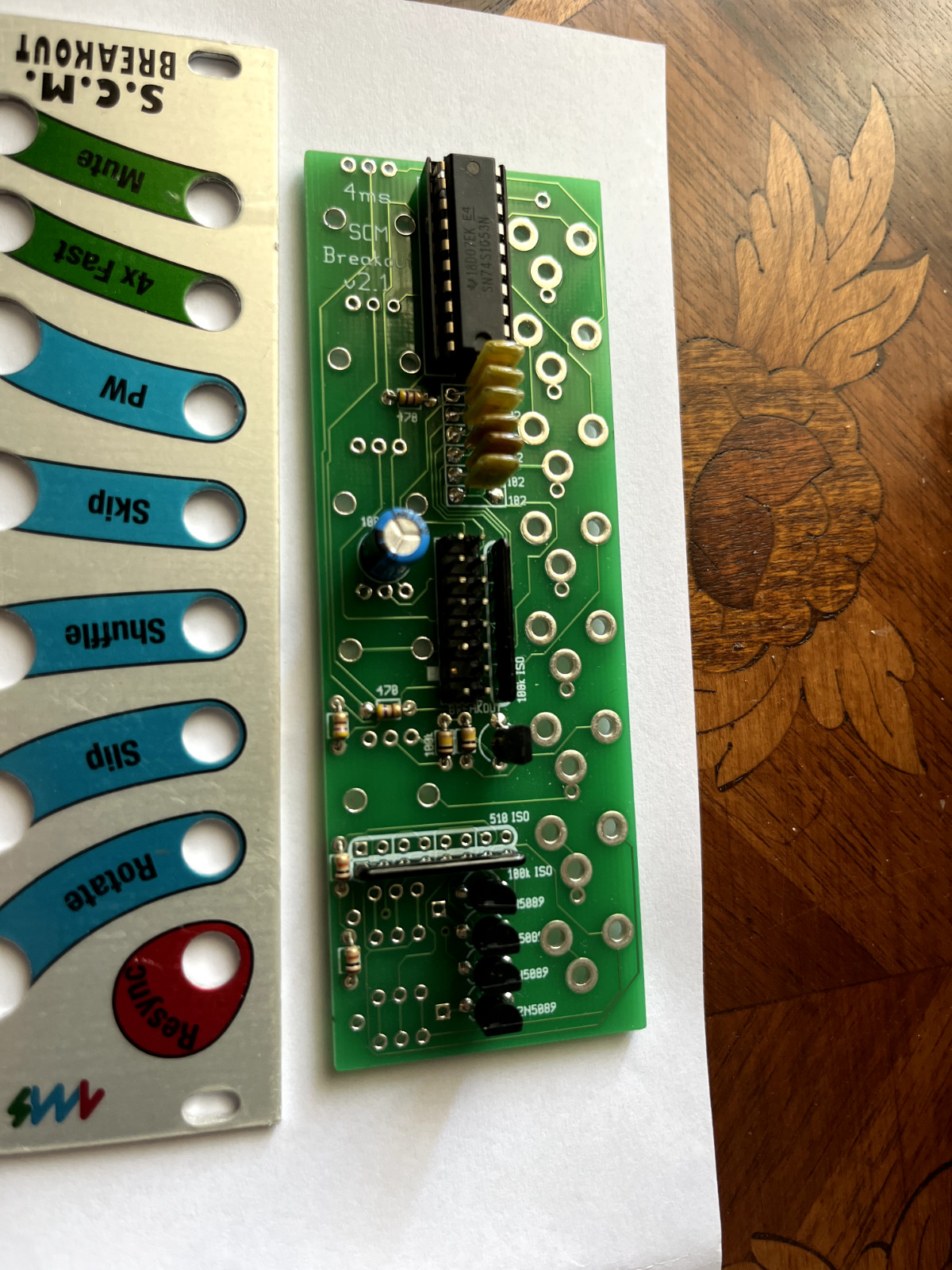
| Available As | Factory-built (discontinued), DIY kit |
| Weight | Approx. 100g (module only) |
| Front Panel | Black anodized aluminum with white silkscreen |
| Knob Type | Small control knobs (centered at 12:00) |
Key Features
Deep Rhythmic Sculpting
The Breakout’s real power lies in how it lets you shape not just tempo, but the character of each beat. The CV Shuffle input, paired with its knob, determines which beats get slipped—defaulting to every other beat but fully variable via control voltage. This isn’t just swing; it’s algorithmic rhythm warping. CV Skip lets you drop beats entirely, turning steady pulses into syncopated stutters. Pulse Width control adjusts the duration of each gate output, from tight blips to long sustains, which is huge for modulating envelopes or driving sample-and-holds with varying window sizes. These aren’t gimmicks—they’re compositional tools. In practice, you can use an LFO to modulate Skip and create evolving rhythmic gaps, or run a random voltage into Pulse Width to give each beat a slightly different length, like a drummer with a nervous tic.
Performance Controls with Feedback
The Mute and 4x Fast functions are activated via LED push buttons that invert the signal on their respective jacks—press Mute and all outputs stop; press again and they resume. The LEDs provide instant visual feedback, which is crucial during live sets. The 4x Fast switch is particularly clever: it effectively quadruples the multiplier amount, letting you jump from x2 to x8 or x4 to x16 on the fly. This isn’t just a tempo boost—it’s a way to launch into frenetic fills or sudden breakdowns. Combined with the Re-sync input, which resets all internal counters, you can build entire rhythmic arcs: start slow, double time into a chorus, skip beats in the bridge, then mute everything and re-sync for a dramatic restart. It’s rare for a clock module to feel performative, but the Breakout makes timing feel like an instrument.
Modular Integration Done Right
What sets the Breakout apart from other expanders is how it integrates CV control without sacrificing manual access. The Rotate and Slip knobs don’t just act as attenuators—they sum their signals with the corresponding jacks on the main SCM. That means you can use the knob to set a base offset and then modulate it further with an external CV, or leave the knob at zero and control everything externally. If nothing is plugged into the CV jacks, the knobs function as direct manual controls, just like the original SCM. This dual-path design makes it equally useful for patching and tweaking on the fly. It’s a thoughtful, musician-first approach: no menu diving, no hidden modes, just knobs and jacks that do exactly what you expect.
Historical Context
The SCM Breakout emerged in the early 2010s, when Eurorack was shifting from boutique curiosity to mainstream modular adoption. Clock modules were often simple dividers or multipliers—functional, but musically flat. The original SCM stood out by introducing shuffle and slip at the hardware level, but its modulation options were limited. The Breakout was 4ms’s answer to a growing demand for deeper control. At the time, modules like the Make Noise Tempi and Intellijel Metropolis were pushing the idea of clocks as creative tools, not just metronomes. The SCM + Breakout combo fit perfectly into that ethos, offering a way to generate complex, evolving rhythms without needing a full sequencer. It wasn’t trying to compete with digital brains like the Turing Machine or Pressure Points—it was a focused, analog-flavored solution for groove-based experimentation. Its timing isn’t perfectly quantized (a quirk some owners report with fast tempo changes), but that slight looseness is part of its charm. It feels more like a drummer than a computer.
Collectibility & Value
Factory-built units are discontinued and increasingly scarce, making them the preferred version for collectors and players who don’t want to solder. NOS (new old stock) examples pop up occasionally, usually priced between $110 and $150 depending on condition and included accessories. Used units in good working order typically sell for $80–$110. The DIY kit version, still available from 4ms, costs $79 and is a solid option for builders, though it requires surface-mount soldering skills. Since the Breakout has no firmware and minimal components, failure points are few—mostly limited to bent jacks or damaged ribbon cables. The real risk is buying one without the 16-to-16 pin cable; without it, the module is useless. Always verify that the cable is included. Also, check that the LED buttons for Mute and 4x Fast illuminate properly—early units had occasional LED failures, though not widespread. Given that the SCM Plus now combines both modules into one, the standalone Breakout has taken on a legacy status. It’s not obsolete, but it’s no longer in production, which adds to its appeal for purists who prefer the original two-module setup or want to upgrade an older SCM.
eBay Listings
As an eBay Partner, we earn from qualifying purchases. This helps support our independent vintage technology research.