4ms Dual Looping Delay (2010–Present)
A digital delay that doesn’t pretend to be analog—crystalline repeats, deep clock sync, and two full loops in 20HP of serious sonic real estate.
Overview
You patch in a simple melody, set the clock, and suddenly your modular rig starts echoing back not just sound, but time itself—layered, evolving, perfectly in step. That’s the 4ms Dual Looping Delay, a module that doesn’t chase warmth or tape wobble, but instead doubles down on precision, flexibility, and rhythmic depth. It’s not a nostalgic nod to the past; it’s a surgical tool for building sonic architectures that unfold over minutes, not milliseconds. With two fully independent delay/loop channels locked to a shared clock, the DLD turns your system into a self-referential playground where feedback isn’t just a parameter—it’s a compositional partner.
Born in the early 2010s, when Eurorack was shifting from analog purism to digital experimentation, the DLD arrived as a statement piece: digital doesn’t mean cold, and precision doesn’t mean sterile. It can mean control. It can mean structure. It can mean a delay line that holds 88 seconds per channel—nearly three minutes of total loop memory—without breaking a sweat. That kind of headroom was unheard of in compact modular formats at the time, and even now, few modules match its stamina. Each channel runs at 48kHz with 16-bit resolution (with an optional 24-bit upgrade path), delivering a clean, transparent delay that doesn’t color the source—unless you want it to, via feedback routing, external processing, or creative CV manipulation.
What sets the DLD apart isn’t just capacity, but its architectural philosophy. The two channels aren’t just stacked delays—they’re synchronized siblings, each capable of independent timing via divisions and multiplications of a master clock. You can run one at 1/4 note and the other at 5/8, or stretch one into a glacial 32-beat loop while the other stutters in 1/16 triplets. The clock system is robust, with dedicated inputs and outputs that let it lock seamlessly to sequencers, drum modules, or external gear. It doesn’t just follow time—it helps define it.
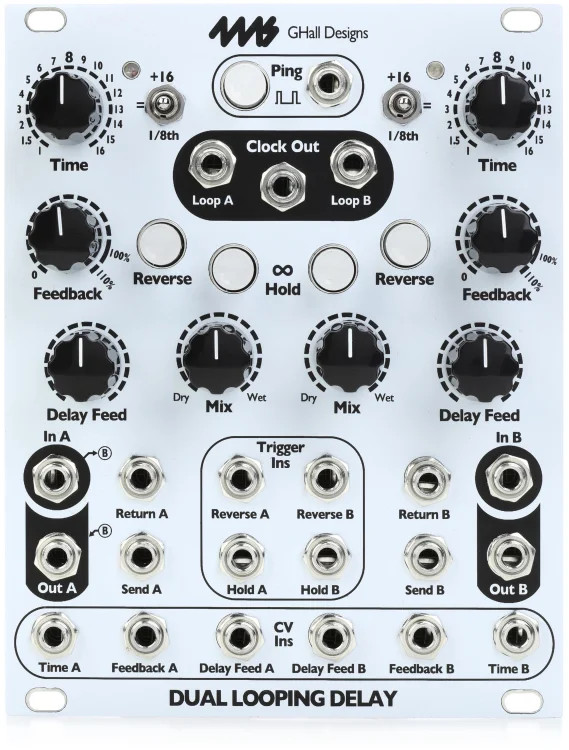
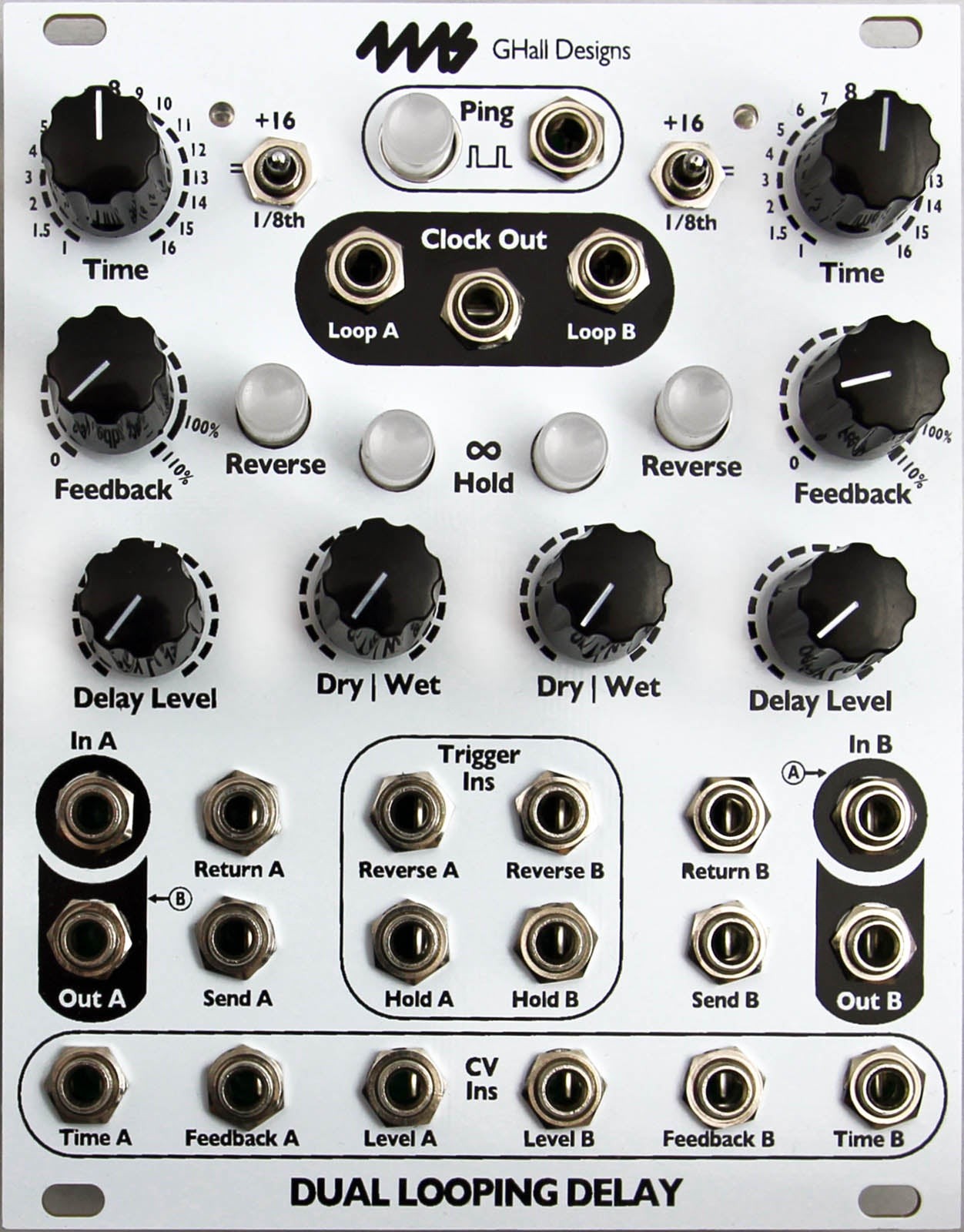
And then there’s the workflow. No menus, no LCD screens, no endless button presses. Everything is immediate: knobs for time, feedback, mix, and delay level, with CV control over every parameter. The front panel is sparse but deliberate, with color-coded sections separating inputs (black) from outputs (white), and illuminated buttons for Infinite Hold, Reverse, and Ping (tap tempo). The tactile feedback of those buttons, the way they click and glow, makes looping feel physical, almost ritualistic. You’re not just setting a delay; you’re engaging with time.
Specifications
| Manufacturer | 4ms Company |
| Production Years | 2010–Present |
| Original Price | $495 (assembled) |
| Module Width | 20 HP |
| Depth | 50 mm |
| Power Requirements | +12V @ 120mA, -12V @ 30mA |
| Sampling Rate | 48 kHz |
| Bit Depth | 16-bit (24-bit upgrade available) |
| Maximum Delay Time | 88 seconds per channel |
| Total Loop Time | Up to 2 minutes 56 seconds |
| Frequency Response | 0 Hz (DC) to 24 kHz (-1.7 dB) |
| Signal-to-Noise Ratio | Extremely quiet, low-noise design |
| Inputs | Audio In A/B, Time CV A/B, Feedback CV A/B, Mix CV A/B, Delay Feed CV A/B, Clock In, Hold In, Reverse In |
| Outputs | Audio Out A/B, Send A/B, Return A/B, Clock Out, Loop Clock Out A/B |
| Normalization | Inputs and outputs normaled for mono operation |
| CV Control | All major parameters CV-controllable |
| Tap Tempo | Yes (Ping button) |
| Reverse Playback | Yes, per channel |
| Infinite Hold | Yes, per channel |
| Weight | 0.5 lbs (227 g) |
Key Features
Two Delays, One Clock—Rhythmic Symbiosis
The DLD’s dual-channel design isn’t just about doubling up—it’s about interplay. Both channels sync to a single clock, but each interprets time differently. The Time knob doesn’t just set milliseconds; it sets rhythmic divisions and multiples. Turn it to “4” with the toggle in center position? That’s a 4-beat loop. Flip the toggle to “+16” and it becomes 20 beats. Set it to “1/8” and now you’re dividing the base clock by eight, creating intricate polyrhythms with a flick of a switch. This isn’t just convenient—it’s compositional. You can build entire pieces around the tension between two loops drifting in and out of phase, feeding each other, evolving over minutes. The clock I/O makes it a central nervous system for rhythmic modules, syncing delays to sequencers or using its Loop Clock Out to drive other time-based effects.
Send/Return: The Hidden Playground
Tucked between the two channels are Send and Return jacks—one per side—that open up a world beyond clean repeats. Patch a filter, a second delay, or a granular processor into the Send/Return loop and suddenly your delay isn’t just echoing—it’s transforming. Feedback can be routed through external effects, letting you build resonant feedback chains that spiral into self-oscillation or ambient washes. The manual warns that you might hear something you played minutes ago, resurfacing unexpectedly—because yes, with nearly three minutes of total memory, the DLD remembers. This isn’t a bug; it’s a feature. It turns the module into a memory machine, where sound accumulates, mutates, and reemerges like ghosts in the signal path.
CV-Driven Time Manipulation
Every major parameter—time, feedback, mix, delay level—accepts CV, and that’s where the DLD transcends being a mere delay. Patch in a slow LFO to the Time CV, and the delay length breathes, swelling and contracting like a living thing. A random stepped generator on feedback creates unpredictable decay patterns. An envelope follower from a drum hit can momentarily boost the mix, making delays punch through a mix only on transients. The lack of onboard attenuators means you’ll want to pair it with attenuators or use buffered mults, but that’s a small trade-off for the level of control. And because the Time knob responds to both absolute CV and offset, you can blend manual adjustment with modulation—say, holding a base delay time while an LFO adds rhythmic wobble.
Historical Context
The Dual Looping Delay didn’t emerge from a vacuum. It arrived in 2010, a time when Eurorack was still dominated by analog oscillators, filters, and envelopes, and digital modules were often viewed with suspicion—seen as clunky, opaque, or too “computer-like.” 4ms had already carved a niche with the Spectral Delay and the Ensemble Oscillator, but the DLD was different: it was accessible, immediate, and deeply musical without relying on analog warmth. Instead, it drew inspiration from early digital delays like the Lexicon PCM42 and the EMT 250—machines prized for their clarity and precision, not their coloration.
But the DLD wasn’t a retro reissue. It was a forward-looking tool for a new kind of modular musician—one who thought in terms of systems, feedback loops, and generative composition. At a time when most delay modules offered a few seconds of echo at best, the DLD’s 88-second capacity was revolutionary. It aligned with a broader shift in modular culture: from short-form sound design to long-form, evolving textures. Artists like Tim Exile and Richard Devine, who used looping and feedback as core compositional tools, found a natural home in the DLD. It wasn’t just for guitarists or traditional delay users—it was for system thinkers, for patchers who saw the modular synth as an ecosystem, not just a collection of sound sources.
Competitors like the Qu-Bit Nebulae or the Make Noise Mimeophon offered more texture and manipulation, but they came later—and at a higher complexity and cost. The DLD carved its niche as the no-nonsense, high-capacity workhorse: less about mangling sound, more about sustaining it, layering it, letting it breathe over time.
Collectibility & Value
The 4ms Dual Looping Delay has never been a “rare” module in the traditional sense—it’s been in continuous production since 2010, with consistent availability through major retailers. But that doesn’t mean it’s common. Well-maintained units in good condition typically sell between $450 and $550 on the used market, with black-panel versions (the standard) being the most prevalent. The 24-bit upgrade, if factory-installed or properly retrofitted, can add $50–$75 to resale value, though it’s not a dramatic premium.
What makes the DLD a keeper isn’t scarcity, but reliability and utility. Unlike some early digital modules that suffered from firmware bugs or power sensitivity, the DLD has a solid track record. Failures are rare, but when they happen, they’re usually tied to power issues—specifically, reverse polarity or overvoltage. The module lacks onboard protection, so a misplugged power cable can fry the board. Technicians report that the most common repair is replacing the microcontroller or RAM chips, which are surface-mount and require skilled rework. There’s no user-serviceable parts inside; if it fails, it’s a send-back-to-4ms situation.
Another consideration: firmware. The DLD has received several updates over the years, including the v5 Send-Return Pre-Loop firmware, which adds advanced routing options. Units with older PCBs (v1.2-F446) can’t run this firmware, so buyers should check revision history. A module with outdated firmware isn’t broken, but it’s missing features that many users now consider essential.
For collectors, the DLD isn’t about hunting down vintage variants or limited editions. It’s about owning a module that does one thing exceptionally well: long, clean, synchronized looping. It’s the kind of module that, once you’ve used it, you don’t want to patch without. It’s not flashy, but it’s foundational. And because it’s still in production, there’s no urgency to buy—just the quiet confidence that if you need two minutes of pristine delay, this is still one of the best ways to get it.
eBay Listings


As an eBay Partner, we earn from qualifying purchases. This helps support our independent vintage technology research.