2HP Vowel (2018–Present)
A two-inch-wide Eurorack module that turns voltage into babbling, robotic speech—no patching required.
Overview
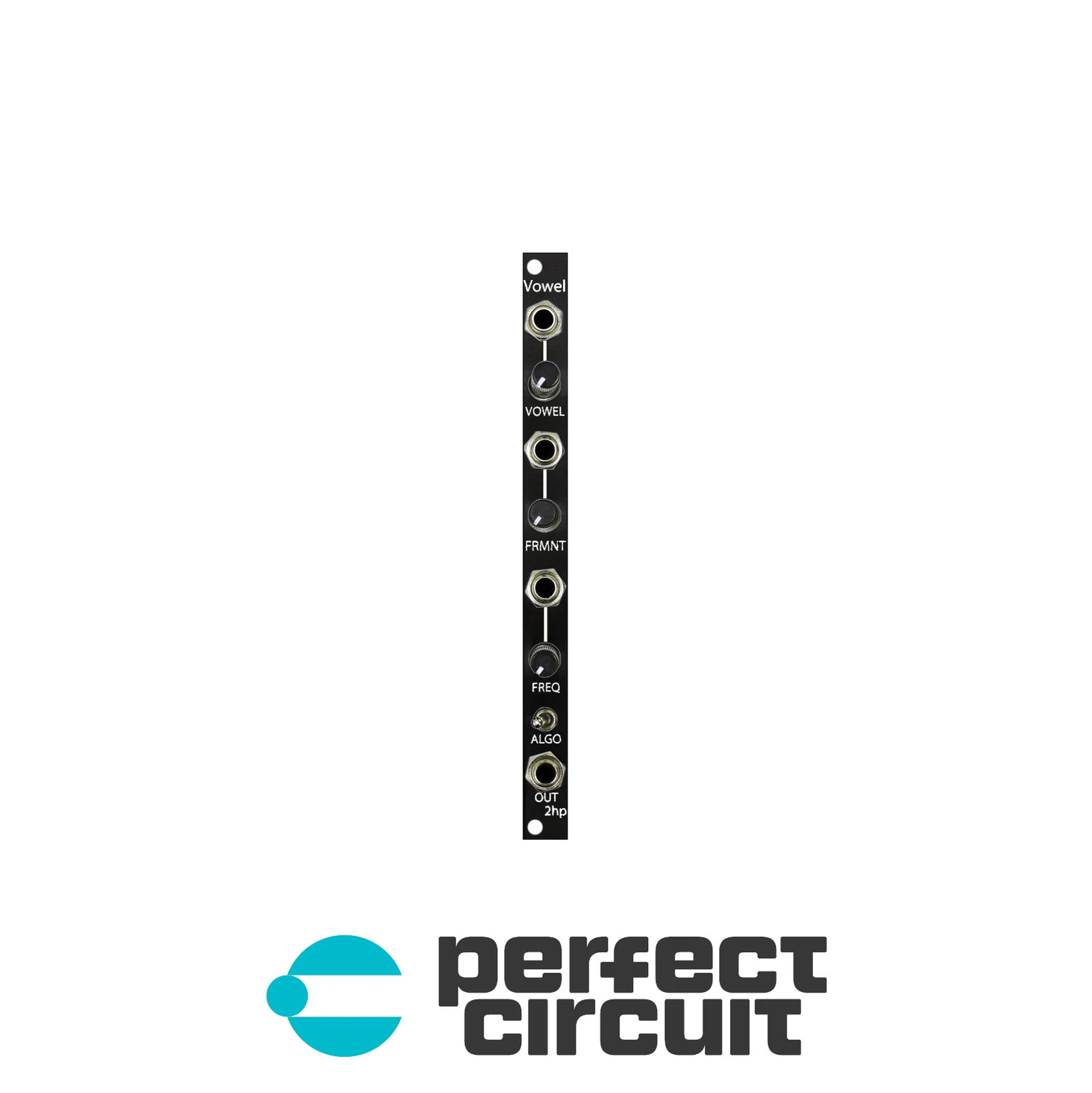
It starts with a gurgle, then a low “ohhh” like a theremin ghost trapped in a matchbox, and suddenly it’s chirping “ee-ah-ee-ah” like a malfunctioning robot parrot. That’s the 2HP Vowel: a sliver of a module that does one thing with eerie precision—make your modular rig talk. Not sing, not hum, but actually form vowel sounds that shift and morph in real time, from guttural growls to nasal whines, all from a circuit board smaller than a postage stamp. You don’t need to wire up a chain of filters and envelope followers to fake a voice; this thing is purpose-built for vocal mimicry, and it does it with a kind of minimalist elegance that feels almost cheeky. Two knobs, two CV inputs, a pitch control, and a switch to toggle between two internal algorithms—one smoother, one more jagged—and that’s it. No menus, no screens, no firmware updates. Just voltage in, vowel out.
And yet, for all its simplicity, the Vowel punches far above its size. It’s not just a novelty; it’s a compositional tool. Run a slow LFO into the Formant CV, modulate the Vowel parameter with a sequencer, and suddenly your drone has a voice, a personality—like a sentient foghorn trying to communicate in syllables. The magic lies in how it handles formant synthesis, digitally modeling the resonant frequencies of the human vocal tract without needing a full-blown sampler or wavetable engine. It’s not trying to replicate speech perfectly—no consonants, no words—but it captures the soul of vocal timbre, the wet resonance of an “ah” or the tight squeeze of an “ee,” and it does so with surgical clarity. Compared to patching a vowel filter bank manually, this is like going from hand-cranking a film projector to streaming in HD. It’s instant, reliable, and musically immediate.
Positioned in the 2HP lineup—a brand known for stripping functions down to their bare essentials—the Vowel sits as one of their most conceptually pure modules. It’s not the flagship, not the most powerful, but it’s emblematic of their design philosophy: if a function can be distilled into a 2HP space, it should be. Above it in complexity are modules like the 2HP Spectral or 2HP Step, but the Vowel stands apart as one of the few dedicated formant oscillators in Eurorack. While other digital modules like Mutable Instruments’ Plaits or Noise Engineering’s Loquelic Iteritas offer vowel modes among dozens of others, the Vowel does *only* this—and does it with focus. It’s not trying to be everything; it’s trying to be the best at one oddly specific thing. And in that niche, it’s hard to beat.
Specifications
| Manufacturer | 2HP |
| Production Years | 2018–Present |
| Original Price | $149 |
| Format | Eurorack |
| Width | 2HP |
| Depth | 45mm |
| Power | +12V: 78mA, -12V: 2mA |
| Power Connector | 2x5 pin header (reverse mount) |
| Outputs | 1x Audio (1/8" TS) |
| Inputs | Pitch CV (1/8" TS), Vowel CV (1/8" TS), Formant CV (1/8" TS) |
| Pitch Control | Manual knob, 2V/Oct CV input |
| Vowel Parameter | Manual knob, CV input with attenuator |
| Formant Parameter | Manual knob, CV input with attenuator |
| Algorithm Selection | Front-panel switch (two modes) |
| Pitch Range | -1V to +1.5V |
| Signal Type | Digital formant synthesis |
| Weight | Approx. 30g |
| Case Clearance | Requires no adjacent panel space |
Key Features
Dual-Algorithm Formant Engine
At its core, the Vowel runs two distinct digital algorithms that shape how vowel transitions behave. One produces smoother, more naturalistic shifts between phonetic sounds—ideal for eerie vocal pads or evolving drones that feel almost organic. The other is more abrupt, with sharper transitions and a slightly digital, “chiptune” character that leans into the artificiality of the synthesis. This isn’t just a subtle tweak; switching between them changes the module’s entire personality. The smooth mode can mimic a human voice warming up, sliding from “oh” to “ah” with liquid grace. The sharp mode, meanwhile, sounds like a robot learning to talk, syllables snapping into place with a digital click. Neither is objectively better—it’s a matter of intent. For cinematic sound design, the smooth algorithm feels more believable. For glitchy, rhythmic sequences, the sharp one cuts through with more articulation.
Three-Parameter Voltage Control
While many formant-based oscillators lock vowel shape to a fixed set of waveforms, the Vowel hands full control over pitch, vowel type, and formant frequency—each with dedicated CV inputs and manual knobs. The pitch CV follows standard 2V/Oct scaling, making it easy to integrate into any tuning system. The Vowel knob sweeps through the spectrum of vowel sounds (from “ee” to “oo”), while the Formant control adjusts the perceived vocal tract length, letting you shift from childlike squeaks to cavernous baritone growls. Both parameters accept CV with onboard attenuators, so you can dial in exactly how much modulation you want from an LFO, sequencer, or envelope. This level of control in such a small space is rare. Most modules that offer vowel synthesis bury it under layers of menu diving; here, it’s all immediate, tactile, and patchable. You can sequence vowel changes like notes, or let an envelope shape the formant in real time for talking-filter effects that don’t require external processing.
Minimalist Design, Maximum Impact
The Vowel’s 2HP width isn’t just a gimmick—it’s a statement. In a format where modules often sprawl across 20HP or more, this one occupies the smallest possible footprint without sacrificing functionality. It doesn’t need a display, a shift button, or a hidden menu. Every function is front-panel, every knob purposeful. The reverse-mounted power header saves space, and the module sits flush with no overhang, meaning it can be installed in tight rows without blocking adjacent controls. This isn’t just about saving rack space; it’s about reducing friction between idea and sound. You patch it, twist the knobs, and immediately hear results. There’s no setup, no calibration, no software. It’s the anti-bloatware of Eurorack—proof that a module can be both deeply capable and ruthlessly simple.
Historical Context
When the 2HP Vowel launched in 2018, Eurorack was already deep into the digital renaissance. Modules like Plaits, Morphagene, and Clouds had proven that complex synthesis could live in compact, affordable packages. But while many digital oscillators included vowel modes as one option among dozens, none had dedicated an entire module to the concept—especially not in 2HP. The Vowel arrived as a kind of conceptual counterpoint: what if, instead of packing more functions into a single module, you stripped everything away and focused on one expressive idea? It wasn’t the first formant synthesizer—Korg’s i3 and Roland’s D-50 had explored vocal modeling in the late ’80s—but it was the first to bring that capability to Eurorack in such a minimal, accessible form.
At the time, speech synthesis in modular was still largely a patch-heavy endeavor, requiring multiple oscillators, filters, and envelope generators to approximate vowel sounds. The Vowel eliminated that complexity, offering a ready-made solution for composers interested in vocal textures without the engineering overhead. It also arrived alongside a growing interest in “talking” synths in experimental and electronic music—artists like Holly Herndon and Arca were pushing the boundaries of vocal manipulation, and the Vowel gave modular users a tool to explore similar territory. Competitors like Intellijel’s Formant EQ or ALM’s BIA offered formant filtering, but the Vowel was unique in being a *source* of formant-rich sound, not just a processor. It filled a niche that many didn’t realize existed—until they heard it speak.
Collectibility & Value
Despite being a relatively recent module, the 2HP Vowel has developed a quiet cult following. It’s not a rare item—production has been steady since 2018—but its reputation for reliability and utility keeps it in demand. On the used market, prices typically range from $100 to $130, depending on condition and seller location. Units in pristine condition with no cosmetic wear or bent pins tend to fetch closer to $130, while those with minor scratches or older serial numbers might go for less. Unlike some boutique modules that inflate in value due to scarcity, the Vowel remains fairly stable—partly because it’s still in production, partly because it’s not flashy enough to attract speculators.
That said, there are real ownership considerations. Because it’s a digital module with a microcontroller, firmware updates are possible, though 2HP has not released any since launch—indicating a “set it and forget it” design. The biggest risk isn’t failure but physical damage: the 2HP form factor means the PCB is narrow and the jacks are close to the panel edges. Rough handling during installation or removal can crack solder joints or bend the power header. Technicians report that the most common failure point is the reverse-mounted power connector, which can break off if the module is forced into a crowded case. Buyers should inspect the power header closely and ensure the module fits flush without strain.
Another consideration is sonic context. The Vowel doesn’t output line-level signal—it’s more akin to a headphone output in level—so it may need amplification when feeding into mixers or audio interfaces. Some users report low output volume compared to other oscillators, requiring a boost stage in the patch. This isn’t a flaw, per se, but a design trade-off for the compact circuit. It’s also worth noting that while the Vowel excels at vowel sounds, it can’t produce consonants or full speech. It’s not a text-to-speech module; it’s a formant oscillator, best used as a texture generator rather than a vocal replacement. Buyers expecting a full speech synthesizer may be disappointed. But for those seeking an expressive, compact tool for vocal-like timbres, it remains one of the most efficient solutions in Eurorack.
eBay Listings
![2HP VOWEL SILVER : NEW : [DETROIT MODULAR]](https://i.ebayimg.com/images/g/i-cAAeSwlV1od8DO/s-l1200.jpg)
![2HP VOWEL BLACK : NEW : [DETROIT MODULAR]](https://i.ebayimg.com/images/g/IzQAAeSwpLpod8DL/s-l960.jpg)

As an eBay Partner, we earn from qualifying purchases. This helps support our independent vintage technology research.