2hp Verb (2010–2023)
A reverb so compact it feels like a cheat code—until you hear how wide it can make your rack sound.
Overview
You know that moment when you patch in a reverb and suddenly your patch breathes? The 2hp Verb delivers that, but in a module so narrow it barely registers on the scale—2HP, to be exact. It’s the kind of thing you install almost as an afterthought, a gap-filler between your oscillator and filter, and then you forget it’s there until you bypass it and realize your whole system sounds like it’s been stuffed in a sock drawer. That’s the magic: it doesn’t just add space, it restores dimension. From tight room ambience to cathedral-sized decays, the Verb can stretch its legs sonically despite being physically cramped into one of the smallest footprints in Eurorack. It’s stereo in and out, which matters more than you’d think—especially when you’re feeding it stereo delays or dual-panned voices and want the reverb to preserve that width instead of collapsing it into a muddy center.
And yet, for all its sonic generosity, it’s not trying to be a boutique algorithm showcase. This is digital reverb, no pretense about it. Some users report a slight metallic edge when the decay is cranked or the mix is pushed too wet, a characteristic of the FV-1 DSP chip it runs on—a detail you’ll either shrug off or fixate on depending on how much you’ve spent chasing “analog warmth” in your rig. But that’s not really the point. The Verb isn’t here to mimic plate reverbs or spring tanks; it’s here to be always available, always patchable, and always useful. The dampening control lets you tame the high-end zing, dialing in a darker, more natural tail when needed. And the CV input over mix? That’s where it stops being just an effect and starts being an instrument. Imagine a plucked sequence that starts dry and, over eight bars, dissolves into a shimmering cloud—no automation, no DAW, just a slow LFO nudging the mix CV. That’s the kind of motion that makes modular feel alive.
It’s also a product of its era—the early 2010s Eurorack boom, when every HP counted and builders were obsessed with density. 2hp, as a brand, built its reputation on minimalism: tiny modules that did one thing well. The Verb wasn’t the first reverb in Eurorack, but it was the first that didn’t demand a mortgage. Before this, you needed 8HP, 10HP, even 16HP for a decent reverb. The Verb said, “No, you can have stereo reverb in 2HP,” and suddenly everyone had space in their rack—and in their patches.
Specifications
| Manufacturer | 2hp |
| Production Years | 2010–2023 |
| Width | 2HP |
| Depth | 42 mm |
| Power | 81 mA +12V, 28 mA -12V, 0 mA 5V |
| Audio Inputs | Stereo (1/8" TS jacks) |
| Audio Outputs | Stereo (1/8" TS jacks) |
| CV Input | Mix control (1/8" jack) |
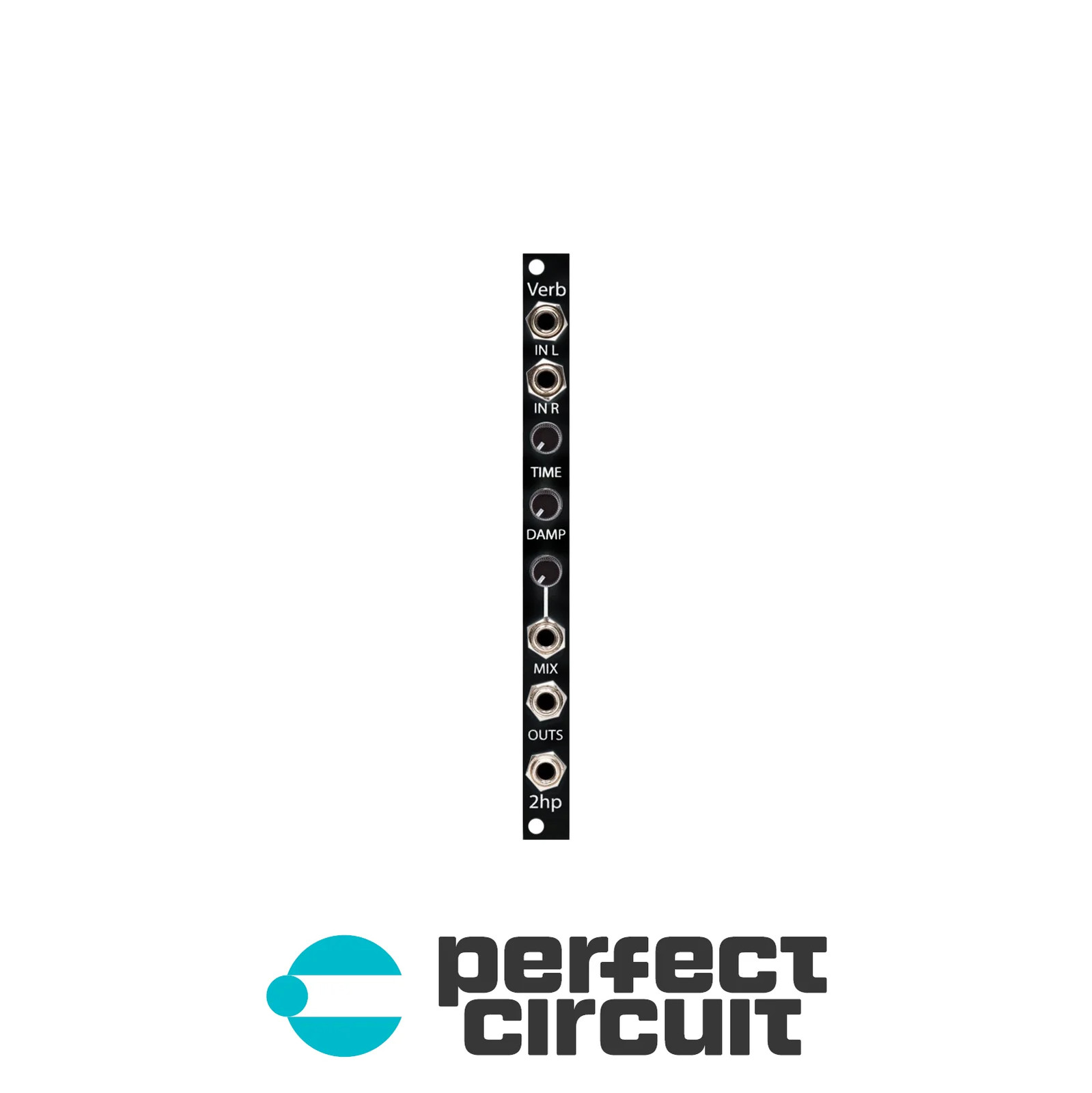
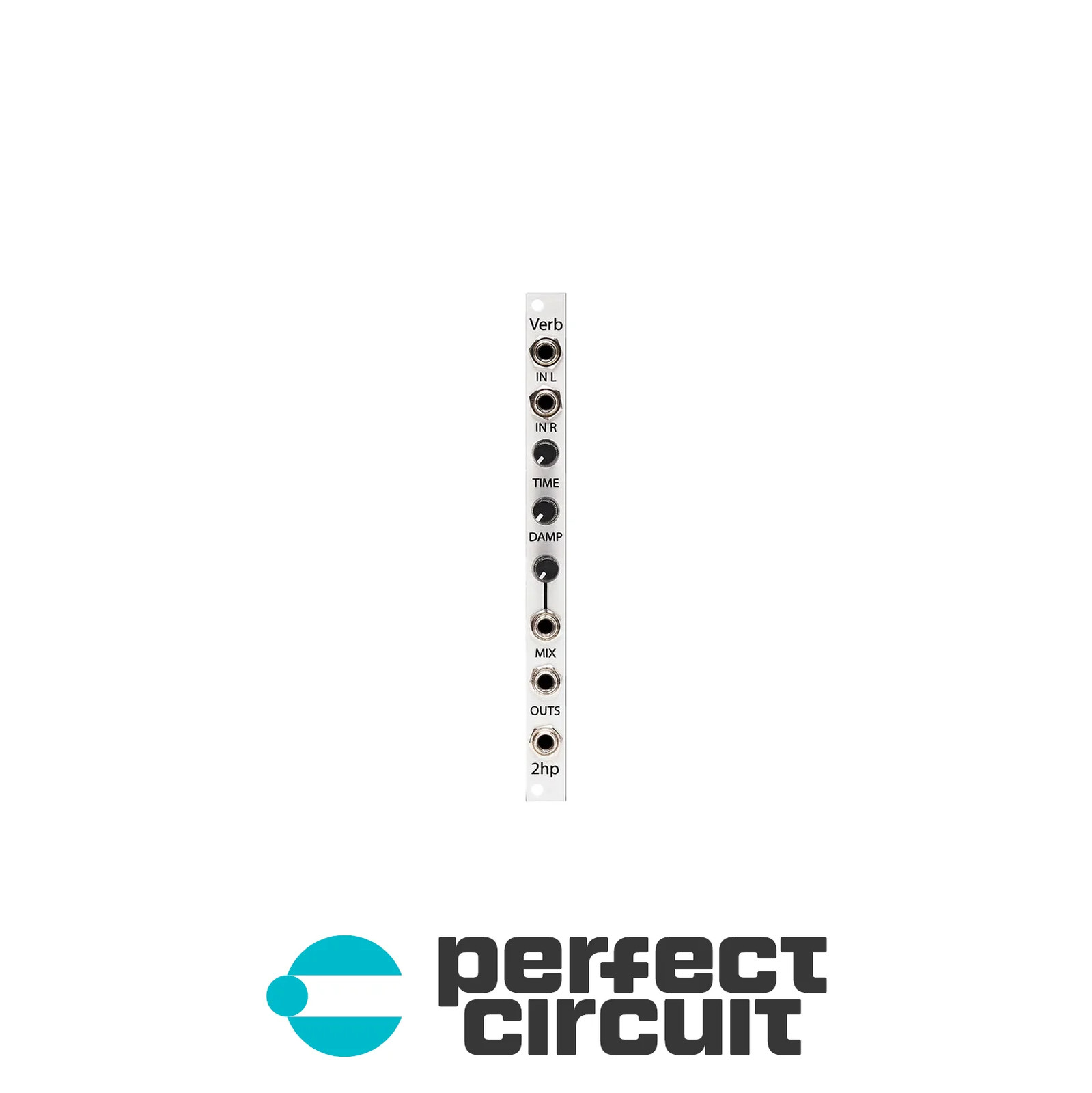
| Controls | Reverb time, dampening, mix (with CV attenuverter) |
| Signal Path | Digital (FV-1 DSP chip) |
| Reverb Types | Algorithmic stereo reverb (room, hall, plate-like spaces) |
| Reverb Time Range | Adjustable from short room to long hall |
| Dampening | High-frequency decay control |
| Mix Control | Dry/wet blend with CV input and attenuverter |
| Weight | Approx. 50g |
Key Features
The 2HP Miracle
Two horizontal HP. That’s the width of a single nut on a Eurorack panel. And yet, inside that sliver lives a fully functional stereo reverb with CV control, dampening, and a surprisingly full sound. This wasn’t just engineering—it was alchemy. The 2hp Verb became a benchmark for density, proof that you didn’t need bulk to get dimension. It’s the module you reach for when you’re one HP short of a full row and think, “Well, I could just leave a blank panel…” but then remember you could instead have reverb. And not just any reverb—stereo, with CV over mix. That kind of efficiency reshaped how people built racks. Suddenly, reverb wasn’t a luxury reserved for large systems; it was a standard utility, like a VCA or attenuator. The trade-off? No CV over reverb time, no preset storage, no shimmer or pitch-shift effects. But that’s not the brief. The Verb doesn’t want to be a multi-effects unit. It wants to be always on, always ready, and never in the way.
Dampening as a Sculpting Tool
Most small-format digital reverbs give you time and mix—and that’s it. The Verb adds dampening, and that changes everything. Without it, digital reverbs can get harsh in the upper mids and highs, especially when pushed. But the dampening control here lets you roll off the fizz, turning a glassy, metallic decay into something warmer, more organic. It’s not a full EQ, but it’s enough to make the reverb sit in the mix rather than fight it. Turn it down, and your long halls start to sound like they’re in a carpeted ballroom instead of a tiled bathroom. It’s subtle, but in a modular context—where every parameter is a potential modulation target—that subtlety becomes expressive. Patch an envelope follower into the dampening CV input (via an attenuator), and you’ve got a reverb that brightens as the source gets louder, mimicking how real spaces behave. It’s a small feature with big implications.
CV Over Mix: The Secret Weapon
The only CV input on the Verb is for mix, and that’s actually perfect. Most reverb algorithms don’t benefit from real-time time modulation—it can get chaotic, unstable. But mix? That’s gold. Being able to sweep from dry to wet with a sequencer, an envelope, or a slow LFO turns reverb from a static effect into a dynamic element. You can make a drum sequence start tight and close, then open up into a massive space on the downbeat. You can have a lead synth that’s dry on attack but swells into reverb on release. The attenuverter on the CV input means you can invert the response or scale it down, so a small CV signal gives you fine control instead of slamming the mix to 100%. It’s not full-on automation, but in a modular context, it’s enough to make the reverb feel like it’s part of the composition, not just an afterthought.
Historical Context
When the 2hp Verb launched around 2010, Eurorack was still a niche within a niche. Racks were small, power supplies were limited, and every HP was a decision. Most reverb solutions were external pedals or bulky modules like the Mutable Instruments Clouds (which came later). The idea of having a stereo reverb in 2HP seemed impossible—until it wasn’t. 2hp, as a brand, was built on this kind of minimalism: the Switch, the Mix, the Logic, all modules that did one thing in the smallest possible space. The Verb was their most ambitious yet, because reverb is computationally heavy. It ran on the Spin Semiconductor FV-1, a DSP chip popular in boutique guitar pedals and compact effects, which allowed for efficient, low-power reverb algorithms. This wasn’t just a technical achievement—it was a philosophical one. It said that effects didn’t have to be secondary, external, or expensive. They could be first-class citizens in the modular world, patched like any other module, modulated, sequenced, and integrated. Competitors like Erica Synths and Industrial Music Electronics were building larger, more complex reverbs, but the Verb carved out its own niche: the always-on, set-and-forget, but still modulatable reverb. It wasn’t the most powerful, but it was the most accessible.
Collectibility & Value
The 2hp Verb was discontinued in 2023, and while it’s not yet a “holy grail,” it’s becoming harder to find in clean, working condition. Used prices hover between $180 and $250 depending on color (black, silver, or special editions) and whether it’s sold with a warranty or tested status. Given its original MSRP of around $229, it’s holding value well—especially for a module that doesn’t have presets, MIDI, or flashy features. The reason? Utility. People don’t buy the Verb because it’s rare; they buy it because they need it. And because it’s so small, it’s often the last module installed in a build, meaning many units have been heavily used. That’s the risk: the jacks, especially the 1/8" audio and CV inputs, are delicate. Owners report jack solder joints cracking from repeated patching, and the FV-1 chip, while reliable, can fail if the module is exposed to voltage spikes or incorrect power. There’s no user-serviceable fuse, so a power issue can mean a trip to a technician. When buying used, test every input and output, check for crackling, and verify that the CV mix control responds smoothly. Also, confirm the version—some early units had slightly different power draw, but most modern power supplies handle it fine. If you’re building a compact or travel rig, the Verb is still worth the hunt. Just don’t expect miracles—expect practicality, with a side of wonder.
eBay Listings


As an eBay Partner, we earn from qualifying purchases. This helps support our independent vintage technology research.