2hp Unity (2017–)
A tiny mixer that does exactly what you need—when you need it—without stealing space from the stars of your rack.
Overview
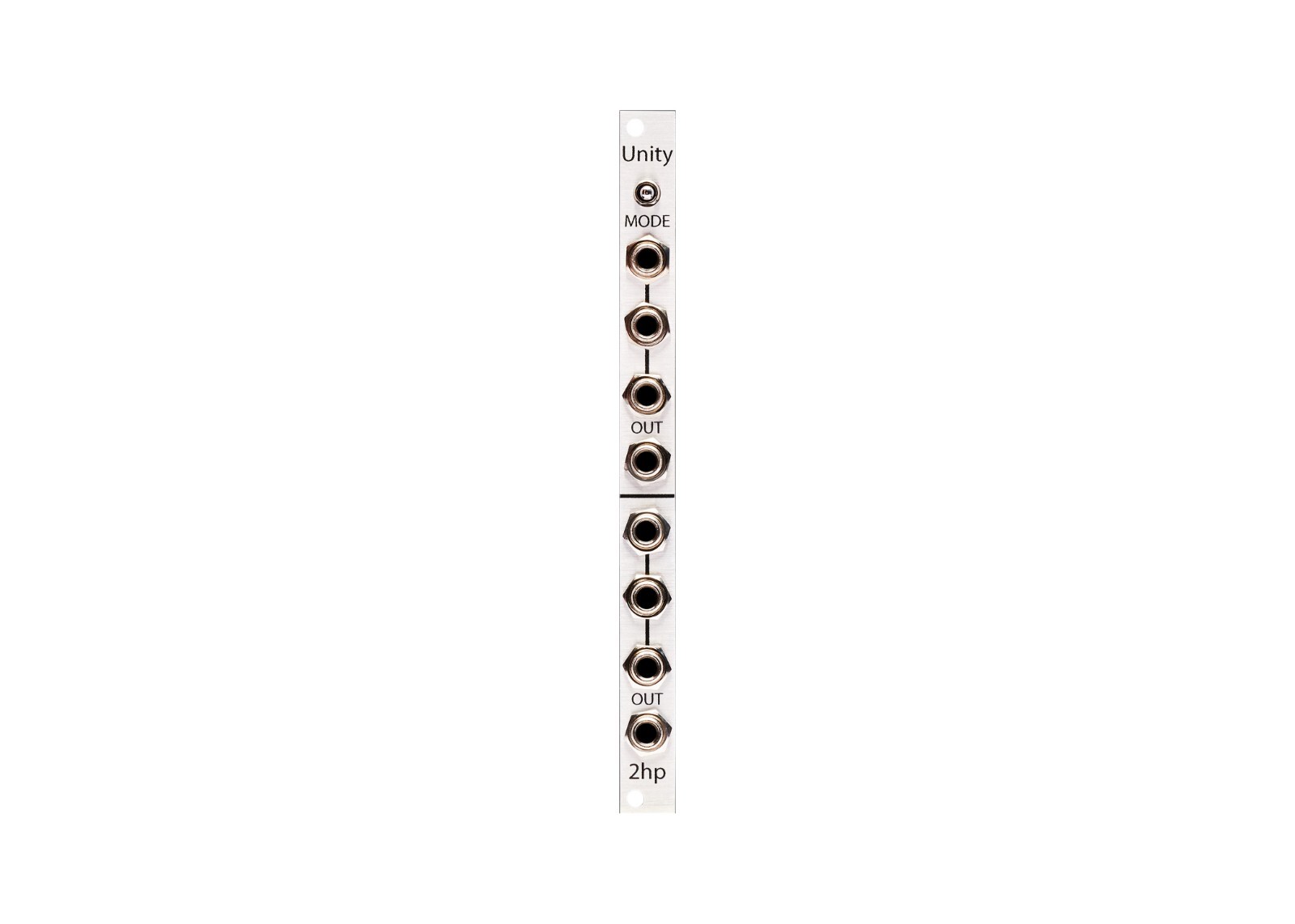
Slip a patch cable into one of the Unity’s six inputs and you’re not just routing a signal—you’re making a decision about how your modular system behaves when things collide. It’s a deceptively simple module: two 3-channel unity mixers in 2HP, capable of morphing into a single 6-in/1-out summing hub thanks to clever normalling. But its real power lies in how it refuses to get in the way. In a format where every millimeter counts, the Unity doesn’t just save space—it earns its real estate by being useful in almost every patch, whether you’re blending three LFOs to modulate a filter cutoff or summing drum triggers before a logic module. It’s not flashy, it doesn’t generate or shape sound dramatically, but try building a rack without one and you’ll feel the absence like a missing kitchen drawer.
What sets the Unity apart from other micro mixers isn’t just its size—it’s the operational modes. Most mixers sum signals and call it a day. The Unity lets you choose how it sums. In Averaging Mode, audio signals maintain their relative levels, so no one voice overpowers the others just because it’s the third one patched in. That’s crucial when you’re layering oscillators or blending effects returns—no sudden volume jumps. Unity Mode, on the other hand, is where control voltages shine: summing CVs without attenuation means vibrato depth adds cleanly, modulation sources stack predictably, and chaotic modulation networks stay coherent (or deliciously incoherent, depending on taste). Then there’s Split Mode, which quietly unlocks a dual personality—one side averaging for audio, the other summing CVs. It’s the kind of flexibility that makes you wonder how you ever patched without it.
And yet, for all its utility, the Unity doesn’t pretend to be more than it is. It’s not a VCA, not a processor, not a performance module. It’s a utility. But in the world of Eurorack, where patching is a language, utilities are the grammar. They’re the commas, the conjunctions, the silent “and” that lets two ideas coexist. The Unity speaks that language fluently. It doesn’t draw attention to itself, but remove it and your patches start to stumble. That’s the hallmark of good design: invisibility through effectiveness.
Specifications
| Manufacturer | 2hp |
| Production Years | 2017– |
| Original Price | $89 |
| Width | 2hp |
| Depth | 39.5 mm |
| Power Consumption +12V | 10 mA |
| Power Consumption -12V | 6 mA |
| Number of Inputs | 6 (two groups of three) |
| Number of Outputs | 2 |
| Function | Dual unity mixer |
| Mixing Modes | Averaging Mode, Unity Mode, Split Mode |
| Normalling | Normalled to function as 6:1 mixer; unpatched inputs allow dual 3:1 operation |
| Unity Gain | Yes |
| Signal Type | Audio and CV capable |
| Color Options | Silver, Black |
Key Features
Averaging Mode: The Quiet Hero of Audio Mixing
Most mixers in Eurorack simply sum voltages—additive, unweighted, and prone to clipping when too many hot signals pile in. The Unity’s Averaging Mode sidesteps this by dividing the sum by the number of active inputs, keeping overall level consistent. That means patching a third oscillator into a mix doesn’t suddenly make the stack twice as loud. It’s a subtle but critical behavior for live performance and complex patches where level stability matters. You don’t need to reach for an attenuator every time you add a voice. It’s not a compressor, it’s not limiting—it’s just math, done right. And because it preserves the balance between sources, it’s ideal for blending similar timbres, like parallel wavefolders or layered noise sources, without one dominating by sheer amplitude.
Unity Mode: Where Control Voltages Multiply
When you’re deep in modulation territory—say, routing three LFOs to a single filter cutoff—Unity Mode is your ally. Unlike averaging, it sums CVs without division, so each input contributes fully. This is essential when you want vibrato depth to scale with the number of modulators, or when combining gate signals to trigger multiple events. It’s also the go-to for chaotic modulation networks, where overlapping envelopes or random voltages create evolving textures. Because there’s no level reduction, the full dynamic range of each source is preserved, letting complex control structures build naturally. It’s the difference between politely sharing a stage and all shouting at once—sometimes, you want the shout.
Split Mode: Two Brains, One Body
Sometimes your rack needs to multitask—mixing audio on one side, CV on the other. Split Mode lets you do exactly that, assigning Averaging to one mixer and Unity to the other. It’s the kind of feature that seems minor until you’re in the middle of a patch and realize you need both behaviors simultaneously. Maybe you’re blending three drum outs while also summing three modulation sources for a wobble effect. Instead of grabbing two separate modules, you use one. That’s 2HP saved, and in Eurorack, that’s a luxury. It’s not just about conserving space—it’s about reducing patch complexity. One module, two jobs, no extra cables snaking across your case.
Historical Context
The Unity arrived in 2017, a time when Eurorack was shifting from boutique curiosity to mainstream staple. Racks were getting denser, more complex, and more expensive. In that climate, 2hp carved a niche by doing less—but doing it perfectly. While other manufacturers chased feature-rich modules with screens, menus, and endless algorithms, 2hp doubled down on minimalism. The Unity wasn’t the first dual mixer in 2HP, but it was one of the first to offer intelligent mode switching in such a compact form. It stood in contrast to the bloated, multi-function modules that dominated the market, proving that utility could be elegant.
At the time, mixers were often afterthoughts—passive components or oversized modules with unnecessary features. The Unity challenged that by making the mixer a dynamic part of the patch. It competed not with other mixers, but with the absence of them. Why dedicate 4HP or 6HP to mixing when two channels could live in the space of a blank panel? It wasn’t trying to beat Intellijel or Doepfer at their own game. It was playing a different one: efficiency, elegance, and restraint. In a format increasingly defined by excess, the Unity was a quiet act of rebellion.
Collectibility & Value
The Unity isn’t a collector’s item in the traditional sense—no limited runs, no exotic finishes, no firmware revisions that change its behavior. It’s a workhorse, and that’s reflected in its value. New units still sell for around $89, and used ones trade between $60 and $75 depending on condition and color. Silver panels sometimes fetch a slight premium from purists who prefer the original aesthetic, but the difference is marginal. Unlike rare or discontinued modules, the Unity remains in production, so there’s no urgency to buy.
That said, its reliability is part of its appeal. There are no moving parts, no trimpots to drift, no firmware to update. Failures are exceedingly rare—documentation and user reports show no recurring hardware issues. The PCB is simple, the components are standard, and the build quality is consistent. If a Unity fails, it’s usually due to a damaged jack or a power supply incident, not a design flaw. That makes it a low-risk purchase, even on the secondhand market.
When buying used, check for bent mounting tabs or cracked faceplates—both possible if the module was forced into a crowded rack. Test all inputs and outputs if possible, though given the simplicity of the circuit, failure is more likely from external damage than internal degradation. Because it draws so little power (10mA on +12V, 6mA on -12V), it’s safe to use on crowded power buses. No need for recalibration, no hidden maintenance costs. It’s about as worry-free as modular gear gets.
eBay Listings
![2HP UNITY SILVER : NEW : [DETROIT MODULAR]](https://i.ebayimg.com/images/g/AFMAAeSwdJNod8Cs/s-l500.jpg)
As an eBay Partner, we earn from qualifying purchases. This helps support our independent vintage technology research.