2hp Trim (2008–Present)
Two channels of passive signal attenuation in a very small footprint. No power needed.
Overview
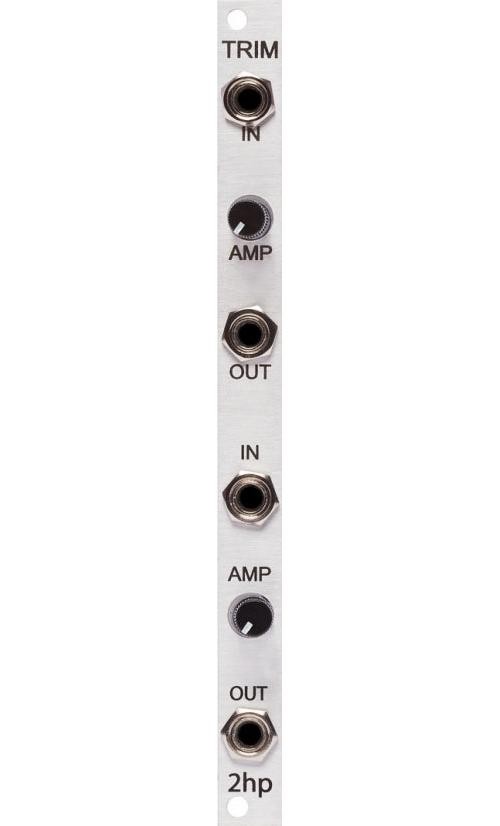
You don't hear the 2hp Trim. You notice it when it's missing. In a Eurorack system full of wild oscillators, unpredictable noise sources, and modulation paths that spiral into chaos, the Trim keeps things in check. It doesn't color the signal, it doesn't amplify, and it doesn't draw power. It's often one of the first modules a builder reaches for when patching gets serious. At just 2hp wide and 15mm deep, it fits into gaps where other modules can't, which makes it a handy utility for skiffs. Two independent attenuators each dial a signal from full strength down to complete silence. That gives you control over audio or CV, such as taming a piercing sine wave, scaling a random voltage for subtle modulation, or balancing levels before a mixer or output stage.
The Trim doesn't do much, but it does that one thing well. It's passive, so there's no active circuitry, no op-amps, and no noise floor to worry about. It's a pair of high-quality potentiometers wired as voltage dividers. What goes in comes out, just quieter. There's no clipping, no distortion (unless your source is already hitting it), and no added artifacts. Owners report using them in pairs, threes, even fives. They go at the end of modulation chains, next to complex processors like Clouds or Warps, or beside VCOs that lack onboard attenuation. It's not glamorous, but in a modular system predictability and reliability count for a lot.
Specifications
| Manufacturer | 2hp |
| Production Years | 2008–Present |
| Original Price | $45 |
| Width | 2hp |
| Height | 3U |
| Depth | 15 mm |
| Power | Passive (No power required) |
| Function | Attenuator |
| Channels | 2 |
| Signal Type | Audio, CV |
| Attenuation Range | Full-scale to infinity (complete signal reduction) |
| Panel Options | Silver, Black |
| Mounting | Standard Eurorack |
| Weight | Approx. 30g |
| Input Impedance | High (passive divider) |
| Output Impedance | Dependent on potentiometer position |
| Current Draw | 0 mA |
| Compatibility | All Eurorack systems |
Key Features
No Power, No Problem
The Trim needs nothing from your power supply. In a format where every milliamp counts and bus boards struggle under power-hungry digital modules, a module that asks for zero current is a real relief. You can install it in the tightest, most power-starved skiff without a second thought. There are no ribbon cables, no reverse power concerns, and no ground loops. Plug in a patch cable and turn the knob. That makes it a good fit for travel systems, DIY cases with limited power, or educational setups.
Skiff-Sized Utility Done Right
At 2hp, the Trim is the smallest standard module width in Eurorack, yet it still fits two fully functional attenuators with usable knobs. Many modules at this size end up with fiddly controls or awkward spacing. Here the knobs are spaced far enough apart to avoid accidental bumps, and the panel layout is clean and intuitive. The module comes in both silver and black anodized aluminum. Its 15mm depth keeps it clear of deeper modules behind it, so it's a favorite for stacking in dense systems.
Universal Signal Taming
It's marketed as an attenuator, but the Trim does more than volume control. It scales CV for subtle parameter shifts, for example reducing an LFO's output to gently modulate filter cutoff without sweeping the entire range. It can act as a manual offset when paired with a constant voltage source, or as a crude but effective way to balance multiple signals before summing. Some users deploy it as a "soft mute" in feedback loops or to prevent runaway modulation in complex patches. Because it's passive, it won't load down sensitive outputs, though care should be taken when driving low-impedance inputs, as the output impedance varies with knob position.
Historical Context
2hp launched the Trim in 2008, when Eurorack was still a niche within a niche, well before the explosion of the 2010s. Most utility modules were bulky, often 4hp or wider, and passive attenuators were frequently overlooked in favor of flashier, feature-rich modules. 2hp was founded by designer Tony Rolando (also behind the Korg Monotron), and its approach was minimalist, simple solutions to everyday patching problems. The Trim, along with the Mult and Mix, formed the backbone of that approach: small, focused modules that did one thing well. While builders were cramming more functions into each hp, 2hp went the opposite direction. Competitors like Intellijel and Doepfer offered attenuators, but none matched the space efficiency of the Trim. It became a quiet standard, the kind of module that shows up in rack photos without fanfare.
Collectibility & Value
The 2hp Trim has never been rare. Production has remained steady since 2008, and its value lies in availability and utility, not scarcity. New units still sell for around $45, unchanged from the original price, which is unusual in a modular world where inflation and demand often push prices up. Used units fetch $30 - $40 depending on condition, with little premium for vintage status, since there's no meaningful difference between a 2009 and a 2023 unit. Failures are uncommon but not unheard of. The main risk is potentiometer wear, especially with frequent use or dirty patch cables. Crackle or dropouts in the signal path usually point to a dirty or failing pot, which can often be cleaned with contact cleaner. Full replacement is straightforward but requires desoldering. There's no firmware and no calibration, so the only wear is mechanical. When buying used, check both channels thoroughly and inspect the jacks for looseness. Given its passive nature, there's little else that can go wrong.
eBay Listings
As an eBay Partner, we earn from qualifying purchases. This helps support our independent vintage technology research.