2hp TM (2012–Present)
A tiny brain for your modular that dreams up melodies you’d never think of—sometimes beautifully, sometimes stubbornly.
Overview
You patch in a clock, twist the probability knob, and suddenly your synth is humming a tune that feels like it came from somewhere else—some half-remembered dream or a glitch in the matrix. That’s the 2hp TM: a sliver of logic in a 4HP panel that generates evolving sequences with a mind of its own. It doesn’t play notes directly, but feeds voltages into your oscillators, filters, or envelopes, nudging your patch toward unpredictability. At its core, it’s a probabilistic step generator—each step in a sequence (1 to 32) gets a random voltage, but how random? That’s where you come in. Turn the probability down, and only a few steps change each cycle; crank it up, and the whole pattern melts into chaos. It’s not a full Turing Machine in the computational sense, but it borrows the spirit—simple rules spawning complex behavior.
And it does it all in the width of a credit card. 4HP is absurdly narrow, even by Eurorack standards, making the TM a favorite for skiff builders and minimalists who count every millimeter. But don’t mistake its size for simplicity. The module’s charm lies in how it walks the line between control and surrender. You set the boundaries—sequence length, voltage range, how often things change—but the actual output? That’s left to chance. It’s like giving a toddler a paintbrush and a canvas: you provide the materials, but the masterpiece (or mess) is theirs. Musicians use it for drifting basslines, unpredictable arpeggios, or as a compositional spark when inspiration stalls. It won’t replace your sequencer, but it’ll haunt it—adding subtle mutations that keep a loop from getting stale.
Specifications
| Manufacturer | 2hp |
| Production Years | 2012–Present |
| Original Price | $109 |
| Module Width | 4HP |
| Depth | 45mm |
| Current Draw +12V | 23 mA |
| Current Draw -12V | 7 mA |
| Current Draw 5V | 0 mA |
| Polyphony | Monophonic (stepped voltage output) |
| Sequence Length | 1–32 steps |
| Probability Control | Adjustable from 0% (locked) to 100% (fully random) |
| Amplitude Control | Adjusts range of random voltage per step |
| Outputs | 1x CV (random stepped voltage) |
| Inputs | 1x Clock, 1x Reset (optional) |
| MIDI | No |
| Quantizer Integration | External (output typically patched to quantizer) |
| Weight | Approx. 50g |
| Construction | PCB with aluminum front panel |
| Color Options | Silver, Black |
Key Features
The Probability Knob: Your Lever on Chaos
More than just an on/off switch for randomness, the probability knob is the soul of the TM. At minimum, it locks the sequence—every step holds its voltage, turning the module into a static 1–32 step sequencer. As you turn it up, steps begin to refresh randomly with each clock pulse. But it’s not all-or-nothing: even at high settings, some steps may stay the same while others flip, creating a sense of partial evolution. This is where the TM shines in musical contexts—imagine a bassline that shifts one note every few bars, just enough to keep the ear guessing. It’s not generative in the AI sense, but it feels alive because it resists repetition without abandoning structure.
Compact Design, Big Patching Impact
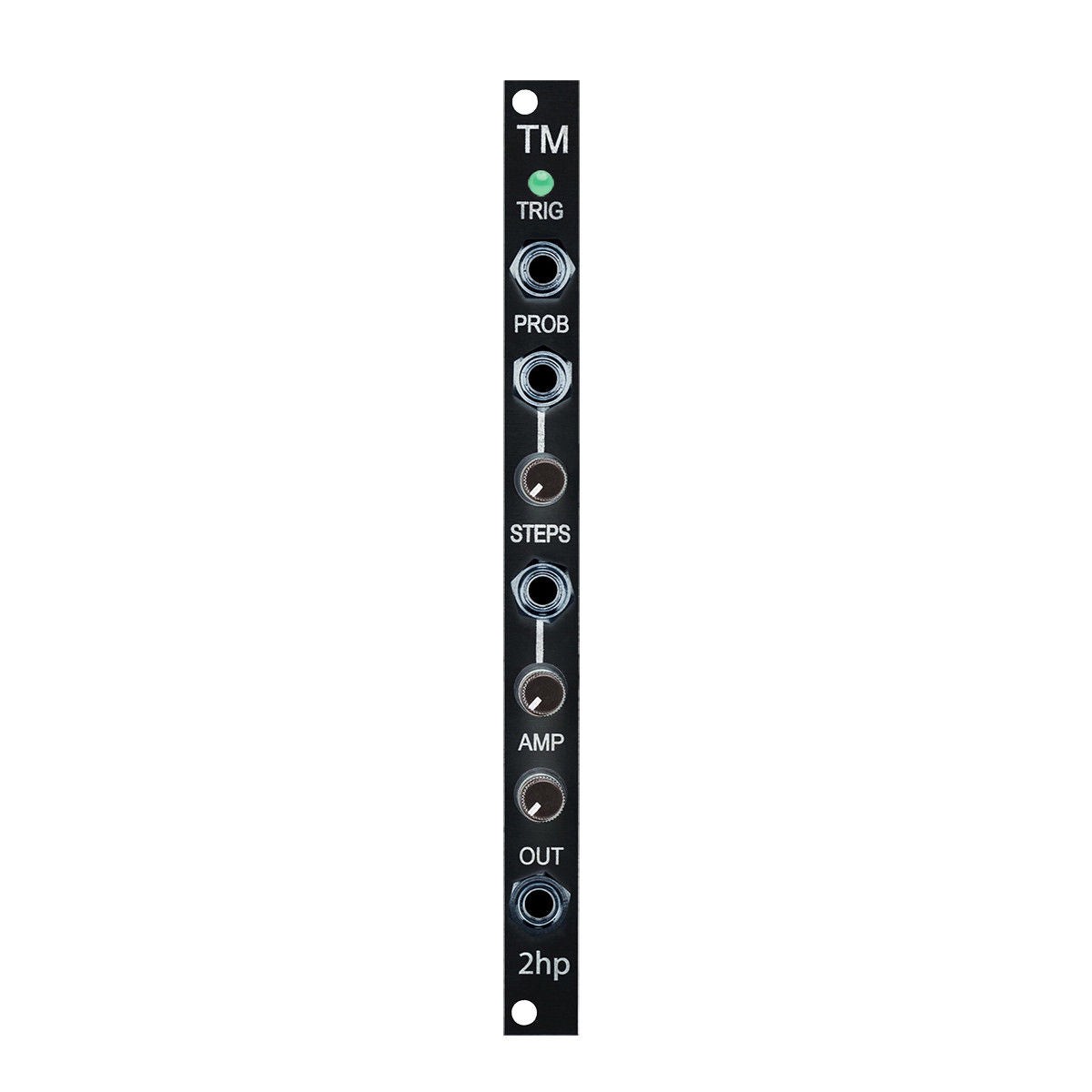
At 4HP, the TM is one of the narrowest modules in Eurorack, a triumph of minimalist engineering. It doesn’t even need a 5V rail, drawing only from ±12V, which helps in power-constrained systems. The front panel is clean—just three knobs (probability, length, amplitude) and three jacks (clock, reset, CV out). There’s no display, no menu diving, no firmware updates. What you see is what you get, and that’s part of its appeal. But that simplicity comes with a trade-off: you can’t see the sequence, only hear it. Debugging a wonky pattern means ear training or patching the CV out to a scope or comparator. For some, that’s part of the fun. For others, it’s a black box that occasionally spits out a -5V spike when you weren’t looking.
Deterministic Randomness: The Hidden Limit
Despite its name and conceptual roots in Alan Turing’s work, the TM doesn’t use true analog noise. Instead, it runs on an Atmel microcontroller with a pseudorandom number generator (PRNG). That means the sequence, while seemingly endless, will eventually repeat—though likely after days or weeks of continuous clocking. For live performance or studio use, this isn’t an issue; the cycle is long enough that no human would notice. But purists who prize true unpredictability—like those using Make Noise’s René or the original Turing Machine by Random*Source—might find this a philosophical flaw. It’s not sampling transistor hiss or cosmic noise; it’s an algorithm, elegant but finite. Still, for 99% of users, it’s random enough, and the predictability of the PRNG can actually help with repeatability in compositions.
Historical Context
The 2hp TM arrived in 2012, right as Eurorack was shifting from boutique curiosity to widespread adoption. At the time, modules were getting bigger, more complex, and more expensive—multi-function oscillators, digital wavetable beasts, sequencers with OLED screens. The TM was a counterpoint: a return to minimalism, inspired by early computer music and algorithmic composition. It drew clear lineage from the Turing Machine concept popularized by electronic musician and engineer Robin Whittle in the 1990s, which used analog shift registers and noise sources to create evolving sequences. But 2hp’s version was digital, compact, and affordable—$109 put it within reach of almost any modular user. It wasn’t the first random sequencer, but it was the first to fit in 4HP and still offer meaningful control. Competitors like ALM’s Pam’s New Workout offered more features but took up eight times the space. The TM carved out a niche as the “pocket philosopher” of Eurorack—small, deep, and a little mysterious.
Collectibility & Value
The TM has never been rare—2hp has kept it in steady production since 2012—but it’s also never lost relevance. Used units typically sell for $75–$90, depending on condition and color. Black panels sometimes fetch a slight premium from collectors who like the stealthy look, but silver remains the most common. Because it’s a simple digital module with no moving parts, failure rates are low. The most common issue is cold solder joints on the power pins, especially in early units, but these are easy to fix with a reflow. The microcontroller itself is robust, and there are no known firmware bugs that affect operation. Unlike analog modules that drift or need calibration, the TM either works or doesn’t—there’s no in-between. That reliability makes it a favorite for touring musicians who need something that won’t fail mid-set. That said, it’s not a “grail” module. It won’t appreciate in value, and you won’t find people scalping it. But it’s a keeper: once you’ve used it, you’ll find excuses to patch it in, even when you don’t “need” randomness. It’s the kind of module that changes how you think about composition—not by doing everything, but by doing one thing just well enough to matter.
eBay Listings
As an eBay Partner, we earn from qualifying purchases. This helps support our independent vintage technology research.