2HP Snare (2010s)
A snare that doesn’t just crack—it sings, snaps, and snarls through a single knob and a volt of imagination.
Overview
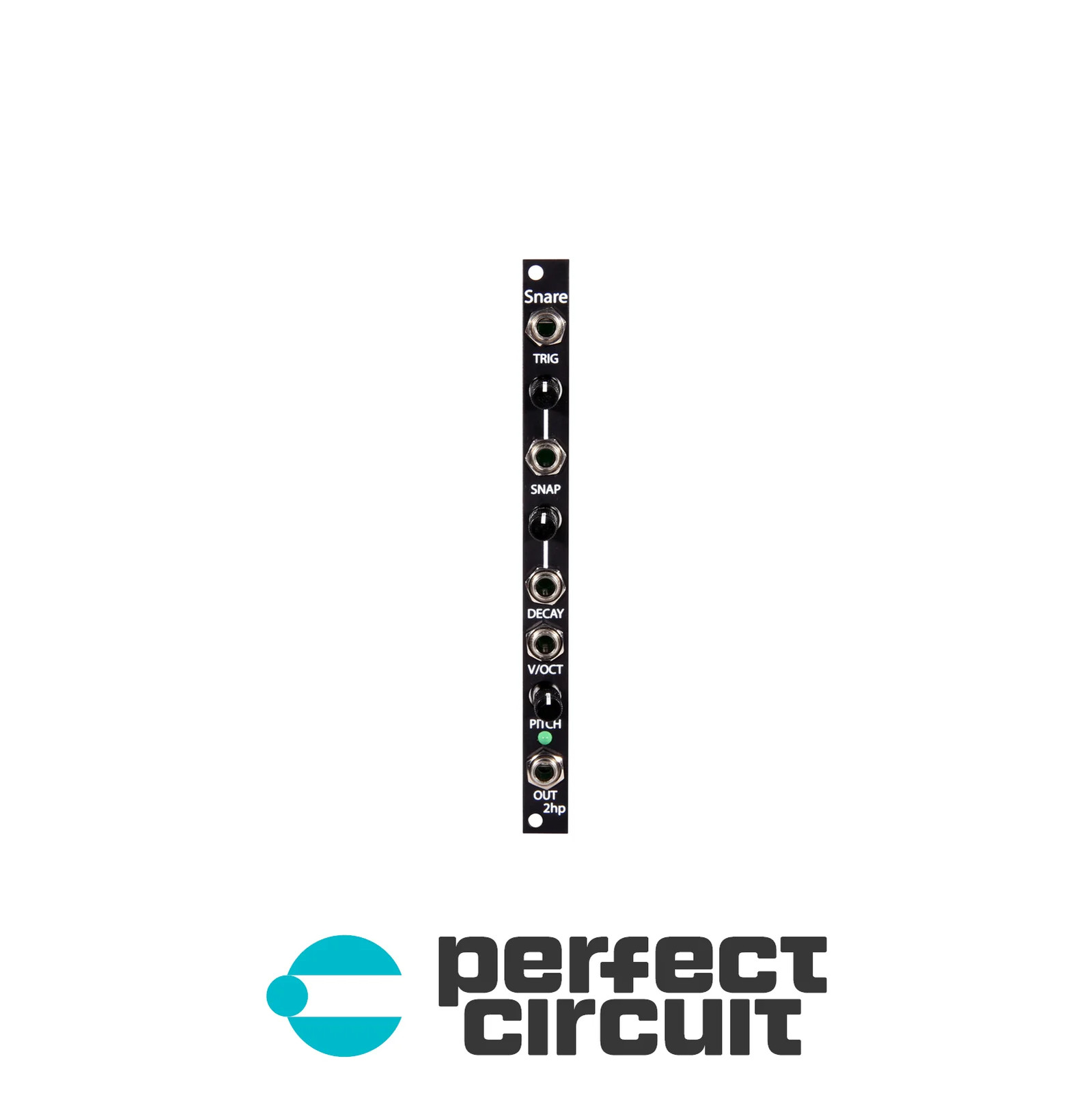
You patch in a trigger, twist the Snap knob, and suddenly you're not just building a beat—you're dissecting the soul of a snare hit. The 2HP Snare doesn’t mimic drums so much as it rewrites what a snare could be: a short blip, a metallic rattle, a deep 909 thwack, or a resonant wash that lingers like smoke. It lives in that sweet spot where minimalism meets obsession—two horizontal knobs on a sliver of aluminum, doing more with less than almost any other drum module in Eurorack. And at just 2HP wide, it’s not just compact; it’s a statement. This isn’t a module that takes up space. It earns it.
What makes the Snare so disarmingly effective is how it refuses to be boxed in. It’s not pretending to be a sampled acoustic kit, nor does it lean into the overprocessed digital realm. Instead, it’s an analog beast with a voice that’s both familiar and alien. Turn Snap all the way down and you get a tight, almost electronic tick—perfect for glitchy IDM rhythms. Crank it up and the tone opens into a bright, snappy crack that can cut through any mix. But the real magic happens when you start modulating it. With full CV control over both pitch and envelope parameters, this module doesn’t just play snares—it performs them. You can sequence it melodically via 1V/Oct tracking, making it sing chromatic rolls or stutter through rhythmic glissandos. It’s percussive, yes, but it’s also musical in a way few dedicated drum modules ever manage.
Despite its size, the Snare doesn’t feel like a compromise. It doesn’t skimp on character to save panel real estate. If anything, the constraints seem to sharpen its focus. There’s no menu diving, no hidden modes, no firmware updates—just two knobs, three jacks, and a sound engine that punches far above its weight. It’s the kind of module you forget is there until someone asks, “Wait, what *is* that snare?” and you realize you’ve been underplaying a gem.
Specifications
| Manufacturer | 2HP |
| Production Years | 2010s |
| Original Price | $139 |
| Width | 2HP |
| Depth | 45mm |
| Power | +12V: 75mA, -12V: 3mA, 5V: 0mA |
| Inputs | Trigger, 1V/Oct, Snap CV, Decay CV |
| Outputs | Snare |
| Control Interface | Rotary knob (Snap), Rotary knob (Decay) |
| Color Options | Silver, Black |
| Material | Aluminum panel |
| Mounting | Standard Eurorack 3U |
Key Features
The Snap Knob That Does Everything
The Snap knob is the heart of the module, and it’s doing double, maybe triple duty. On the surface, it controls the “tightness” or “brightness” of the snare tone—but in practice, it’s shaping the entire character of the sound. Turn it low and the attack is sharp and dry, like a finger snap recorded in a closet. Push it higher and the tone blooms into something more resonant, with a metallic ring that evokes a tightly tuned drum or even a distorted noise burst. But here’s the twist: because the module uses analog synthesis to generate the snare, the knob isn’t just filtering a sample—it’s altering the behavior of the sound-generating circuit itself. That means the change isn’t linear or predictable. It’s organic, slightly unstable, and full of character. And because Snap has a CV input, you can modulate this transformation in real time—say, with an LFO to make the snare “breathe” or with a sequencer to shift its timbre with each hit.
1V/Oct Tracking: A Melodic Percussionist
Most drum modules treat pitch as an afterthought, if at all. The 2HP Snare treats it as a first-class citizen. With proper 1V/Oct tracking, it can play discrete notes across a range, turning what should be a static hit into a tunable event. This opens up compositional possibilities that go far beyond rhythm. Imagine a snare roll that ascends chromatically, or a breakbeat where each snare hit lands on a different note of a minor scale. It won’t track like a precision oscillator—there’s some wavering at the extremes—but within a usable range, it’s remarkably musical. And because the pitch affects not just the fundamental tone but the resonance and decay behavior, every note feels distinct, not just higher or lower.
Minimalist by Design, Maximalist in Practice
The module’s physical design is ruthlessly efficient: two knobs, three inputs, one output, all on a 2HP panel. There are no buttons, no displays, no hidden functions. And yet, the number of sounds it can produce feels almost infinite. This isn’t due to complexity—it’s due to the way its simple controls interact. The Decay knob doesn’t just lengthen the tail; it changes how the Snap parameter behaves. A long decay with low snap gives you a soft, ambient thud. The same decay with high snap turns into a ringing metallic decay that could pass for a cymbal. Patch in random voltages to either CV input and the module starts generating evolving textures that feel more like granular synthesis than percussion. It’s a masterclass in how constraints can breed creativity.
Historical Context
The 2HP Snare arrived during the early explosion of Eurorack modular synthesis in the 2010s, a time when the format was shifting from boutique curiosity to mainstream adoption. At that moment, most drum modules were either bulky, sample-based units or overly complex digital engines. 2HP, founded by engineer and designer Tony Rolando, took the opposite approach: make something small, affordable, and sonically distinct. The Snare, along with its siblings Kick and Hat, formed a trilogy of ultra-compact drum modules that proved you didn’t need a full rack to make compelling rhythms.
It wasn’t the first analog drum voice in Eurorack, but it was one of the first to embrace minimalism as a virtue. While competitors were adding screens, multiple waveforms, and onboard sequencers, 2HP stripped everything back to the essentials. The result was a module that didn’t just save space—it redefined what a drum module could be. It appealed to minimalists, experimentalists, and anyone tired of bloated interfaces. In a market increasingly dominated by feature-rich modules, the Snare stood out by doing less, but doing it with more character.
Its closest competitors at the time were modules like the Doepfer A-110-3 Percussion Oscillator or the Make Noise Mimeophon (in spring mode), but neither offered the same combination of tracking, CV control, and compactness. The Snare carved out its own niche: not a full drum machine, not a sound designer’s playground, but a focused tool that rewarded deep engagement.
Collectibility & Value
The 2HP Snare has held its value remarkably well, considering its original $139 price and simple construction. New units still sell for around $130–$150, while used ones typically go for $90–$120 depending on condition. Given its all-metal build and lack of moving parts beyond the potentiometers, it’s a durable module—failures are rare, but not unheard of. The most common issue reported by technicians is crackling in the knobs, usually due to dust or wear in the potentiometers. Since the module uses standard Alps-style pots, replacements are straightforward, but cleaning them with contact cleaner often resolves the issue without disassembly.
There are no known design flaws or systemic failures—no cold solder joints, no failing ICs, no power-related quirks. The module draws minimal current and doesn’t generate much heat, making it a safe addition to any system. Because it doesn’t use the +5V rail, it’s also compatible with older or non-standard power supplies that lack that voltage.
For collectors, the Snare isn’t a “holy grail” in the way a vintage Roland drum machine might be, but it’s considered a modern classic. Its significance lies in its influence: it proved that small modules could be sonically powerful, paving the way for an entire generation of 1HP and 2HP utilities and sound sources. The black and silver panel options are functionally identical, though some users prefer the stealth look of the black version. Neither is significantly rarer than the other.
If you’re buying used, check for bent mounting ears and test both CV inputs for smooth response. Patch in a sequencer to verify 1V/Oct tracking across a few octaves—some units may drift at the extremes, but consistent semitone steps should be clear. Also, listen for any background noise or hum, which could indicate a grounding issue, though this is uncommon.
eBay Listings


As an eBay Partner, we earn from qualifying purchases. This helps support our independent vintage technology research.