2hp Seq (2010–2020s)
A sequencer the size of a matchbox that somehow holds an entire song inside.
Overview
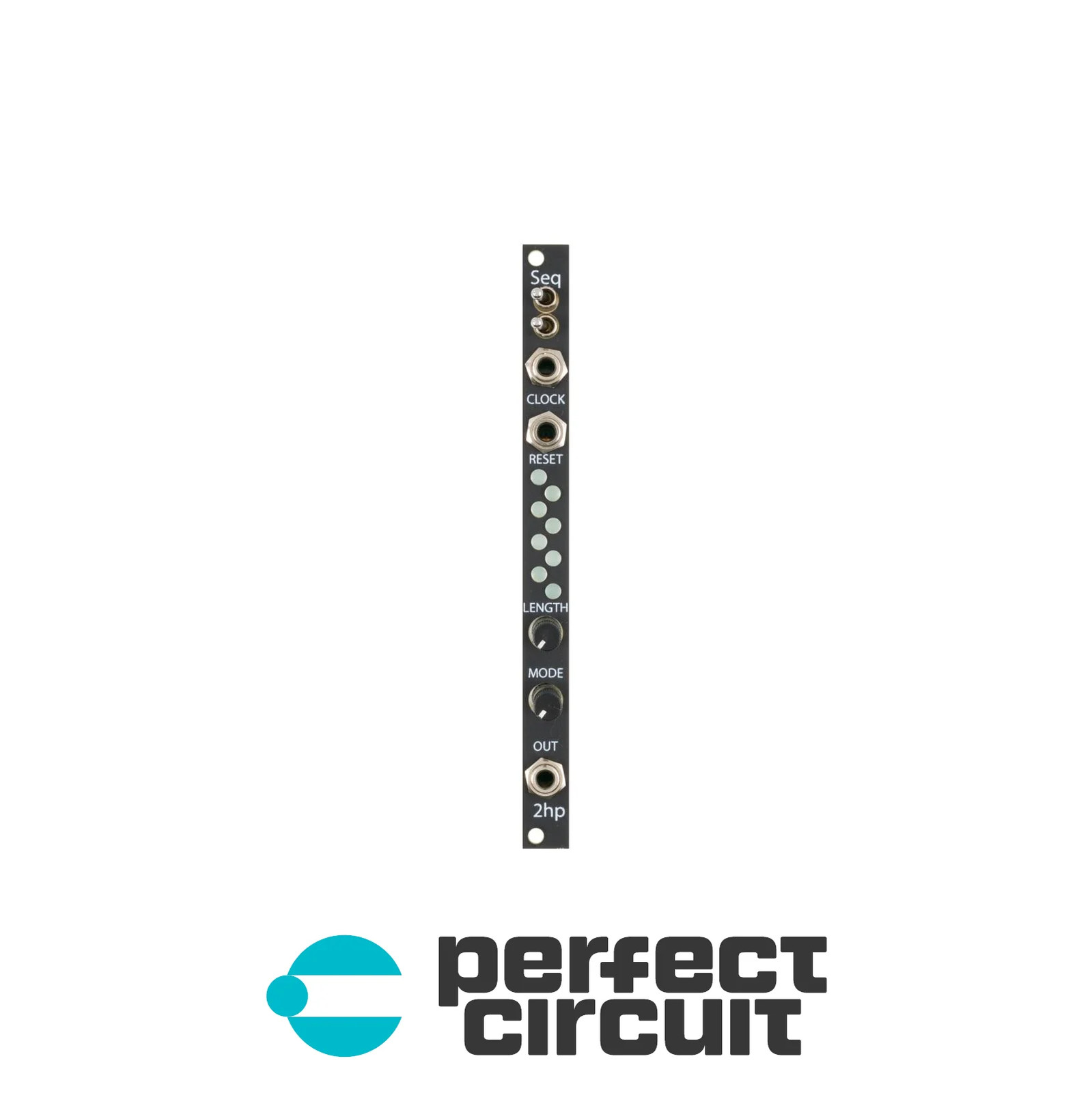
Slide the 2hp Seq into your Eurorack case and you might wonder if you’ve been pranked. It’s barely wider than a power cable—just two horizontal units, the narrowest form factor in the format—and yet it manages to pack in a full 16-step melodic sequencer with memory, quantization, portamento, and multiple playback modes. There’s no screen, no endless menus, no touchscreen gimmicks. Just eight tiny knobs, a row of LEDs, and a logic that feels less like programming and more like tuning a tiny mechanical brain. You turn a knob, a light blinks, a voltage shifts—and suddenly your oscillator is playing a perfect minor pentatonic scale, gliding between notes like a theremin at dawn.
The genius of the Seq isn’t just its size; it’s how it reframes what a sequencer should do. While other modules chase complexity—randomization, probabilistic triggers, MIDI-to-CV translation, polyphony—the Seq strips everything back to the essentials: pitch, timing, and motion. It’s a melodic sequencer first, designed to drive oscillators, but just as useful for modulating filter cutoffs, LFO rates, or even panning. The output is unipolar CV, 0–8V, quantized or not, with gate output on the side. You can set the sequence length anywhere from 1 to 16 steps, switch between forward, reverse, pendulum, or random playback, and dial in portamento with a smooth analog glide that feels organic, not digital. It’s not a rhythm machine, not a drum sequencer—this is for melodies, basslines, and evolving leads that need to breathe.
What really sets it apart is the tuning interface. Eight preset scales—major, minor, chromatic, pentatonic, whole tone, and others—let you lock into musicality instantly. No more hunting for the right intervals; just select the scale, tune the root, and every step snaps to the correct pitch. It’s the kind of feature that seems minor until you’re deep in a patch and realize you’re not fighting dissonance anymore. And unlike many early Eurorack sequencers, the Seq remembers your settings when powered down. No retuning every time you reboot your case. That alone makes it a keeper in a world where “save state” was once a luxury.
Specifications
| Manufacturer | 2hp |
| Production Years | 2010–2020s |
| Original Price | $124 |
| Module Width | 2 HP |
| Depth | 45 mm |
| Power Consumption | +12V: 54 mA, -12V: 3 mA |
| CV Output Range | 0–8V |
| Gate Output | 5V |
| Sequence Length | 1–16 steps (adjustable) |
| Playback Modes | Forward, Reverse, Pendulum, Random |
| Portamento | Variable (analog) |
| Quantization | Quantized or unquantized output |
| Preset Scales | 8 (including major, minor, pentatonic, chromatic, whole tone) |
| Tuning Interface | Root note and scale selection |
| Memory | Saves pitch values and settings between power cycles |
| Display | 8 LED indicators for step and parameter feedback |
| Inputs | Clock, Reset, CV In (for external pitch control) |
| Outputs | CV Out, Gate Out |
Key Features
Scale-Based Quantization for Instant Musicality
Most sequencers from this era either quantized to chromatic or left you to tune by ear. The 2hp Seq sidesteps both with eight built-in scales, selectable via a hidden menu accessed by holding a button while powering on. Once a scale is chosen, every step locks to that tonality. Want a blues run? Pick minor pentatonic. Going modal? Switch to Dorian. It’s not just convenient—it changes how you compose. Instead of thinking in voltages, you think in keys and modes, and the module does the math. This is especially powerful when jamming live; you can shift the root on the fly and the whole sequence stays in tune. It’s like having a tiny harmonica that never plays a wrong note.
Portamento That Feels Alive
The glide control isn’t just a smoothing filter—it’s an expressive tool. Turn it up and notes smear into each other like wet paint, creating synth leads that breathe and swell. Unlike digital portamento that steps in discrete jumps, the Seq’s analog glide feels continuous, almost vocal. It works beautifully with slow sequences, where the transition between notes becomes part of the melody. Pair it with a resonant filter and you’ve got something close to a human voice sighing through a wire. And because it’s voltage-controlled, you can modulate the glide time with an LFO or envelope for evolving textures.
Memory That Actually Works
In the early 2010s, many Eurorack modules reset to default on power-up. The Seq didn’t play that game. It saves your sequence, scale, root note, and portamento setting even when unplugged. That might sound trivial now, but back then, it was a quiet revolution. No more scribbling down knob positions or rebuilding patches from scratch. You could leave a sequence running overnight, power down your case, and pick up exactly where you left off. For live performers and studio tinkerers alike, that reliability was a game-changer.
Historical Context
The 2hp Seq arrived in 2010, right as Eurorack was shifting from boutique curiosity to mainstream modular revival. Doepfer, Make Noise, and Intellijel were expanding their lines, but most sequencers were either wide, complex beasts like the Makenoise René or minimal gate generators with no pitch control. The Seq carved a niche by being ruthlessly focused: a compact, affordable, melodic sequencer that didn’t sacrifice usability for size. It wasn’t the first 2HP module—2hp had already proven the concept with the TM and Q—but it was the first to deliver full musical sequencing in that footprint.
Its closest competitors were modules like the Erica Pico Sequencer (released later) and the Doepfer A-155, both wider and more expensive. The Seq’s brilliance was in its constraints: by limiting polyphony to monophonic operation and skipping MIDI entirely, it avoided bloat. It wasn’t trying to be everything; it was trying to be excellent at one thing. That philosophy resonated with a generation of modular users who valued elegance over excess. It also helped define 2hp’s brand identity—minimalist design, maximum utility, no wasted space.
Collectibility & Value
The 2hp Seq trades between $150 and $220 on the used market, depending on condition and finish (black or silver). It’s not a rare module, but it’s not common enough to be disposable—most cases that have one tend to keep it. The build quality is solid: aluminum faceplate, sturdy knobs, and a simple PCB layout that rarely fails. There are no known catastrophic failure points. The most common issue is LED dimming over time, but that’s cosmetic. No electrolytic capacitors to dry out, no power regulation to fry—just a clean, low-draw design that plays nice with any power supply.
When buying used, check that the scale selection menu works (hold the reset button while powering on) and that the CV output tracks accurately across the full 8V range. Some early units had slight calibration drift, but it’s easily corrected with a trimmer inside. Also verify that the portamento glide is smooth and not stepped—signs of a faulty op-amp are rare but possible. Otherwise, it’s a “buy with confidence” module. No need for recap, no firmware updates, no hidden flaws. It’s one of the few Eurorack modules that feels like it was engineered to last.
Its value lies in its utility. Unlike flashy modules that gather dust, the Seq gets used. It’s the kind of thing you install once and never remove. Owners report using it for basslines, drone generators, filter sequencers, and even as a control voltage source for non-musical modulation. Its small size means it doesn’t block adjacent modules, and its low power draw won’t strain your bus board. In a world of ever-wider modules, the Seq remains a masterclass in efficiency.
eBay Listings



As an eBay Partner, we earn from qualifying purchases. This helps support our independent vintage technology research.