2hp S+H (2010–)
Two channels of analog voltage capture, packed into the smallest footprint you can plug into a Eurorack bus.
Overview
It’s the module that barely takes up space—but punches way above its weight in utility. Slot the 2hp S+H into a forgotten sliver of your rack, and suddenly you’ve got a dual-channel analog sample and hold ready to inject chaos, structure, or surprise into your patches. It doesn’t try to be flashy: no displays, no menus, no firmware updates. Just two independent circuits that grab a voltage when triggered and hold it steady—well, as steady as analog can manage—until the next clock. You’ll use it to randomize filter cutoffs with white noise, freeze arpeggiated sequences into stuttering staircases, or downsample audio-rate signals into gritty, stepped artifacts that feel like digital decay before the digital even arrived.
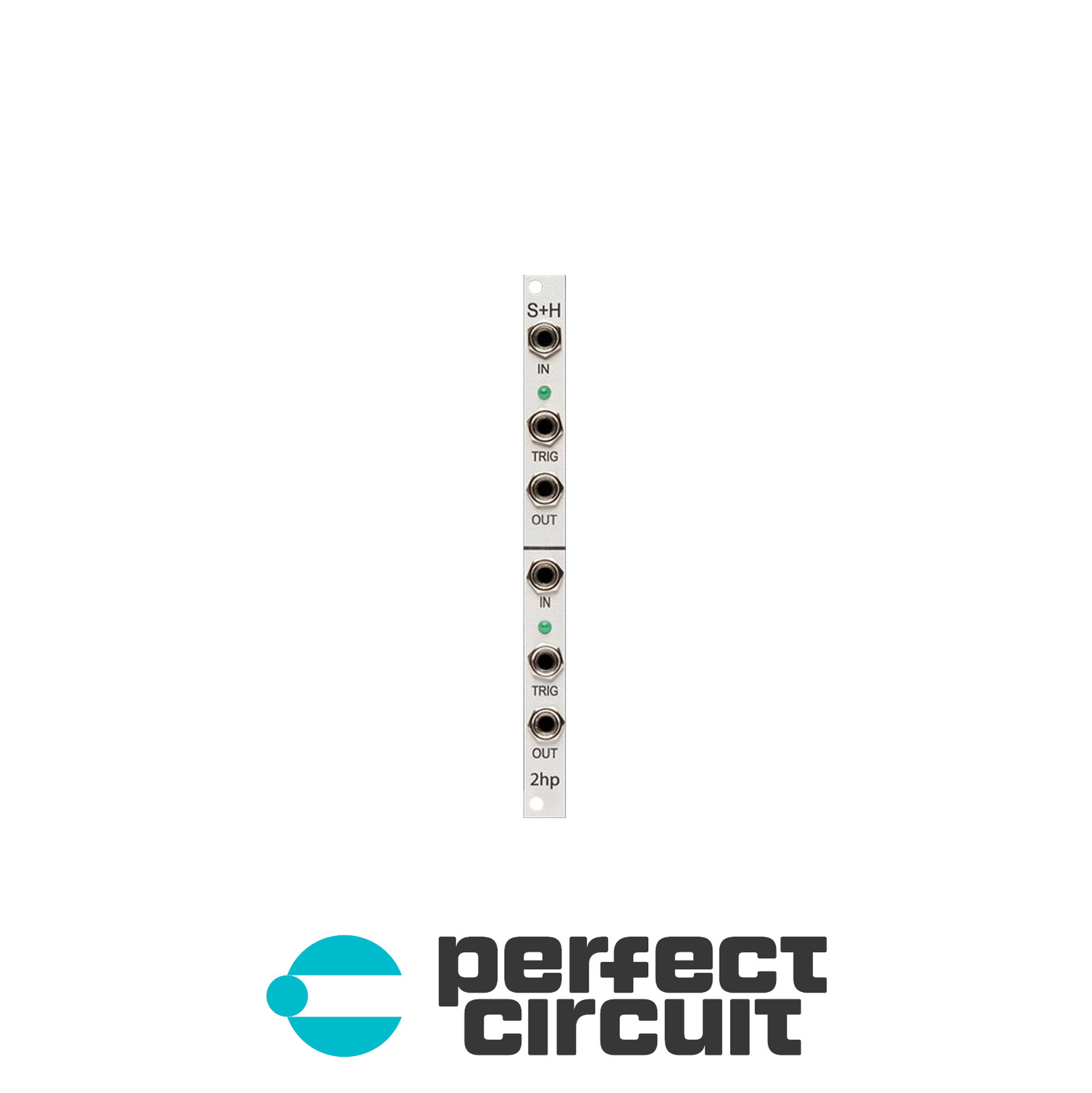
Despite its minimalism, the S+H is no afterthought. It’s a deliberate piece of circuitry built for Eurorack’s tightest spaces, where every millimeter counts. The dual channels aren’t just clones; they’re siblings with shared DNA but independent lives—each with its own signal input, trigger input, and output. Patch them separately, or gang them together for stereo voltage manipulation. The input range is generous: ±12V, so it can handle not just control voltages but full audio signals without clipping. That means you can clock it fast enough to sample incoming audio, turning smooth waveforms into jagged, bit-crushed textures—perfect for glitchy transitions or rhythmic gating that feels organic but unpredictable.
What it doesn’t do is promise lab-grade precision. This is analog sample and hold, not a digital converter. There’s droop—inevitable voltage sag over time as the holding capacitor leaks. If you’re using it to capture pitch CVs for more than a few seconds, you’ll hear the note drift slightly downward. That’s not a flaw; it’s character. Some users fight it with quantizers downstream. Others lean in, letting the slow decay become part of the composition. The module doesn’t pretend to be a tuning machine. It’s a texture generator, a chaos agent, a utility that rewards experimentation more than exactitude.
Specifications
| Manufacturer | 2hp |
| Production Years | 2010– |
| Original Price | $89 |
| Width | 2hp |
| Depth | 45mm |
| Power Consumption +12V | 5 mA |
| Power Consumption -12V | 5 mA |
| Power Consumption 5V | 0 mA |
| Channels | 2 |
| Function | Analog Sample and Hold |
| Input Voltage Range | ±12V |
| Signal Inputs | 2 (one per channel) |
| Trigger Inputs | 2 (one per channel) |
| Outputs | 2 (one per channel) |
| Color Options | Silver, Black |
| Manual Availability | Available online |
Key Features
Analog Capture with Character
The heart of the S+H is its analog sample and hold circuitry—simple in theory, rich in behavior. When a trigger hits, a switch closes, charging a capacitor to the instantaneous voltage of the input signal. That voltage is then buffered and sent to the output, where it stays—ideally—until the next trigger. But analog isn’t ideal. The capacitor leaks. The op-amps aren’t perfect. The result? A slow voltage droop, usually in the millivolt-per-second range. Some users see this as a limitation. Others hear it as warmth—a subtle downward glide that makes randomized sequences feel more organic, like a tape loop slowly losing tension. It’s not the module for pinning down exact 1V/oct pitches over long durations, but it’s perfect for moments where imperfection adds life.
Dual Independent Channels
Two channels in 2hp isn’t just a space-saving gimmick—it’s a design philosophy. You can run them in parallel, feeding the same source into both and triggering them together for stereo voltage output. Or use them independently: one capturing noise for filter modulation, the other freezing an LFO to control panning. The independence means no crosstalk, no shared resources—just two clean, isolated circuits sharing only power and physical space. This makes the S+H unusually flexible for such a narrow module. It can act as two utility tools at once, or combine forces for more complex modulation routing. No jumpers, no internal switches—just patch cables and intention.
Audio-Rate Sampling Capability
Most sample and holds live in the world of control voltages—slow, smooth changes that modulate filters or pitch. The 2hp S+H, however, can keep up with audio signals. Feed it a sine wave and clock it at audio rates, and it will output a stepped approximation of that waveform. The result isn’t high-fidelity—it’s lo-fi, crunchy, and full of artifacts—but that’s the point. It transforms smooth audio into something granular and rhythmic, perfect for creating stutter effects, pseudo-bit reduction, or rhythmic gating without external sequencers. Clock it with a fast LFO or a divided-down audio signal, and you’ve got a real-time resampling engine that feels more like circuit bending than synthesis.
Historical Context
When 2hp launched the S+H around 2010, Eurorack was still in its adolescence—growing fast, but far from the sprawling ecosystem it is today. Racks were smaller, budgets tighter, and module width was a real concern. The idea of a 2hp-wide dual sample and hold wasn’t just novel; it was borderline radical. Most S&H modules at the time were 4hp or wider, often bundled with other functions like noise sources or logic. 2hp’s entire brand philosophy—minimalist, no-frills, space-efficient—was built around the idea that utility shouldn’t take up real estate. The S+H embodied that: pure function, stripped of everything but the essentials.
It arrived alongside a wave of ultra-compact modules from builders like Intellijel and Doepfer, but 2hp stood out by making *everything* 2hp. No exceptions. That consistency created a niche: users with leftover gaps in their cases could fill them with functional modules instead of blank panels. The S+H wasn’t the first sample and hold, but it was one of the first to make the function feel like a modular accessory—something you could add almost as an afterthought, yet still get serious use from. It didn’t compete with high-end, precision S&Hs like the Doepfer A-184-1 or the Mutable Instruments Stages. Instead, it offered a fast, compact, characterful alternative for users who valued speed and space over laboratory accuracy.
Collectibility & Value
The 2hp S+H has never been rare—production has remained steady since its debut—but it’s consistently in demand. Used units sell for $60–$80 depending on condition, while new ones still list at $89. There’s no significant price inflation, which speaks to both availability and the module’s role as a utility rather than a collector’s item. That said, it’s a staple in many skiff builds and travel cases, where space efficiency is non-negotiable. If you’re buying used, check for bent pins or damaged jacks—its compact size makes it vulnerable during insertion and removal, especially in crowded rows. The PCB is simple, with few failure points, but the power pins can stress over time if the module is frequently unplugged.
There are no known firmware issues (it has none) or common circuit failures beyond standard capacitor aging. After a decade or more of use, some units may exhibit increased droop due to capacitor degradation, but this is easily remedied with a recap—though few bother, given the module’s low cost and the fact that droop is already part of its sonic identity. For those using it in critical pitch applications, pairing it with a quantizer (like the Intellijel Quadrax or MakeNoise René) is common practice. But most users accept its analog quirks as part of the charm. It’s not a precision instrument. It’s a spark plug for creative patches—small, reliable, and always ready to surprise.
eBay Listings



As an eBay Partner, we earn from qualifying purchases. This helps support our independent vintage technology research.