2hp Reverb (2014–2023)
Two HP of digital shimmer that fits in the crack between your oscillators—and somehow still sounds like a real space.
Overview
You don’t expect much from a sliver of a module that takes up less space than a patch cable. But plug a signal into the 2hp Reverb and you’re immediately confronted with a paradox: how can something so small conjure such a wide, believable sense of space? It doesn’t try to be everything—no endless presets, no granular washes or glitchy stutters—but what it does, it does with quiet confidence. The reverb tail blooms naturally, from tight room reflections to cathedral-sized decays, and while it won’t fool anyone into thinking they’re in Vienna’s Musikverein, it lands somewhere honest: a padded studio, a tiled stairwell, a half-empty church on a Tuesday afternoon. It’s the kind of effect you don’t notice until it’s gone, and then you realize your whole patch feels claustrophobic.
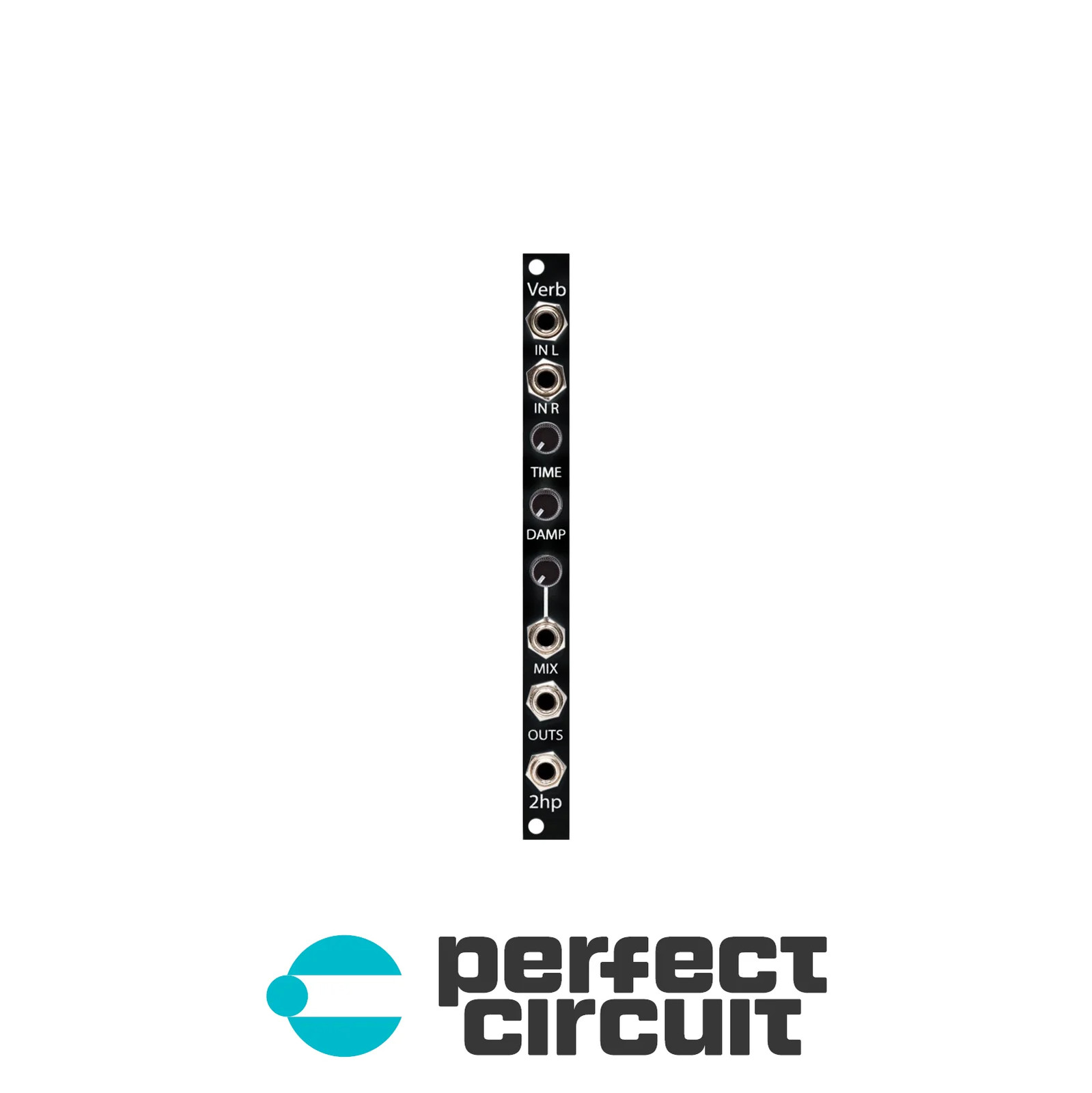
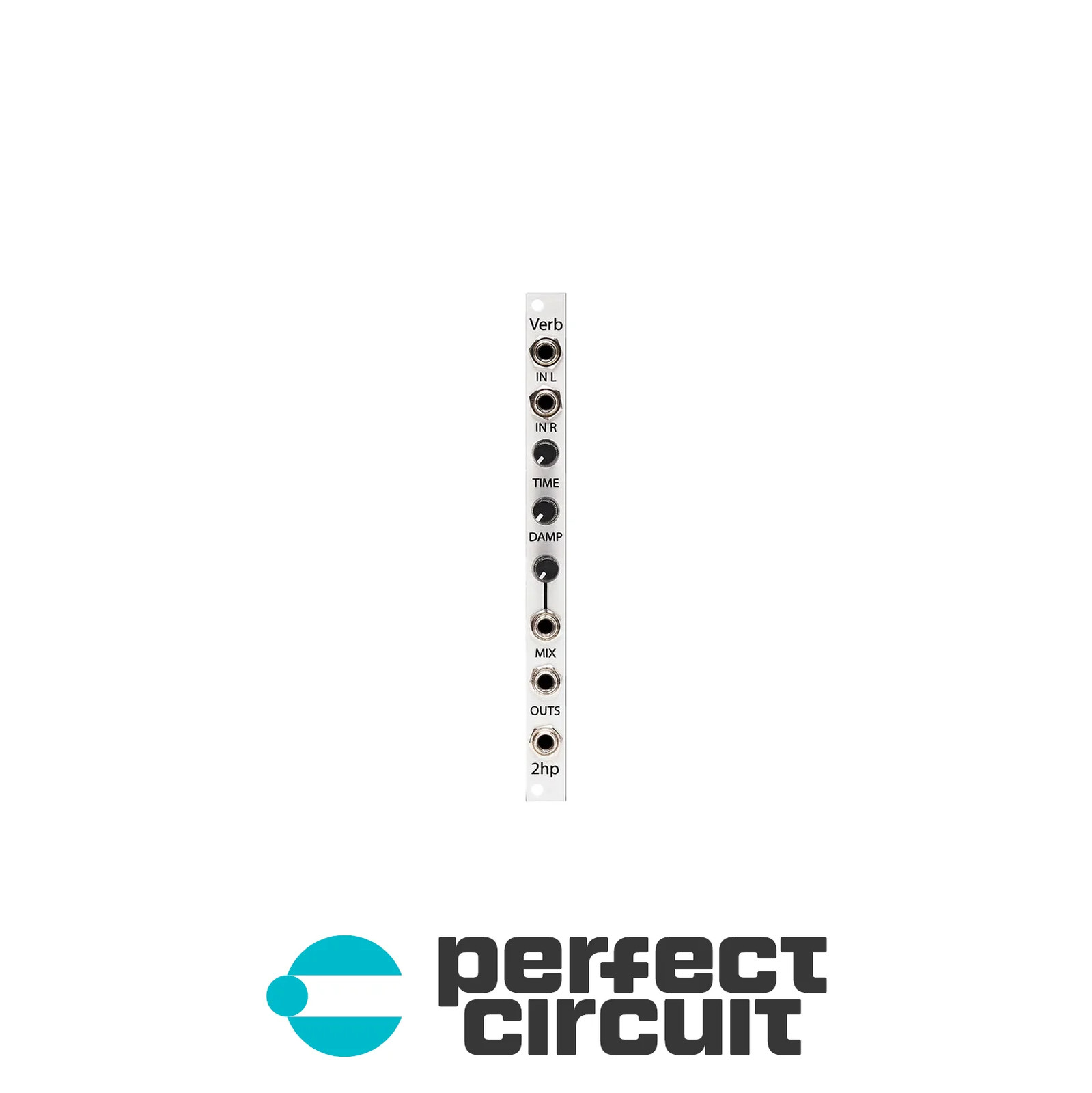
Built around the FV-1 digital signal processor—a chip that became a cult favorite in compact effects for its low power draw and manageable footprint—the Reverb delivers stereo in and out with just two knobs and a single CV input. That’s it. No menu diving, no hidden functions, no firmware updates. The simplicity is the point. You turn the Time knob and the space expands; you tweak Dampening and the high-end fizz softens into warmth, like lowering a scrim across a bright window. The CV control is dedicated solely to mix, letting you automate the blend from bone-dry to drenched without touching the knob. It’s not the most flexible modulation setup, but it’s effective: pair it with an envelope follower and you can make your drums breathe, or use an LFO to gently pulse a pad in and out of a fog.
And yes, it’s digital—but not in the harsh, aliased way some early DSP reverbs were. The 2hp unit avoids the worst of the metallic artifacts, though push it too hard and the truth shows: at maximum decay with bright sources, there’s a slight ringing in the upper mids, a glassy resonance that reminds you this isn’t a Lexicon 480L. But in a modular context, where you’re often layering textures and need something to glue them together, that slight character can work in its favor. It doesn’t disappear; it sits in the mix like a textured backdrop, not a polished illusion.
Specifications
| Manufacturer | 2hp |
| Production Years | 2014–2023 |
| Original Price | $169 |
| Form Factor | Eurorack |
| HP | 2 |
| Depth | 35mm |
| Current Draw +12V | 60mA |
| Current Draw -12V | 20mA |
| Inputs | Stereo audio in (3.5mm jacks) |
| Outputs | Stereo audio out (3.5mm jacks) |
| CV Inputs | 1 (Mix control) |
| Controls | Time, Dampening, Mix (knob and CV attenuverter) |
| Signal Processing | Digital (FV-1 DSP chip) |
| Reverb Types | Algorithmic stereo reverb |
| Reverb Time Range | 0.1 to 10 seconds |
| Dampening Control | Adjusts high-frequency content of reverb tail |
| Mix Control | Dry/wet blend via knob and CV input |
| Weight | 100g |
Key Features
The FV-1 Advantage: Tiny Brain, Big Sound
At the heart of the 2hp Reverb is the Spin Semiconductor FV-1, a DSP chip designed specifically for compact audio effects with minimal host processing. Unlike full-blown microprocessors, the FV-1 runs preloaded algorithms stored in external ROM, which keeps the design simple and the power draw low. For 2hp, this meant they could build a stereo reverb in 2HP without needing a heat sink, external power tap, or complex firmware. The trade-off? Limited real-time control. You can’t switch algorithms or tweak internal parameters via CV—the reverb character is fixed, shaped only by Time, Dampening, and Mix. But within those constraints, the algorithm is well-tuned: it avoids the “hall of mirrors” effect that plagues some minimalist digital reverbs, instead offering a smooth decay that feels organic, even when pushed.
Stereo In, Stereo Out—Without the Bloat
In a format where every millimeter counts, the decision to make the Reverb fully stereo was quietly radical. Most 2–3HP effects either sum to mono or offer stereo outs with a shared input. The 2hp unit gives you discrete left and right inputs and outputs, preserving spatial information from stereo sources like dual delays or stereo oscillators. This makes it especially useful when placed at the end of a stereo effects chain—say, after a stereo delay or chorus—where maintaining width matters. The module doesn’t process each channel independently (it’s not a dual mono reverb), but the stereo image is preserved through the algorithm, creating a cohesive, immersive field rather than two parallel reverb tails.
CV Over Mix: Subtlety Over Spectacle
The single CV input is dedicated to mix control, and while that might seem limiting compared to modules offering CV over decay or damping, it’s also one of the most musically useful parameters to modulate. Automating the dry/wet blend lets you create dynamic swells, duck reverb during rhythmic passages, or fade a sound into oblivion with an envelope. The attenuverter on the CV input gives precise control over modulation depth, so you can go from barely-there modulation to full wet/dry sweeps. It’s not the flashiest feature set, but it’s immediately functional—no patching required to get expressive movement. For live performance or evolving textures, that simplicity is a strength.
Historical Context
When the 2hp Reverb launched in 2014, Eurorack was in the middle of a space race—not for bigger systems, but for smaller modules. The format’s popularity was exploding, and cases were filling up fast. Builders like 2hp, Doepfer, and Intellijel were pushing to make essential functions fit into shrinking footprints. The Reverb arrived at a time when most modular users still relied on external pedals for effects; putting reverb inside the rack meant dealing with level matching, impedance issues, and precious HP. The 2hp unit solved part of that equation: it ran at Eurorack levels, had stereo I/O, and took up barely any space. It wasn’t the first compact reverb—Erica’s Pico DSP and Industrial Music’s RT-60 predated it—but it was among the first to balance size, sound quality, and price in a way that felt like a real alternative to pedals.
It also reflected a broader shift in how modular was being used. No longer just a tool for academic sound design or sequenced repetition, Eurorack was becoming a complete performance and production environment. Having reverb in the rack meant you could patch it into feedback loops, modulate it with random sources, or use it as a texture generator. The 2hp Reverb wasn’t designed for extreme mangling—it won’t self-oscillate or create infinite tails—but it was reliable enough to be a workhorse, and small enough to justify its place even in tightly packed systems.
Collectibility & Value
The 2hp Reverb was discontinued in 2023, and while it’s not yet a “holy grail” item, it’s becoming harder to find in clean, fully functional condition. Original retail was $169, and used prices now range from $180 to $250 depending on color (black, silver, or limited editions) and seller. There are no known chronic hardware failures—the FV-1 is solid-state and the build quality is consistent—but owners report occasional issues with jack solder joints, especially if the module has been frequently patched. The 3.5mm jacks are standard Eurorack size, but they’re close together, so using wider cables can stress the board over time.
When buying, check that the CV input responds smoothly across its range and that there’s no crackling in the audio path when turning the knobs. Some users have noted slight channel imbalance in stereo output, usually due to pot wear, but this is rare. Because the module is DSP-based, there are no aging capacitors or analog drift to worry about—just clean digital operation as long as the chip and power regulation hold up.
It’s not the last word in reverb quality—anyone with a Strymon BigSky or Eventide H9 will hear the difference—but its value lies in integration. For a system where every HP counts, the 2hp Reverb offers a “good enough” solution that doesn’t require leaving the rack. It’s the kind of module you don’t appreciate until you’re on stage and realize you didn’t have to bring a pedal board.
eBay Listings


As an eBay Partner, we earn from qualifying purchases. This helps support our independent vintage technology research.