2HP Pluck (2013–)
A two-inch-wide portal to infinite string ensembles, if you don’t mind squinting while you tune it.
Overview
Plug in the 2HP Pluck for the first time and you’ll wonder if you’ve accidentally summoned a harpsichord trapped inside a matchbox. It’s not loud, not flashy, not even particularly flexible—but within its narrow lane, it’s devastatingly effective. This isn’t a full-featured synth voice; it’s a laser-guided missile aimed squarely at one sound: the plucked string. Using a Karplus-Strong physical modeling algorithm, the Pluck generates tones that range from tight, staccato pizzicato to long, shimmering decays that hang in the air like dust motes in sunlight. For such a minimal module, the sonic range is surprisingly expressive—especially when you start voltage-controlling its parameters. But make no mistake: this is a specialist. It won’t growl, it won’t sweep, and it won’t morph into a bass synth no matter how hard you beg. What it will do, better than almost anything else in Eurorack, is sound like a string being flicked.
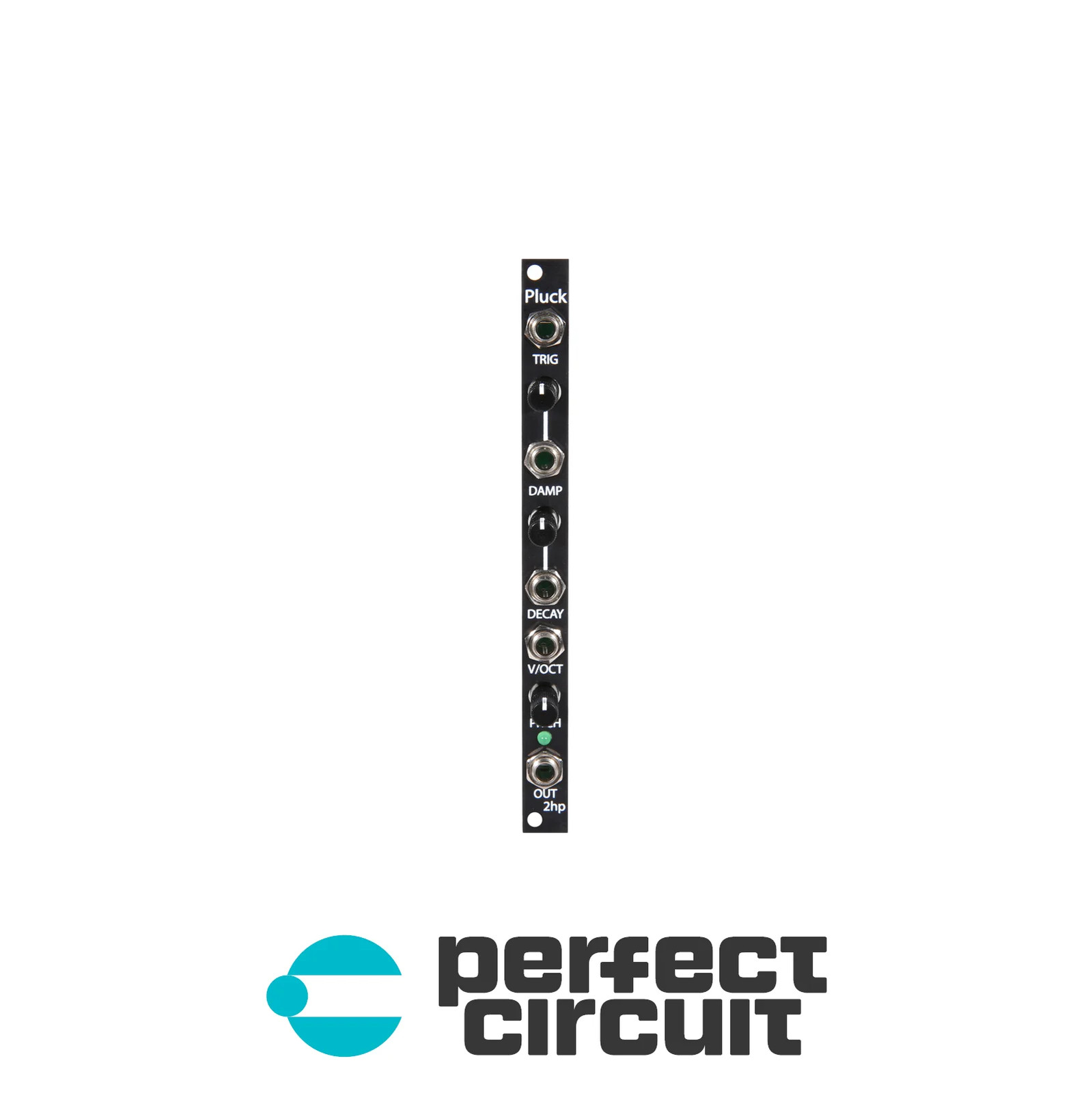
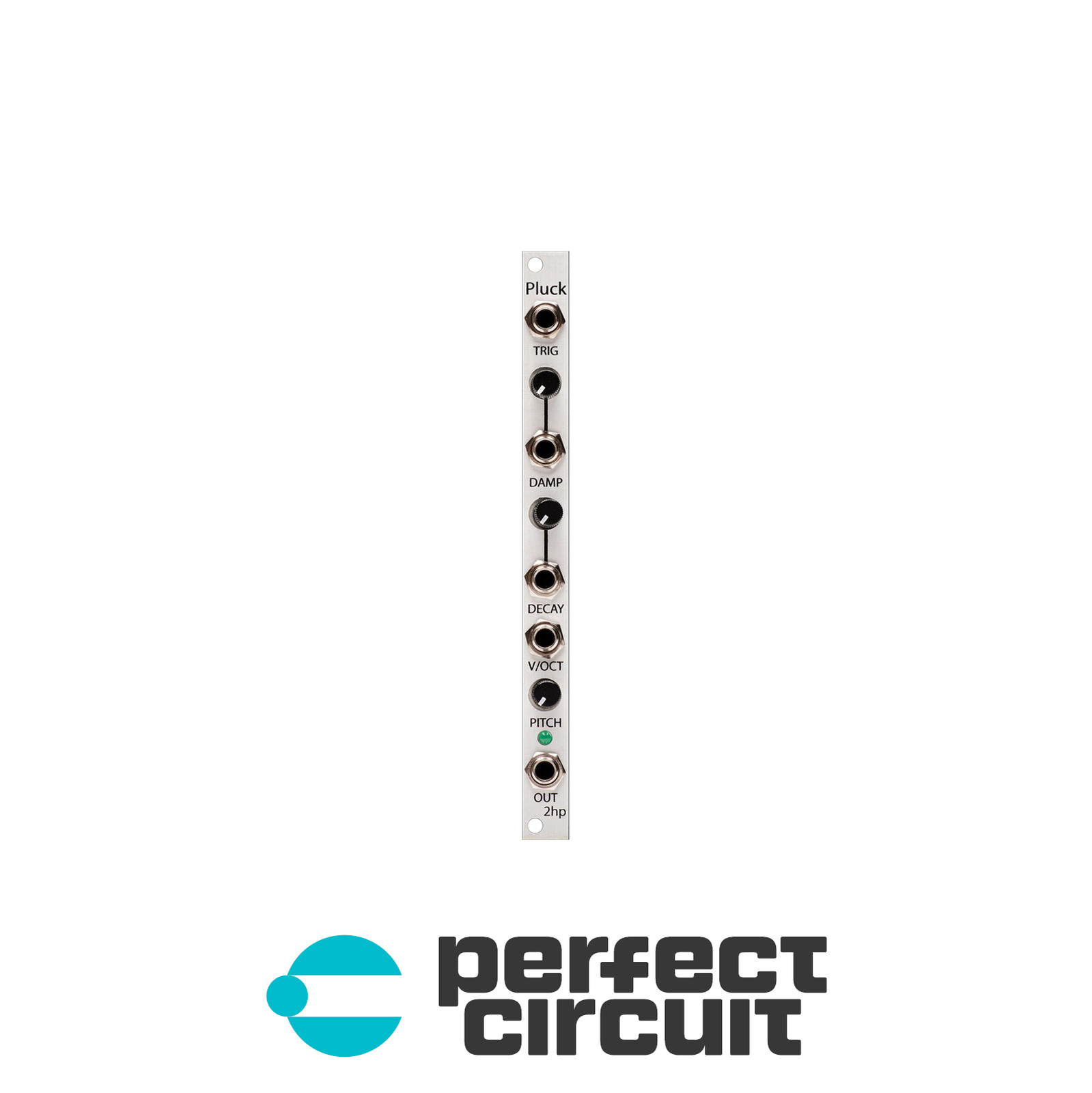
When it launched, the Pluck stood out not for its innovation but for its audacity—how could two horizontal inches possibly contain a complete polyphonic voice? Yet here it is: a four-voice synthesizer that fits in the shadow of a standard power cable. That density comes at a cost, of course. The front panel is spartan to the point of austerity: one tiny knob for pitch, another for damping, and a third for decay. No display, no menu diving, no performance controls beyond what you can route via CV. But that minimalism is also its charm. There’s no distraction. No decision fatigue. Just a single, focused algorithm doing one thing with surgical precision.
It arrived in a Eurorack ecosystem already bursting with physical modeling options—Mutable Instruments’ Rings being the most obvious comparison—and yet the Pluck carved out a niche not by competing on features, but by embracing constraints. It doesn’t try to simulate every resonant body under the sun. It doesn’t offer modal synthesis or convolution. It just plucks. And in doing so, it became a cult favorite among minimalists, drone artists, and anyone trying to stretch their rack space to its breaking point.
Specifications
| Manufacturer | 2HP |
| Production Years | 2013– |
| Original Price | $149 USD |
| Width | 2HP |
| Depth | 45mm |
| Power | +12V: 78mA, -12V: 6mA |
| Polyphony | 4 voices |
| Synthesis Type | Physical modeling (Karplus-Strong algorithm) |
| Tracking | Accurate 1V/Oct across five octaves |
| Inputs | Pitch CV, Gate, Damp CV, Decay CV |
| Outputs | Audio out |
| Keyboard Size | N/A (module) |
| Oscillators | Digital (algorithmic) |
| Filter Type | Not applicable (damping via algorithm) |
| Effects | None (pure synthesis engine) |
| MIDI | No (CV only) |
| Weight | Approx. 30g (estimated) |
| Dimensions | 4HP height, 2HP width, 45mm depth |
Key Features
The Karplus-Strong Engine in a Sliver of Metal
At its core, the Pluck relies on the Karplus-Strong algorithm—a digital technique developed in the early 1980s that simulates the behavior of a plucked string by feeding a burst of noise through a delay line with a low-pass filter. The brilliance of this method is its efficiency: it requires minimal processing power and produces startlingly organic results. 2HP didn’t invent this algorithm, but they weaponized it for Eurorack. By stripping away everything non-essential—no wavefolding, no resonance shaping, no alternate modes—they managed to fit a fully functional polyphonic implementation into 2HP. The result is a voice that feels alive, even though it’s entirely synthetic. When you dial in a long decay and low damping, the note doesn’t just fade out—it evolves, with higher harmonics dissipating faster than the fundamental, mimicking the natural behavior of a nylon or steel string.
Polyphony Without the Bulk
Four-voice polyphony in 2HP was unheard of when the Pluck debuted. Most compact modules at the time were monophonic or offered pseudo-polyphony via arpeggiation. The Pluck, however, genuinely plays four notes at once—chords included. This makes it shockingly useful for texture layers, ambient pads, and rhythmic counterpoint. Patch in a sequencer with chord triggers, and suddenly you’ve got a tiny harp filling out your mix. But the polyphony isn’t just a gimmick; it’s integral to the character. Because the voices share the same algorithm and are tightly packed in memory, they interact in subtle ways—slight detuning, phase nudges—that give chords a natural, almost human imperfection. It’s not pristine unison; it’s a small ensemble playing in close quarters.
CV Control That Rewards Experimentation
While the front panel is sparse, the Pluck opens up dramatically under CV control. The Damp and Decay inputs respond smoothly to modulation, allowing you to morph from a tight, muted jazz bass pluck to a ringing, open-string sustain with a simple envelope or LFO. Run a slow random voltage into Damp, and the string length seems to shift unpredictably, like fingers sliding along a fretless neck. Patch a sample-and-hold to Decay, and each note lingers for a different duration, creating evolving, aleatoric textures. The module doesn’t just accept CV—it thrives on it. Without modulation, the Pluck can feel static, even sterile. But feed it dynamic control sources, and it transforms into something far more expressive than its size suggests.
Historical Context
The 2HP Pluck emerged in 2013, at a time when Eurorack was shifting from boutique curiosity to full-blown modular renaissance. Manufacturers were racing to pack more functionality into smaller spaces, and 2HP—founded by engineer and minimalist designer Tony Rolando—was at the forefront of that movement. The Pluck wasn’t the first physical modeling module, nor the most advanced, but it was the first to deliver a convincing, polyphonic string voice in such a diminutive form. It arrived just as Mutable Instruments was gaining acclaim for its powerful, feature-rich modules like Braids and Rings, which offered vast sonic terrain at higher price and space costs. The Pluck didn’t try to beat them at their own game. Instead, it offered an alternative: do less, but do it perfectly, and do it in 2HP.
It also reflected a growing appetite for algorithmic synthesis in Eurorack. While analog oscillators and filters still dominated, digital modules were proving they could offer unique timbres that were difficult or impossible to achieve with traditional circuitry. The Pluck, along with the 2HP Bell (its metallic cousin), showed that digital didn’t have to mean complex or menu-dense. It could be immediate, focused, and—dare we say—elegant. In a market increasingly crowded with “do-anything” modules, the Pluck’s single-mindedness felt like a rebellion.
Collectibility & Value
The 2HP Pluck has held its value remarkably well since its release, with used units regularly selling between $120 and $160 depending on condition. Given its original MSRP of $149, that’s a testament to its enduring appeal. It’s not a rare module—production has been steady—but it’s also not one that people tend to flip. Once you’ve got a Pluck, you usually keep it, even if you don’t use it daily. Its main competition isn’t other modules so much as obsolescence: why buy a one-trick pony when you could get a Plaits or Shades that do this and a dozen other things? Yet the Pluck persists, valued not for versatility but for purity.
That said, it’s not without quirks that affect ownership. The tuning knob is notoriously fiddly—tiny, recessed, and hyper-sensitive. Many users report struggling to dial in precise pitches by hand, especially in low-light environments. Some resort to using a toothpick or tweezers; others simply patch a quantizer before the pitch CV input and leave the knob at a fixed position. It’s not a flaw in the circuitry—tracking across five octaves is accurate when properly calibrated—but the interface makes manual tuning a chore. This isn’t a module for live tweaking.
Another consideration: while the Pluck is digitally robust, its physical construction is minimalist to a fault. The PCB is thin, the jacks are standard-sized but tightly packed, and the module offers no protection against accidental shorts. In a densely packed case, a loose patch cable can easily bump the knobs or short adjacent pins. Some users mitigate this by installing 1HP blank panels on either side, creating breathing room. It’s a small price to pay for the space savings, but it does eat into the very real estate the module was meant to conserve.
If you’re buying used, check for firmware updates—though the module has seen no major revisions, earlier units may benefit from stability patches. Also verify that all four voices trigger consistently; while rare, some defective units exhibit voice dropout under certain CV conditions. Power draw is minimal (+12V: 78mA, -12V: 6mA), so it won’t tax even the smallest power supplies.
eBay Listings


As an eBay Partner, we earn from qualifying purchases. This helps support our independent vintage technology research.