2hp Mult (2010s)
A tiny passive splitter that solves the most common modular headache—without drawing power or wasting space.
Overview
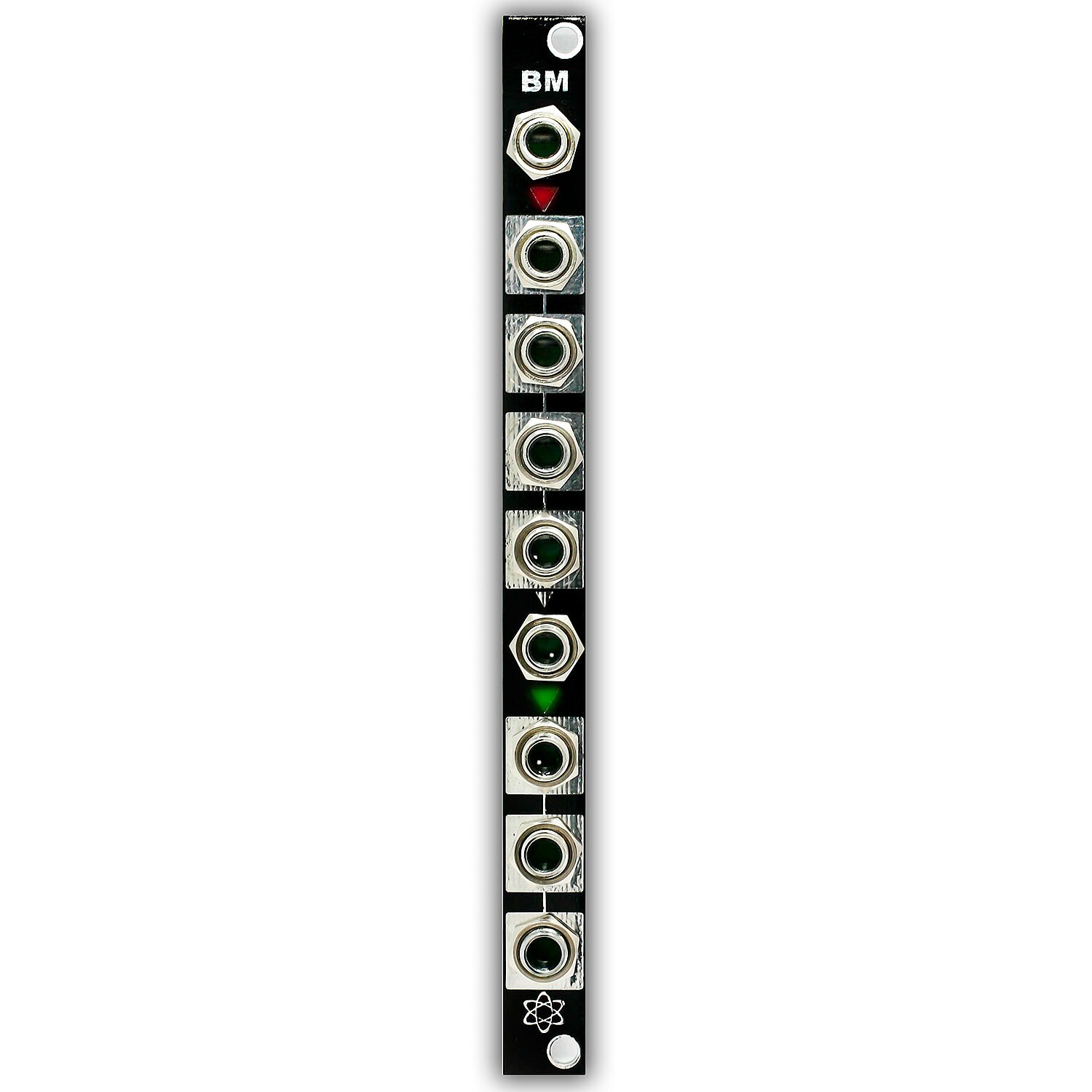
You’re elbows-deep in a patch, CV cables snaking across the panel, when you realize you need to send the same gate to three different envelopes—except you’ve already used up every multiple you’ve got. That’s when you curse, unplug something important, and create a daisy chain that inevitably bleeds signal or detunes an oscillator. The 2hp Mult exists to end that nonsense. It’s not flashy, it doesn’t oscillate or filter or modulate—what it does is multiply. Specifically, it gives you two sets of three outputs from two inputs, with the first input normalled to the second. That means if you plug a clock into the first jack, you get six identical copies across both output banks—no power, no fuss, just clean signal distribution. And it does it in 2hp, which is barely wider than a single Eurorack jack.
Passive multiples like this don’t buffer the signal, so they’re not ideal for splitting pitch CV over long cable runs or to many destinations—impedance mismatches can cause slight voltage drops, especially with high-impedance sources. But for gates, triggers, clocks, and audio-level signals where exact voltage precision isn’t critical, the 2hp Mult is bulletproof. It’s the kind of module you don’t appreciate until you’ve run out of multiples, then the moment you install it, you wonder how you ever patched without it. It’s not a centerpiece—it’s infrastructure. And like any good utility module, it’s meant to be forgotten until you need it, at which point it just works.
Specifications
| Manufacturer | 2hp |
| Production Years | 2010s |
| Width | 2hp |
| Depth | 15 mm |
| Power | Does not draw current |
| Inputs | 2 |
| Outputs | 6 (3 per input) |
| Normalization | Input 1 normalled to Input 2 |
| Signal Type | Passive multiple (unbuffered) |
| Mounting Type | Eurorack |
| Color | Black anodized aluminum panel |
| Knobs | None |
| Connectors | 3.5mm jacks |
| Weight | Approx. 20 g |
| Country of Origin | USA |
| MSRP at Launch | $35 USD |
Key Features
Passive Design, Zero Power Draw
The 2hp Mult doesn’t connect to the power bus at all—there’s no ribbon cable, no current draw, no need to worry about power supply headroom. That makes it one of the few modules you can install in a powered-off case without a second thought. The trade-off is that it’s unbuffered, meaning it doesn’t actively drive the signal to each output. For gates and triggers, this is rarely an issue. But if you’re splitting a pitch CV to multiple oscillators, especially across a large system, you might notice slight tuning discrepancies due to load interaction. That’s not a flaw in the module—it’s a limitation of passive splitting. For critical CV distribution, a buffered multiple like the Malekko Buffered Mult or Intellijel Umx-4 is a better choice. But for 90% of utility tasks—clock distribution, trigger fanouts, audio mixing via passive summing—the 2hp Mult performs flawlessly.
Normalization for Maximum Flexibility
The normalization between input one and two is what elevates this from a basic splitter to a genuinely smart utility. When nothing is plugged into the second input, the first input’s signal is automatically routed to both output banks, giving you six copies from a single source. The moment you plug a cable into the second input, the normalization breaks, and you now have two independent 1-to-3 multiples. This dual-mode functionality means you can adapt the module on the fly—use it as a six-way clock distributor during sequencing, then switch to dual splitting when you need to route two separate LFOs to multiple destinations. It’s a small detail, but it doubles the module’s usefulness without adding a single millimeter to its footprint.
Build Quality and Physical Design
Like all 2hp modules, the Mult is built with a minimalist aesthetic—black anodized aluminum panel, recessed jacks, no extraneous labeling. The jacks are mounted directly to the PCB, which is secured with standoffs, making the module mechanically robust. At just 15mm deep, it fits comfortably in even the most crowded cases, including compact skiff builds. The lack of power connector also means you can install it in tight spaces where power bus access is limited. It’s not the deepest module, but because the PCB is rigid and well-supported, it doesn’t wobble or flex, even with multiple cables plugged in. Over time, repeated plugging and unplugging can wear on the jack sockets, but owners report that the Switchcraft-style jacks used by 2hp are durable and resistant to common failure modes like cold solder joints or misalignment.
Historical Context
The 2hp Mult emerged during the early 2010s, when Eurorack was transitioning from boutique curiosity to mainstream synthesis platform. As more musicians adopted modular systems, the need for space-efficient utility modules became apparent. Cases were small, budgets were tight, and every hp counted. 2hp (the company) built its reputation on solving this exact problem—offering essential functions in the smallest possible footprint. The Mult was part of that first wave of ultra-compact utilities that proved you didn’t need 8hp for a module to be useful. It arrived alongside similarly minimalist designs like the Doepfer A-185-2 and the Intellijel Mutamix, but stood out for its combination of low cost, zero power draw, and normalization. At a time when many manufacturers were adding features and complexity, 2hp went the opposite direction—stripping everything back to the essentials. The result was a module that didn’t wow with features but earned loyalty through reliability and efficiency.
Collectibility & Value
The 2hp Mult is neither rare nor particularly collectible—it’s a utility module, not a vintage synth with legendary sound. But that doesn’t mean it’s without value. New units still sell for around $35–$45, and used ones typically go for $25–$35 depending on condition. Because it has no active electronics, failure rates are extremely low. The most common issues are bent jacks from careless patching or, in older units, slight panel discoloration from UV exposure. There’s no service life to speak of—no capacitors to dry out, no ICs to fail. That makes it one of the most reliable modules in any rack. For buyers, the only real concern is verifying authenticity—counterfeit Eurorack modules do exist, and some clones of the 2hp Mult have appeared on secondary markets. A genuine unit will have clean silkscreening, precise jack alignment, and a 2hp logo etched into the panel. If the price seems too good to be true—say, under $20 for a used one—it might be a knockoff. But for most users, the 2hp Mult is less about investment and more about function: it’s a tool, not a trophy. And as long as modular synthesis relies on patch cables, tools like this will never go out of style.
eBay Listings



As an eBay Partner, we earn from qualifying purchases. This helps support our independent vintage technology research.