2hp Mix (2010s)
A deceptively simple mixer that disappears sonically—exactly what your modular needs.
Overview
Slap it in your rack between a noisy oscillator and a finicky filter, and suddenly everything tightens up—like someone quietly turned down the static between the notes. That’s the 2hp Mix: four channels of unapologetically clean summing in a sliver of a module that takes up less space than a power cable bend. It doesn’t glitter, it doesn’t modulate, it doesn’t sync to MIDI. It just mixes. And it does it so well that after a few weeks of use, you forget it’s even there—until you unplug it and realize how much you were relying on its invisible hand.
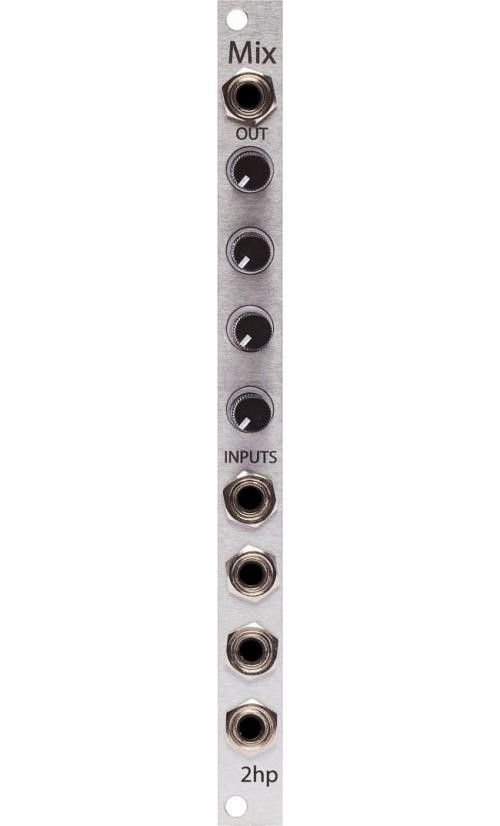
Despite its minimalist faceplate—just four tiny knobs and five jacks—the Mix punches way above its size class in functionality. Each channel accepts audio or CV thanks to DC coupling, which means you can blend control voltages for morphing filter cutoffs or sum LFOs before they hit a VCA. The audio path, though, is where it earns its keep. Noise floor? Virtually nonexistent. Coloration? None. It doesn’t sweeten, saturate, or soften like some mixers that add “character” whether you want it or not. This one stays out of the way, delivering a transparent sum that preserves every transient and harmonic detail from your oscillators, drums, or external gear.
For a brand known for packing utility into tiny footprints, the Mix is 2hp’s quiet manifesto: sometimes the most powerful modules are the ones that do nothing except do it perfectly. It’s not flashy, but in a system cobbled together from boutique oscillators and hand-wired filters, having a clean summing point is like finding a perfectly flat mixing console in a haunted analog basement. You didn’t know you needed it until you used it—and now you can’t imagine patching without it.
Specifications
| Manufacturer | 2hp |
| Production Years | 2010s |
| Original Price | $99 |
| Format | Eurorack |
| Width | 2 HP |
| Depth | 45 mm |
| Power Consumption +12V | 41 mA |
| Power Consumption -12V | 41 mA |
| Power Consumption 5V | 0 mA |
| Inputs | 4 x 3.5mm (DC-coupled) |
| Output | 1 x 3.5mm |
| Signal Type | Audio and CV |
| Coupling | DC-coupled |
| Controls | 4 x Level knobs |
| Weight | Approx. 50 g |
| Color Options | Silver, Black |
Key Features
DC-Coupled for Dual Duty
Most mixers in Eurorack are AC-coupled, meaning they block DC voltage and are strictly for audio. The 2hp Mix doesn’t care. Its DC coupling lets it handle both audio signals and control voltages with equal ease. Need to average two pitch CVs for detuned oscillators? Mix them. Want to sum multiple envelope generators to create a composite modulation source? Done. This flexibility turns the Mix into more than a final summing stage—it becomes a modulation hub, quietly enabling complex patches that would otherwise require attenuators, offset generators, or dedicated CV mixers. It’s a small detail that vastly expands its utility in a modular environment where CV manipulation is half the fun.
Skiff-Sized, Studio-Quality Signal Path
At just 2 HP wide and 45 mm deep, the Mix slips into the tightest skiff or travel case without breaking a sweat. But don’t mistake its size for compromise. The internal circuitry is optimized for low noise and high headroom, with a design that prioritizes signal integrity over gimmicks. There’s no clipping protection, no mute switch, no pan controls—just four precision potentiometers and a clean op-amp summing stage. The result is a module that behaves more like a high-end studio summing amp than a space-saving utility. It handles hot signals without distortion and maintains clarity even when summing dense, harmonically rich sources like digital oscillators or FM pairs.
No Frills, No Failures
With no switches, no LEDs, and no microcontrollers, the Mix has almost nothing to break. It’s entirely analog, passive in topology but actively buffered to prevent loading down upstream modules. The lack of digital components or firmware means it’s immune to the kinds of glitches that plague more complex modules—no resets, no USB issues, no “bricking.” It’s about as close to bulletproof as a Eurorack module can get. Owners report units running reliably for over a decade with zero maintenance, which is rare in a format where even power supplies occasionally hiccup. If a Mix fails, it’s usually due to a damaged jack or a rare PCB solder issue—not inherent design flaws.
Historical Context
When 2hp launched in the early 2010s, Eurorack was expanding rapidly, but rack space remained a premium. Most mixers occupied 4, 6, or even 8 HP, eating up real estate that could be used for oscillators or effects. The Mix arrived as a quiet revolution—proof that you didn’t need width to get quality. At a time when boutique modules were getting flashier and more feature-laden, 2hp went the opposite direction: minimalism as a virtue. The Mix, along with the company’s attenuator and mult modules, defined a new category of “gap fillers”—tiny utilities that solved real routing problems without demanding attention or space.
Competitors like Intellijel and Mutable Instruments offered mixers with pan controls, mute buttons, or LED level meters, but they came at a cost: depth, power draw, and width. The 2hp Mix didn’t compete on features; it competed on efficiency. It appealed to minimalists, travelers, and skiff builders who valued function over flash. In doing so, it helped normalize the idea that utility modules could be as essential as sound generators. Its success spawned a wave of ultra-compact utilities from other brands, but few matched its combination of fidelity and footprint. Even today, over a decade later, it remains a benchmark for what a no-compromise small-format mixer should be.
Collectibility & Value
The 2hp Mix has never been rare—production has been steady, and units are widely available from authorized dealers and secondary markets. But its collectibility lies not in scarcity, but in ubiquity. It’s one of those modules that shows up in nearly every serious Eurorack build, not because it’s flashy, but because it’s necessary. Used units typically sell for $60–$80, depending on condition and color, while new modules still list at $99. Black and silver faceplates are functionally identical, but black tends to fetch a slight premium due to aesthetic preference in minimalist builds.
Failures are uncommon, but when they occur, they’re usually mechanical: bent jacks from careless patching or cracked solder joints from repeated insertion force. The knobs, while sturdy, can become loose over time and may need occasional tightening. There are no known design flaws or batch issues reported by technicians or repair shops. Because it draws equal current on both rails (41 mA ±12V), it plays nicely with most power supplies, though skiff builders should ensure their busboards can handle the negative rail load if stacking multiple 2hp modules.
For buyers, the advice is simple: inspect the jacks for wobble and test all four channels with a known signal. Since the module is so basic, there’s little to go wrong—but also little room for hidden defects. If it powers up and passes audio, it’ll likely last another ten years. No recalibration, no firmware updates, no surprises. It’s the anti-hype module: not something you brag about, but something you quietly depend on.
eBay Listings



As an eBay Partner, we earn from qualifying purchases. This helps support our independent vintage technology research.