2HP Loop (2013–2023)
Five minutes of pristine looping crammed into a sliver of Eurorack—this tiny module turns silence into symphonies with the flick of a gate.
Overview
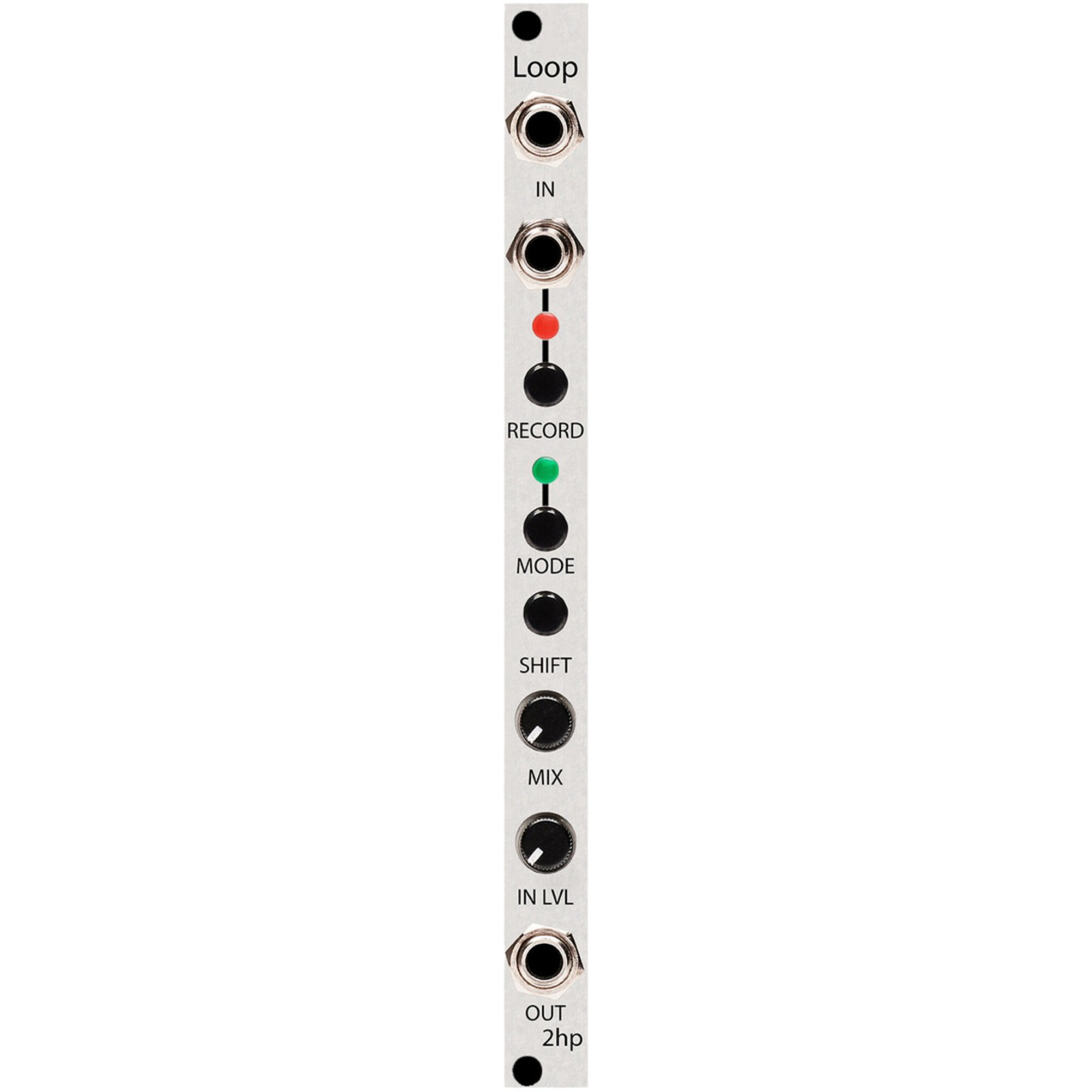
It’s easy to overlook a 2HP-wide module—barely wider than a single patch cable—until you hear what it does. The 2HP Loop slips into the smallest gaps in your rack and delivers something disproportionately powerful: a high-fidelity, five-minute digital looper with the kind of intuitive control that makes looping feel less like programming and more like playing. This isn’t some glitchy, lo-fi artifact; it captures audio at 24-bit/48kHz, making it one of the cleanest-sounding loopers in the Eurorack ecosystem. It’s not flashy, but it’s honest, reliable, and capable of transforming a single oscillator blip into a swirling ambient bed or layering percussive stutters into a rhythmic storm.
Positioned between utility modules and full-featured samplers, the Loop sits in a sweet spot: more flexible than a simple delay, less complex than a granular processor. It’s not trying to be a DAW in a module, but it doesn’t feel limited, either. With four distinct recording modes—Sound on Sound, Dub, Replace, and Reverse—it gives you enough variation to keep things interesting without overwhelming you with menus or shift functions. The interface is minimal: one knob, one button, and a handful of jacks. You record with a gate signal or the front-panel button, and the knob adjusts playback speed and direction. That’s it. No screens, no endless parameter diving. What you see is what you get, and that simplicity is part of its charm.
Despite its size, the Loop doesn’t feel like a compromise. It’s a statement: that even in a format obsessed with complexity, sometimes the most powerful tools are the ones that get out of your way. It’s the module you reach for when you want to build a loop quickly, capture a happy accident, or layer textures without patching a dozen cables. It’s not a centerpiece, but it’s often the glue—the quiet enabler that turns a static patch into something evolving, breathing, alive.
Specifications
| Manufacturer | 2HP |
| Production Years | 2013–2023 |
| Original Price | $149 |
| Format | Eurorack |
| Width | 2HP |
| Depth | 40mm |
| Current Draw +12V | 80mA |
| Current Draw -12V | 20mA |
| Audio Input | 1/8" (3.5mm) TS |
| Audio Output | 1/8" (3.5mm) TS |
| Record Gate Input | 1/8" (3.5mm) TS |
| Record Gate Output | 1/8" (3.5mm) TS |
| Loop Length | Up to 5 minutes |
| Sample Rate | 48kHz |
| Bit Depth | 24-bit |
| Playback Modes | Normal, Half-speed, Reverse |
| Recording Modes | Sound on Sound, Dub, Replace, Reverse |
| Weight | 35g |
Key Features
Four Recording Modes for Expressive Layering
The Loop’s real magic lies in its four recording modes, each offering a different approach to building sound. Sound on Sound is the classic infinite overdub—perfect for stacking drones or rhythmic loops. Dub mode lets you selectively overdub over existing material, like a tape echo with memory. Replace erases the previous loop and starts fresh, ideal for quick sketching or rhythmic resets. Reverse is exactly what it sounds like: it flips the incoming audio and records it backward, opening up surreal textures and unexpected melodic turns. These modes aren’t hidden behind menus or shift functions; they’re hardwired and cycled via a simple gate input, making them immediate and performance-friendly. You don’t need to stop and think—you just patch and play.
Half-Speed and Reverse Playback
Beyond recording, the Loop offers real-time manipulation of playback. The front-panel knob doesn’t just start and stop—it controls playback speed and direction. Turn it one way, and the loop slows to half-speed, thickening the texture and dropping the pitch. Turn it the other, and it reverses playback, creating ghostly echoes of what came before. This isn’t sample-rate reduction or bit-crushing; it’s clean time-stretching and reversal, preserving the integrity of the original signal. It’s a subtle but powerful tool, letting you warp a loop on the fly without mangling its fidelity. In a world full of gritty, glitchy loopers, the Loop’s clarity is a breath of fresh air.
Compact Design with Full Signal Path
At just 2HP wide, the Loop is a masterclass in efficient design. It doesn’t skimp on connectivity—input, output, record gate in, record gate out, and power—all fit neatly on a panel that’s barely wider than a single jack. The 3.5mm (1/8") jacks are a signature of 2HP’s design language, saving space without sacrificing reliability. While some users report difficulty patching when the module is surrounded by wider gear, the trade-off is undeniable: you can fit three Loop modules in the space of a standard 6HP utility. And because it’s digital, it doesn’t load down your oscillators or degrade your signal chain. It’s a transparent processor—one that does its job and gets out of the way.
Historical Context
When the 2HP Loop launched in 2013, Eurorack was still in its renaissance phase—growing fast, but not yet drowning in options. Most loopers were either full-sized samplers or crude buffer modules with seconds of memory. The Loop carved a niche by offering professional-grade recording in a footprint previously reserved for attenuators and multiples. It wasn’t the first digital looper in Eurorack, but it was among the first to deliver high fidelity and meaningful features in such a small package. At a time when many manufacturers were chasing complexity, 2HP doubled down on minimalism, proving that thoughtful design could be more impactful than raw power.
Its closest competitors weren’t other loopers but modules like the MakeNoise Morphagene or the Mutable Instruments Clouds (later Rings)—modules that offered granular or spectral processing in compact forms. The Loop stood apart by refusing to overcomplicate. It didn’t try to be a sampler, a granulator, or a buffer mangler. It just looped, and it did it well. In doing so, it became a staple in ambient, experimental, and live performance setups—where reliability and immediacy matter more than endless modulation options. Over its decade-long production run, it remained largely unchanged, a testament to its “if it ain’t broke” philosophy.
Collectibility & Value
The 2HP Loop was discontinued in 2023, and while it’s not yet a “rare” module, it’s no longer in production, making used units the only option. In excellent condition, a Loop typically sells for $180–$220, with black and silver faceplate variants commanding similar prices. Units with cosmetic wear or untested status can be found for $140–$160, but buyers should be cautious—while the module is solidly built, the 3.5mm jacks can loosen over time, and the PCB is tightly packed, making repairs tricky.
Common issues include intermittent audio dropout, usually caused by failing solder joints on the audio jacks or power rails. Some users have reported a low-level hiss when passing signal through the module even when not recording, though this is inconsistent—some units are dead silent, others exhibit a faint noise floor. Documentation doesn’t list a replaceable buffer or op-amp, so noise issues are difficult to fix without deep electronics work. Power draw is modest (80mA/+12V, 20mA/–12V), but the module is sensitive to dirty power, so a clean, well-regulated supply is recommended.
Before buying, test both input and output with a known-clean signal, check that all four recording modes trigger correctly via gate, and verify that half-speed and reverse playback function without glitches. Because the Loop has no user-accessible storage or firmware updates, there’s no risk of bricking, but there’s also no way to upgrade or reset it. It’s a simple device, but that simplicity means there’s little room for error—if it’s broken, it’s broken.
For those building a stereo looper setup, running two Loops in parallel is a popular workaround, though they won’t sync automatically—external gate control is required to start and stop both units simultaneously. Some users have reported drift over long loops, so for critical stereo applications, a dedicated stereo looper might be a better choice. But for most, the Loop’s affordability, fidelity, and footprint make it a worthwhile addition, even in 2026.
eBay Listings



As an eBay Partner, we earn from qualifying purchases. This helps support our independent vintage technology research.