2HP LFO (2016–Present)
A tiny modulation monster that turns 2HP of rack space into a chameleon of motion, morphing from smooth sweeps to jagged digital stutters with a twist of a knob.
Overview
It’s not just that the 2HP LFO fits in the gaps between your other modules—it’s that it feels like it was designed to exploit every millimeter of your case’s real estate while still punching way above its size. You glance at it and think, “Sure, another LFO,” but the second you start twisting the waveform knob and hear your filter open and close in ways that aren’t just up and down but spiraling, pulsing, stuttering—it clicks. This isn’t background modulation. This is a lead voice in the mix. The original LFO, released around 2016, was already a feat of minimalism: a voltage-controlled oscillator in just 2HP, capable of everything from slow, drifting tides to audio-rate warble. But it was the v2 revision—introduced a few years later—that turned heads by adding CV control over both rate and waveform selection, along with a secondary output offering four alternate, modulation-optimized waveforms you can use simultaneously with the main output. That’s not just efficient—it’s devious. You can run a smooth sine wave into your VCA for a gentle swell while sending a stepped random staircase from the alternate output to your oscillator’s pitch CV, all synced to clock via the reset input. And it does it without breaking a sweat, drawing a mere 40mA from the +12V rail.
The genius isn’t just in the specs—it’s in the behavior. The waveform morphing is smooth, yes, but it’s also musical. Turn the knob slowly and you’ll hear the transition from triangle to sawtooth pick up harmonic grit, then snap into the square wave’s on/off punch, then melt into the sine’s purity—only to dive into the alternate waveforms, which are where the real mischief lives. These aren’t just inverted or phase-shifted versions of the main waveforms; they’re algorithmically shaped for maximum modulation drama—think stepped ramps, gated sines, and wavefolds that behave more like sequenced triggers than traditional LFOs. It’s this duality—the clean, predictable primary output paired with the chaotic, experimental secondary—that makes the LFO v2 feel less like a utility and more like a compositional tool. And at audio rates? It’s not trying to replace your main VCO, but it’ll happily generate gritty, lo-fi tones that cut through a mix with a digital edge that analog oscillators can’t quite match.
Specifications
| Manufacturer | 2HP |
| Production Years | 2016–Present |
| Original Price | $99 |
| Format | Eurorack |
| Width | 2HP |
| Depth | 46mm |
| Power Consumption | 40mA @ +12V, 6mA @ -12V |
| Outputs | Primary Waveform Output, Alternate Waveform Output, Gate Output |
| Inputs | Rate CV Input, Waveform CV Input, Reset Input |
| Waveforms (Primary) | Sine, Triangle, Sawtooth, Square |
| Waveforms (Alternate) | Four modulation-optimized waveforms (morphed with primary) |
| Frequency Range | 0.033 Hz (30-second cycle) to 1 kHz (audio rate) |
| CV Control | Rate and Waveform Morphing |
| Reset Input | Yes, for clock synchronization |
| LED Indicator | Pulse LED synced to LFO rate |
| Color | Silver or Black front panel |
| Skiff-Friendly | Yes |
| Manual | Available online (PDF) |
Key Features
Waveform Morphing That Feels Alive
Most LFOs give you a switch or a knob to select between waveforms—sine, triangle, saw, square, maybe a sample-and-hold. The 2HP LFO v2 doesn’t just switch; it glides. The single waveform knob sweeps continuously through the four primary shapes, but more importantly, it’s designed so the transitions feel organic, not just technical. Turn it slowly during a long pad and you’ll hear the modulation evolve from a soft swell to a sharp tremolo to a rhythmic gate—all without a jump or glitch. And because the waveform selection is voltage-controllable, you can modulate the morphing itself with another LFO or envelope, creating evolving textures that never repeat. It’s this kind of deep, hands-on interactivity that turns a simple modulation source into a performance element.
Dual Outputs: Predictable Meets Unhinged
The primary output delivers the expected analog-style waveforms with clean, stable timing. But the alternate output? That’s where 2HP lets its freak flag fly. These four waveforms aren’t just variations—they’re purpose-built for modulating other modules in unpredictable ways. One might stutter like a broken clock, another ramps in discrete steps, another folds back on itself like a digital origami trick. You can use them to modulate filter cutoff for rhythmic gating, apply them to oscillator pitch for pseudo-sequencing, or even patch them into a VCA for rhythmic amplitude slicing. The fact that both outputs run simultaneously means you’re not choosing between stability and chaos—you’re layering them. It’s like having two entirely different LFOs in one module, each feeding a different part of your patch.
Compact Power with CV Flexibility
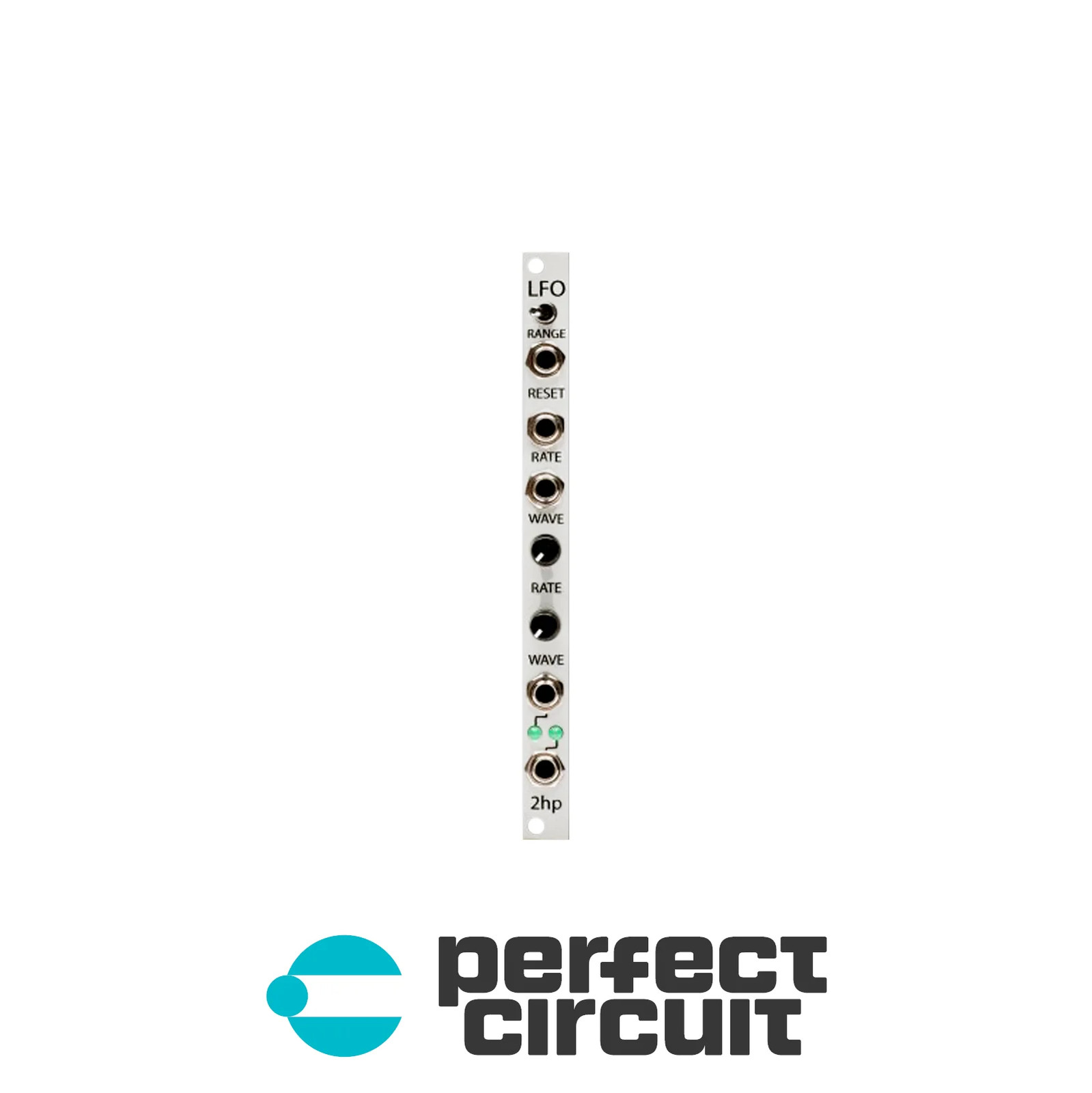
At 2HP, the LFO v2 is barely wider than a patch cable, yet it offers full voltage control over both speed and waveform—something many larger modules still treat as a luxury. The rate CV input accepts 0–10V, letting you sync the LFO to sequencers or scale its speed across octaves. The waveform CV input is equally responsive, allowing for automated morphing that can be sequenced or modulated in real time. The reset input locks the phase to an external clock, making it easy to sync modulation cycles to your sequence or drum pattern. And despite its size, it doesn’t skimp on usability: the front panel is cleanly laid out, with a large central knob for waveform selection, a smaller one for rate, and clearly labeled jacks. It’s dense, but never cluttered.
Historical Context
When 2HP launched in the early 2010s, the Eurorack scene was expanding rapidly, but modules were still mostly measured in 4HP, 6HP, even 10HP or more. The idea of doing anything useful in 2HP seemed absurd—until 2HP proved it wasn’t. Founded by engineer and designer Tony Rolando, the brand built its reputation on extreme miniaturization without sacrificing functionality. The LFO, released in 2016, was one of their early standouts—not just because it was small, but because it was smart. At a time when many LFOs were still offering basic waveforms and limited CV options, the 2HP LFO packed in morphing, dual outputs, and voltage control in a footprint most companies used for a single attenuator. It arrived alongside a wave of interest in compact, skiff-friendly systems—modular users wanting portable, battery-powered setups for live performance or travel. The LFO fit perfectly: low power draw, skiff-compatible depth, and maximum utility per HP. It wasn’t the first 2HP module, but it was one of the first to prove that minimal size didn’t mean minimal creativity.
Competitors like Intellijel, Make Noise, and Mutable Instruments were building feature-rich LFOs in larger formats, but they couldn’t match 2HP’s density. The LFO v2, released a few years later, doubled down on that advantage by adding CV control over waveform selection—a feature still rare even in larger modules. It wasn’t trying to be the flagship; it was trying to be the secret weapon. And in a market where every HP counts, that made it essential.
Collectibility & Value
The 2HP LFO v2 is still in production and widely available new for $99, which keeps the used market relatively stable. Expect to pay $70–$90 for a used unit in good condition, with prices rarely spiking due to consistent supply. The original non-v2 version occasionally appears on eBay or Reverb, sometimes listed as “LFO” without the “v2” designation, and these can go for $100–$130 among collectors who want the earlier revision—though functionally, the v2 is superior. There’s no real scarcity here, and no known production quirks or failure-prone components. Service technicians observe that the module is solidly built, with no common failure points—no pots to crackle, no jacks to loosen, no power issues reported at scale. The PCB is tightly packed, but 2HP’s assembly quality is consistent, and the modules are known to survive heavy gigging.
For buyers, the main thing to check is whether you’re getting the v2. Look for the “v2” designation on the front panel or in the product listing, and confirm it has CV control over both rate and waveform. The original LFO lacks waveform CV, which is a significant limitation. Also, verify the depth—46mm is skiff-friendly, but if you’re building a tight case, every millimeter matters. There are no known counterfeits, but some third-party sellers mislabel older units as v2s, so buying from reputable dealers or directly from 2HP’s site is safest. Maintenance is virtually nonexistent—no user-serviceable parts, no trims, no firmware. It either works or it doesn’t, and when it works, it keeps working.
eBay Listings
![2HP LFO V2 BLACK : NEW : [DETROIT MODULAR]](https://i.ebayimg.com/images/g/tIcAAeSwFflocCqZ/s-l1200.jpg)
![2HP LFO V2 SILVER : NEW : [DETROIT MODULAR]](https://i.ebayimg.com/images/g/CmcAAeSwWUhocCqd/s-l1200.jpg)

As an eBay Partner, we earn from qualifying purchases. This helps support our independent vintage technology research.