2hp Drums (2010s)
Three tiny modules that punch like a full drum machine twice their size
Overview
You open your Eurorack case, scanning for space, and there it is—two empty HP staring back like a dare. That’s where the 2hp Drums live: in the gaps, the leftover slivers, the places most modules won’t even glance at. But don’t let the size fool you. These aren’t gimmicks or space-fillers. The Kick, Snare, and Hat—sold individually but designed as a set—pack a sonic density that belies their footprint. They don’t just sit in a mix; they anchor it. There’s a reason so many compact cases end up with at least one 2hp drum module tucked beside a utility or a mixer: they’re the percussion equivalent of finding a full-size spare tire in your glove compartment.
Designed and built by the Southern California-based 2hp (Two Horses Pedal), these modules emerged in the early 2010s when Eurorack was shedding its experimental niche status and creeping into live rigs and bedroom studios. At a time when many drum modules were either bulky multi-sound units or analog emulations chasing vintage timbres, 2hp went the opposite direction—digital synthesis, minimalist control, maximum flexibility. Each drum voice uses carefully tuned digital algorithms rather than sampled sounds, which means no memory cards, no loading times, and no sample-locked rhythms. Instead, you get immediate, tweakable, and surprisingly organic-feeling percussion that can veer from tight 808-style kicks to glitchy metallic snares and shivering, modulatable hi-hats.
The Snare isn’t just a snare—it’s a texture generator. Turn the snap knob and you’re moving from a crisp pop to a granular burst that sounds like someone shaking a bag of ball bearings underwater. The 1V/oct tracking means you can sequence it melodically, which is weird, disarming, and utterly compelling in the right context. The Kick has weight without being boomy, and while it won’t shake your floor like a Motm-630, it carves a clean hole in the low end that sits perfectly in a mix. But it’s the Hat that feels like the real standout: six oscillators, three sound sources, and a sizzle knob that doesn’t just add noise—it warps the entire harmonic structure, making the hat breathe, choke, and shimmer in ways that feel almost physical.
These aren’t modules for the “I want a 909 in a box” crowd. They won’t perfectly replicate acoustic kits or give you velocity layers or round-robin variations. But if you’re after something that’s immediate, malleable, and capable of sounding both familiar and alien with a twist of a knob, the 2hp Drums deliver. They’re the kind of modules you reach for when you don’t know what you want—until you hear it.
Specifications
| Manufacturer | 2hp |
| Production Years | 2010s |
| Original Price | $139 per module |
| Width | 2HP |
| Depth | 45mm |
| Power: +12V | Kick: 70mA, Snare: 75mA, Hat: 83mA |
| Power: -12V | Kick: 3mA, Snare: 3mA, Hat: 2mA |
| Outputs | 1x audio output per module |
| Inputs | 1x trigger input per module; Hat has separate open/closed inputs |
| CV Inputs | All parameters CV controllable on Snare and Hat; Kick has pitch and decay CV |
| 1V/Oct Tracking | Yes (Snare and Kick) |
| Color | Silver faceplate with black text and controls |
| Module Type | Digital drum synthesis |
| Weight | Approx. 50g per module |
| Construction | Aluminum faceplate, PCB-mounted jacks |
| Manual Availability | Available online via 2hp website |
Key Features
Digital Synthesis with Analog Feel
The 2hp Drums use digital oscillators and noise sources paired with analog-style filtering and envelope shaping, but the line between digital precision and analog warmth is blurred in the best way. The Kick, for instance, starts with a sine wave but layers in transient noise and a tight decay envelope that can be voltage-controlled for everything from subby thumps to short clicks. It tracks 1V/oct, so you can sequence pitch changes—useful for creating rhythmic basslines or tuning the kick to the root of your chord progression. Unlike sample-based modules, there’s no looping or artifacts; the sound is generated in real time, making it responsive and dynamic.
Minimal Front Panel, Maximum Control
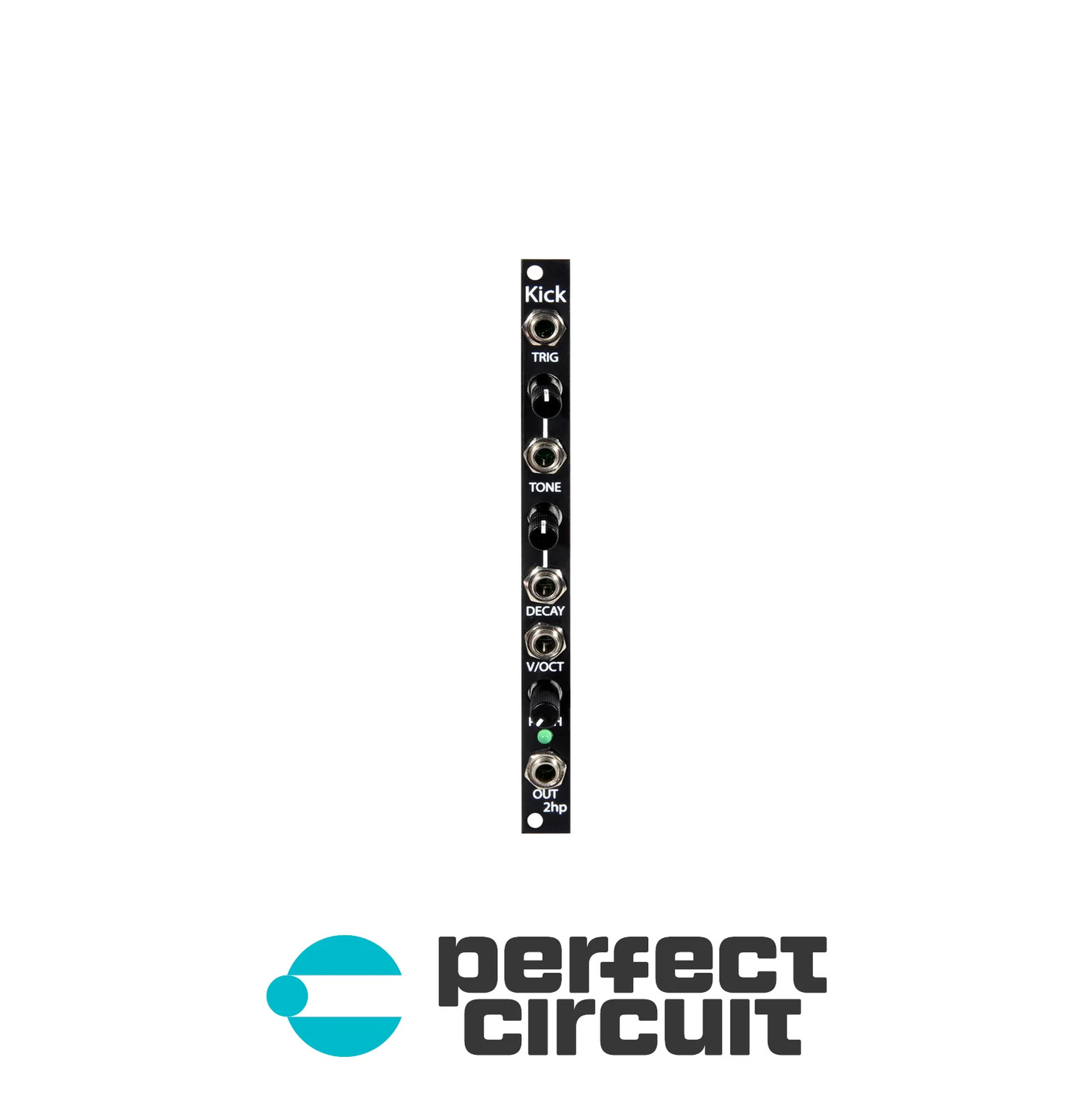
Each module has just a few knobs and inputs, but the layout is surgical in its efficiency. The Snare’s “snap” knob adjusts the balance between noise burst and resonant body, while the Hat’s “sizzle” knob modulates oscillator frequencies and filter states across its three sound sources. What’s not obvious from the front panel is the full extent of CV modulation: every parameter on the Snare and Hat can be controlled via CV, and the manuals provide voltage ranges for precise automation. This makes them ideal for generative patches or evolving rhythms that shift over time. The lack of dedicated attenuators means you’ll need to pair them with mixers or attenuators in your case, but that’s a fair trade-off for the space savings.
Modular Integration Done Right
These aren’t standalone drum machines—they’re drum *voices* built for integration. The separate open and closed trigger inputs on the Hat mean you can sequence complex hi-hat patterns without switching modules or using logic. The trigger response is snappy and consistent, with no noticeable latency, and the outputs are line-level, so they sit well in a mix without additional boosting. Because each module is only 2HP, you can fit a full kit—Kick, Snare, Hat—into just 6HP, leaving room for a mixer, envelope, or sequencer to round out the setup. That kind of density is rare in the drum module world, where most all-in-one units take up 10HP or more.
Historical Context
When 2hp launched these modules, Eurorack was still in a phase of rapid expansion, with builders experimenting on size, power, and usability. Most drum modules at the time fell into two categories: analog drum synths like the Malekko Varigate 5U or the Doepfer A-178, which offered classic 808/909 emulations but with limited variation, or full digital samplers like the Squarp Pyramid or the Critter & Guitari Organelle, which were powerful but bulky and complex. The 2hp Drums carved out a third path—digital synthesis in a micro format, prioritizing immediacy and integration over realism or feature overload.
They arrived alongside a wave of compact utility modules from builders like Intellijel, Make Noise, and ALM, but stood out by applying the “small is beautiful” philosophy to percussion. In an ecosystem where every HP counts, 2hp proved that you didn’t need a full drum computer to get expressive, controllable rhythm sounds. The modules resonated with minimalists, live performers, and case-builders optimizing for portability. They weren’t trying to replace the Roland TR-808; they were offering a new kind of rhythmic language—one built for modulation, experimentation, and tight spaces.
Competitors like the Erica Pico series or the ALM Squid Squeeze offered multi-sound drum modules, but often at the cost of individual voice control or CV flexibility. The 2hp approach—splitting the kit into discrete, specialized modules—gave users more granular control, even if it meant buying multiple units. It was a bet on modularity over convenience, and for many, it paid off.
Collectibility & Value
The 2hp Drums aren’t rare in the traditional sense—they were produced in steady numbers throughout the 2010s and remain available through dealers and the secondary market. But their collectibility lies in their utility, not scarcity. A used 2hp Snare or Hat in good condition typically sells for $100–$130, slightly below the original $139 MSRP, which says something about both their durability and the stability of the used modular market. The Kick tends to hold value a bit better, especially among bass-heavy genres, and NOS (new old stock) units with original packaging can fetch closer to $150.
Failures are uncommon but not unheard of. The PCB-mounted jacks are the weakest point—repeated plugging and unplugging can stress the solder joints, especially in live setups. There are no moving parts, no displays, and no firmware to update, so the modules are largely maintenance-free. However, because they’re digital, a failed chip could render the module unusable, and 2hp doesn’t publish repair schematics, so board-level fixes are left to advanced technicians. That said, documented failure rates are low, and most units from the early 2010s still function perfectly.
When buying used, check for clean PCBs, firm knobs, and consistent trigger response. Test all CV inputs if possible—some users report slight calibration drift over time, especially in temperature-variable environments. Power draw is modest, but ensure your case can handle the combined load if running multiple units. A full kit (Kick, Snare, Hat) pulls about 230mA on the +12V rail, which is negligible in all but the smallest power supplies.
For those building a compact or travel case, the 2hp Drums are a no-brainer. For others, the decision comes down to whether you value space efficiency and deep CV control over all-in-one convenience. They’re not the loudest, flashiest, or most feature-packed drum modules out there—but they’re among the most thoughtful.
eBay Listings

As an eBay Partner, we earn from qualifying purchases. This helps support our independent vintage technology research.