2HP COMB (2015–)
A sliver of metal that turns noise into strings, speech into ghosts, and sine waves into something alive—like a tuning fork dipped in mercury.
Overview
You don’t so much hear the 2HP COMB as recognize it—like spotting a silhouette in fog. It doesn’t blend; it announces. Slot this 2HP sliver into any Eurorack system and suddenly there’s a new voice in the room, one that hums with harmonic ghosts and metallic resonance. It’s not a filter in the traditional sense. It doesn’t smooth or muffle. Instead, it carves sonic teeth into whatever passes through, imposing a ladder of evenly spaced frequency peaks that can either gently shimmer or violently vibrate, depending on how far you push it. At low resonance, it’s a phaser’s introspective cousin—subtle, spatial, coloring without dominating. Crank the resonance, sweep the frequency, and it becomes something else entirely: a singing saw, a theremin lost in a metal warehouse, a voice speaking through a fan.
Designed by Tony Rolando of 2HP, a name synonymous with minimalist design and maximal sonic impact, the COMB fits the label’s ethos like a fingerprint. Every module they’ve made feels like it was stripped down to its DNA and rebuilt with only what matters. The COMB is no exception. It does one thing—comb filtering via an infinite impulse response (IIR) topology—and does it with surgical precision and unexpected musicality. Unlike many comb filters that live in the background as texture tools, this one demands attention. It tracks 1V/oct, which is rare and valuable in this category, meaning you can play it like a melodic instrument, not just modulate it. Feed it a saw wave, sweep the cutoff with a slow LFO, and you’ve got a pad that breathes like a living thing. Run white noise through it, and with the right dampening and feedback, it morphs into something uncannily close to a bowed string section—thin, yes, but haunting in its realism.
What makes the COMB especially potent is its feedback path, which includes a dampening filter. This isn’t just a resonance knob with a longer name—it’s the secret sauce. Without it, high resonance settings would collapse into harsh, chaotic oscillation. With it, the module stays musical even when pushed to self-oscillation, which it achieves cleanly and predictably. The dampening smooths the peaks, taming the upper harmonics just enough to keep things from turning brittle. It’s the difference between a shriek and a song. And because the feedback is internal and voltage-controllable (via the resonance CV input), you can modulate the character of the resonance itself, not just its intensity—something most comb filters don’t offer.
Specifications
| Manufacturer | 2HP |
| Production Years | 2015– |
| Original Price | $119 |
| Width | 2HP |
| Depth | 45mm |
| Power Consumption (+12V) | 87mA |
| Power Consumption (-12V) | 28mA |
| Power Consumption (+5V) | 0mA |
| Filter Type | IIR peaking comb filter |
| Self Oscillation | Yes |
| CV Inputs | Frequency CV, Resonance CV |
| Audio Inputs | Audio In |
| Audio Outputs | Audio Out |
| 1V/oct Tracking | Yes |
| Feedback Path | Internal with dampening filter |
| Topology | Infinite Impulse Response (IIR) |
| Controls | Frequency knob, Resonance knob |
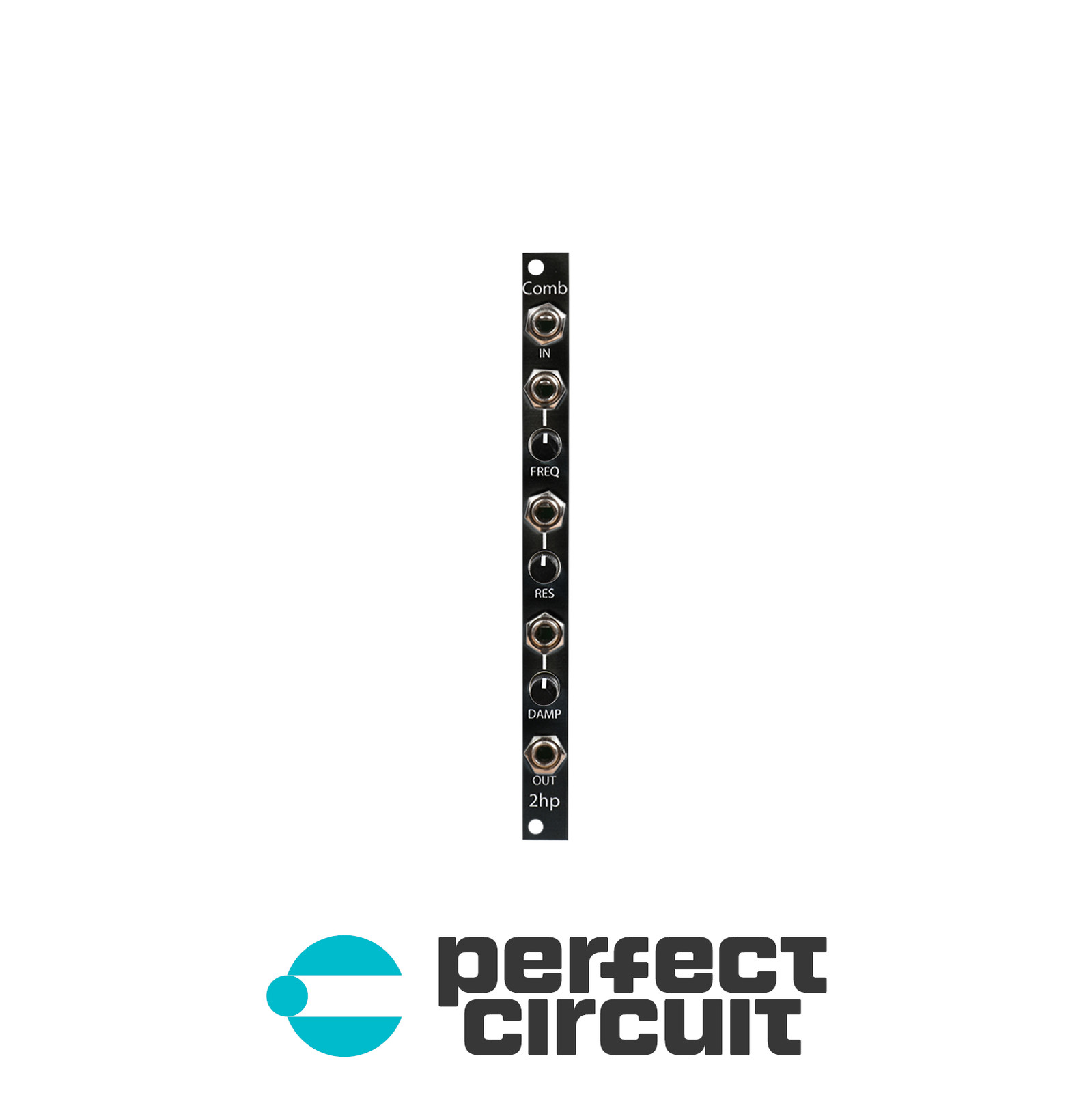
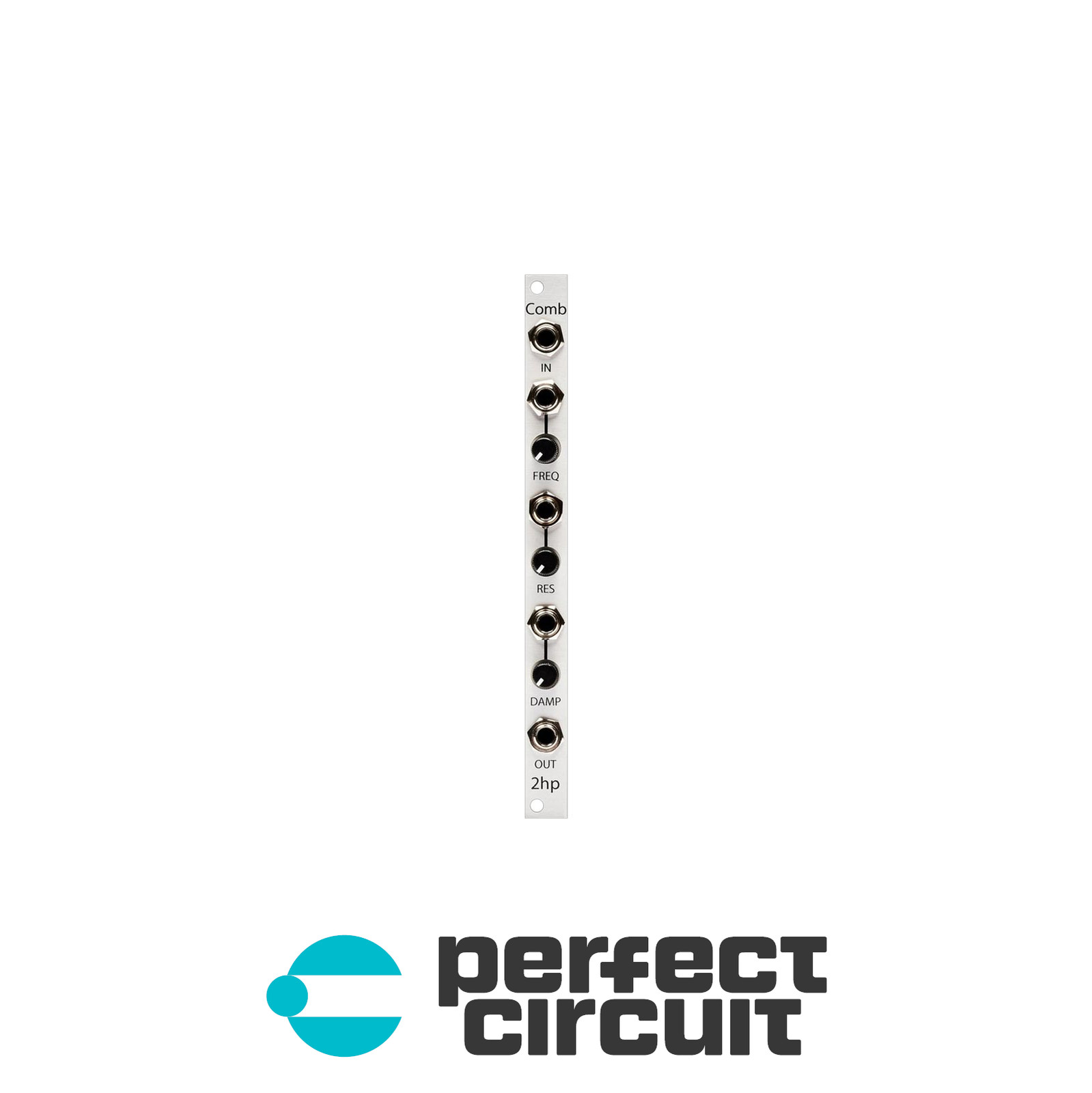
| Panel Options | Silver, Black |
| Manual Availability | Available online |
Key Features
The Narrowest Path to Rich Resonance
At just 2HP wide, the COMB is one of the most space-efficient resonant filters in Eurorack. That’s not just a spec sheet flex—it changes how you use it. You don’t need to dedicate real estate to it like you would a Serge Resonant EQ or a Mutable Instruments Peaks. It fits in the cracks, the leftover inches, the skiff corners. But don’t mistake small for simple. Its IIR topology gives it a smoother, more analog character than many digital comb filters, which can sound cold or clinical. The COMB feels alive, organic, almost acoustic in its harmonic development. The frequency knob has a wide sweep, and because it tracks 1V/oct, you can patch it into a sequencer and play melodies that sound like tuning forks struck in sequence. It’s not a full synth voice, but in a sparse patch, it can carry a melody with eerie clarity.
Resonance That Sings, Not Screams
Most comb filters either sit quietly in the background or collapse into feedback chaos when pushed. The COMB walks the line with grace. Its resonance control goes all the way to self-oscillation, but thanks to the dampening filter in the feedback loop, it doesn’t turn into a digital screech. Instead, it sings—pure sine-like tones that can be modulated, bent, and shaped. This makes it surprisingly useful as a secondary oscillator. Patch it into a feedback loop with a slight delay, modulate the frequency with an LFO, and you’ve got a drone that evolves for minutes without repeating. The resonance CV input is exponential, meaning it responds musically to control voltages, not linearly like some utilitarian modules. This lets you use envelopes or random voltages to swell the resonance in expressive, non-mechanical ways.
Feedback Dampening: The Hidden Architect
The dampening filter in the feedback path is what elevates the COMB from gimmick to essential. Without it, high resonance settings would emphasize upper harmonics to the point of harshness. With it, the module maintains a warm, rounded character even at extreme settings. This isn’t just about avoiding pain—it’s about musicality. The dampening smooths the harmonic ladder, making the peaks less piercing and more tonal. It’s why the COMB can convincingly mimic string ensembles or vocal formants from noise. It’s also why it works so well on drums: a snare hit through the COMB, with resonance modulated by the envelope, can sound like a resonant chamber or a metallic echo. This feature is rarely discussed in reviews, but owners quickly realize it’s the reason the module doesn’t fatigue the ears.
Historical Context
The 2HP COMB arrived in 2015, right as Eurorack was shifting from boutique curiosity to mainstream synth culture. At the time, most filter modules were either analog classics (Moog-style ladder, state-variable) or digital powerhouses (like those from Make Noise or Intellijel). Comb filters existed, but they were often tucked into multi-function modules or digital effects units. A dedicated, skiff-friendly comb filter that tracked 1V/oct was practically unheard of. The COMB filled that gap with surgical precision. It wasn’t trying to be a Swiss Army knife—it was a scalpel.
Tony Rolando, the mind behind 2HP, had already built a reputation for minimalist, high-impact designs like the Loquelic Iteritas and the Z-DSP-based modules. The COMB continued that philosophy: do one thing, do it well, take up no space. It arrived alongside other compact innovators like the ALM 0-Coast and the Noise Engineering Loquelic Iteritas Perc, but stood apart by focusing on a single, under-explored sonic niche. Competitors like the Mutable Instruments Clouds offered comb filtering as part of a larger granular engine, but nothing matched the COMB’s immediacy and focus. It was, and remains, the go-to module for anyone who wants comb filtering without compromise or clutter.
Collectibility & Value
The 2HP COMB has never been rare in the traditional sense—it’s been in continuous production since 2015, and 2HP has maintained steady availability. But that doesn’t mean it’s common on the used market. It’s the kind of module people buy and keep. Original MSRP was $119, and it still sells new at that price, making it one of the best value-to-impact ratios in Eurorack. On the used market, expect to pay $80–$100 depending on condition and color. Black panels sometimes fetch a dollar or two more, but not significantly. There are no known production runs or variants that drive collector prices, and no firmware revisions to track.
Failures are uncommon. The module has no moving parts, no complex ICs beyond the core filter chip, and draws modest current. Service technicians observe that the most common issue is cosmetic—scratched or oxidized front panels, especially on older silver units. There are no known design flaws or failure-prone components. Because it’s a passive filter with no audio output stage, it won’t damage other modules if it fails. That said, always check for 1V/oct tracking accuracy when buying used. Some early units reportedly had slight tracking drift at the extremes, though this is rare and usually correctable with calibration if the design allows.
For buyers, the real question isn’t reliability—it’s utility. The COMB isn’t a “must-have” for everyone. If you’re building a first system and need oscillators, filters, and envelopes, this isn’t the place to start. But if you’ve got a solid foundation and want to add unique texture, it’s a no-brainer. It’s the module you didn’t know you needed until you hear it. And once you do, you’ll find excuses to use it everywhere.
eBay Listings


As an eBay Partner, we earn from qualifying purchases. This helps support our independent vintage technology research.