2HP Bell (2019–)
A six-voice modal synthesizer the size of a business card that rings like a struck tuning fork from another dimension.
Overview
It’s not often you plug in a module and immediately forget how small it is—until the sound hits. The 2HP Bell doesn’t just sing; it resonates, with a crystalline attack and decay that feels like tapping a glass harmonic rod with a spoon. There’s no mistaking this for a traditional oscillator or sample player. This is modal synthesis in its purest form: a digital engine modeling the physical vibrations of imaginary metal bars, plates, and bowls, all wrapped in a module that takes up less space than a power connector. It arrived in 2019 as part of 2HP’s expansion beyond utility modules into actual sound generators, and while it shares DNA with the Pluck, the Bell carves its own niche—less string, more struck metal, with a character that flirts between marimba, vibraphone, and something alien enough to soundtrack a sci-fi meditation retreat.
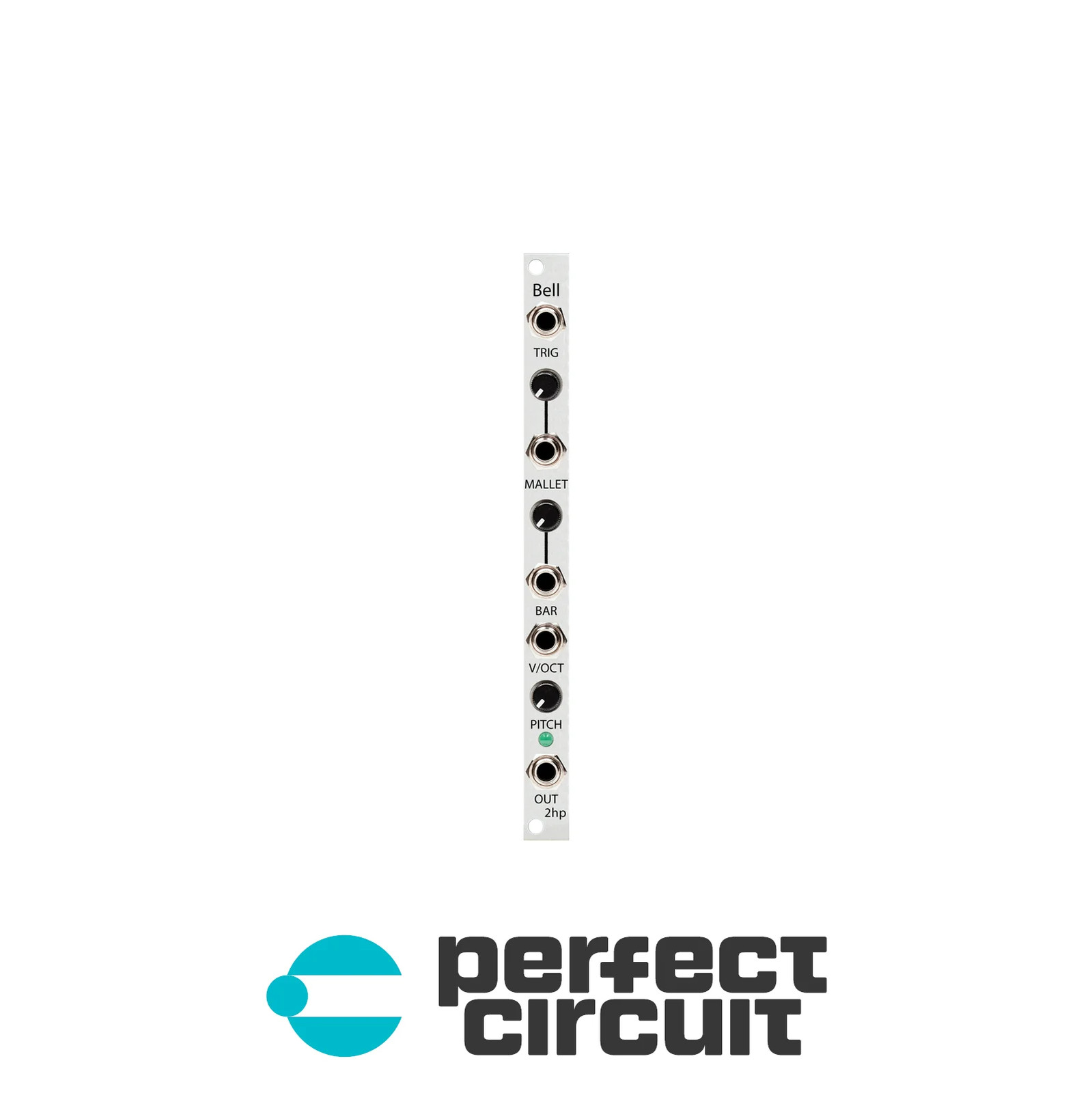
What makes the Bell stand out isn’t just its size—it’s what it doesn’t need. No external envelope, no VCA, no patching gymnastics. Send it a gate or trigger, and it produces a complete percussive event with natural decay. That self-containment is rare in Eurorack, where most physical modeling voices demand layers of modulation to sound finished. Here, the sound is immediate, responsive, and surprisingly expressive. The two front-panel knobs—Mallet and Bar—aren’t just tone controls; they’re physics dials. Mallet adjusts the hardness and damping of the virtual striker, shifting from soft felt to hard plastic to something like a steel beater. Bar alters the harmonic structure of the resonant body, changing the tuning ratios of the overtones to produce everything from in-tune chimes to dissonant, gong-like clusters. Turn them slowly, and you hear the timbre morph in real time, like tuning a bell that doesn’t yet exist.
Despite its minimalist interface, the Bell offers six-voice polyphony, a rare feature in such a narrow module. That means chords—real, ringing chords—can be played across your keyboard or sequencer without voice stealing cutting off tails mid-decay. It’s not a full-featured synth voice by any stretch, but as a melodic percussion generator, it excels. It doesn’t try to be a bass module or a lead oscillator; it knows its role and executes it with surgical precision. And while it lacks an audio input for external excitation (unlike Mutable Instruments’ Rings, its closest conceptual cousin), it makes up for it in immediacy and reliability. No tuning drift, no sensitivity to input level, no need to patch in a noise source or pluck trigger. Just clock it, tune it, and let it ring.
Specifications
| Manufacturer | 2HP |
| Production Years | 2019–present |
| Original Price | $149 USD |
| Format | Eurorack |
| Width | 2HP |
| Depth | 42mm |
| Current Consumption +12V | 86mA |
| Current Consumption -12V | 3mA |
| Polyphony | 6 voices |
| Synthesis Type | Modal synthesis (physical modeling) |
| Inputs | Gate/Trigger, 1V/Oct Pitch, Mallet CV, Bar CV |
| Outputs | Audio Out |
| Control Interface | 2 knobs (Mallet, Bar), 4 mini-toggle switches (mode selection) |
| Weight | Approx. 50g |
| Construction | PCB with front panel, no enclosure shielding |
| Color Options | Black, Silver |
| MIDI Compatibility | No direct MIDI; requires CV interface |
| Internal Envelope | Yes, decay determined by damping and material model |
Key Features
Modal Synthesis in a Matchbox
The Bell doesn’t generate sound through oscillators or samples—it simulates the way real objects vibrate when struck. Each note is a collection of resonant modes that ring and decay based on modeled material properties. This isn’t additive synthesis with pre-recorded spectra; it’s algorithmic physics. The result is a sound that feels organic, even when pushed into unnatural tunings. Because the overtones are mathematically related to the fundamental, chords retain their harmonic integrity, avoiding the metallic mush that can plague poorly tuned FM or sample-based bells. The six available physical models—selected via tiny front-panel switches—range from clean, harmonic chimes to detuned, clangorous plates, each responding differently to the Mallet and Bar controls. One setting might evoke a celesta, another a gamelan instrument, another something like a warped music box left in the rain.
Polyphony Without the Price
Six voices in 2HP is borderline absurd by Eurorack standards. Most modules that offer polyphony—like MakeNoise Mimic or Intellijel Metropolis—consume 16HP or more. Even basic digital oscillators with poly support tend to be wider. The Bell achieves this by offloading complexity to its firmware and minimizing analog circuitry. There’s no individual voice DAC per oscillator; instead, it uses a single output stream with internal voice management. This keeps the footprint tiny but means you can’t independently modulate each voice’s parameters. Still, for chordal textures, arpeggios, or layered percussion, the polyphony is a game-changer. It allows for dense, evolving bellscapes that would otherwise require multiple modules or external sequencing tricks.
No Patching Required
One of the Bell’s quiet revolutions is its independence. Unlike most Eurorack sound sources, it doesn’t demand an envelope generator or VCA to produce a finished sound. The decay is built into the physical model, shaped by the Mallet hardness and Bar damping. This makes it ideal for beginners or minimalist setups—just connect a keyboard, a clock, or a sequencer, and you’re making music. Even advanced users appreciate the simplicity: no need to match envelope times, no risk of clipping from overdriven VCAs, no phase issues from misaligned modulation. The trade-off is flexibility. You can’t force a long sustain or create a gated tremolo effect without external processing. But for what it does, it does it perfectly: a single trigger in, a complete percussive event out.
Historical Context
The 2HP Bell emerged in early 2019 at NAMM, part of a quartet of new modules (alongside DC, Grain, and Sine) that marked 2HP’s shift from being known solely for space-saving utilities to offering full-featured sound generators. At the time, Eurorack was deep into the golden age of digital synthesis, with Mutable Instruments leading the charge with modules like Rings and Plaits. Rings, in particular, had set a high bar for physical modeling in modular, offering stereo outputs, audio input processing, and multiple excitation methods. The Bell didn’t try to out-feature Rings—it aimed to out-compete on space and immediacy. In a market where rack real estate was becoming as precious as gold, a six-voice bell synth in 2HP was a provocation. It wasn’t the first modal synthesizer in Eurorack, but it was the first to deliver that complexity in such a minimal footprint. Its release coincided with a broader trend toward “minimalist maximalism”—modules that did one thing exceptionally well without wasting space. It also reflected 2HP’s design philosophy: reduce everything to its essential function, then shrink it further.
Competitors like the ALM Squarp Hermod or WMD Crucible offered similar metallic textures but with larger footprints and more complex interfaces. The Bell’s closest rival in spirit was the 2HP Pluck, its sibling module using similar physical modeling for string-like sounds. Together, they formed a compact duo for plucked and struck textures—ideal for users building small or travel systems. But while Pluck was often compared (and found wanting) next to Rings, the Bell occupied a slightly different niche. It wasn’t trying to model arbitrary resonant bodies with audio input; it was focused on melodic percussion, a role where its polyphony and self-containment gave it an edge in certain patches.
Collectibility & Value
The 2HP Bell has settled into a stable secondary market, typically selling between $120 and $180 depending on condition and color. Black units are more common and usually at the lower end, while silver panels occasionally fetch a small premium from collectors favoring contrast. Since it’s a relatively recent module with ongoing production, it’s not rare—nor is it likely to become a vintage “grail” in the way older analog classics have. But its utility ensures it rarely sits unsold. Used units are generally reliable, with no widespread failure modes reported. The most common issue is accidental damage to the tiny knobs or toggles from over-tight cabling or clumsy patching. The PCB is well laid out, but the lack of internal shielding means it can pick up digital noise in crowded cases, especially near high-current digital modules. This isn’t a fault of the module itself, but a limitation of its size—there’s simply no room for shielding.
For buyers, the main concern isn’t reliability but context. The Bell excels in small systems or as a specialized texture generator, but in larger racks, it can feel limiting. It has no audio input, no FM or sync capabilities, and no way to modulate its internal decay independently. If you already own a Rings or a Plaits, the Bell might feel redundant. But for minimalists, travelers, or those building a compact percussion-focused system, it’s hard to beat. It’s also a favorite in shared or educational racks, where its simplicity and robustness make it accessible to newcomers. Maintenance is minimal—no calibration, no tubes to replace, no mechanical parts to wear out. Just keep the jacks clean and avoid yanking patch cables sideways, and it should last indefinitely.
eBay Listings

As an eBay Partner, we earn from qualifying purchases. This helps support our independent vintage technology research.