2hp AVert (2017–)
A tiny gatekeeper of signal flow that flips your patches on their head—literally.
Overview
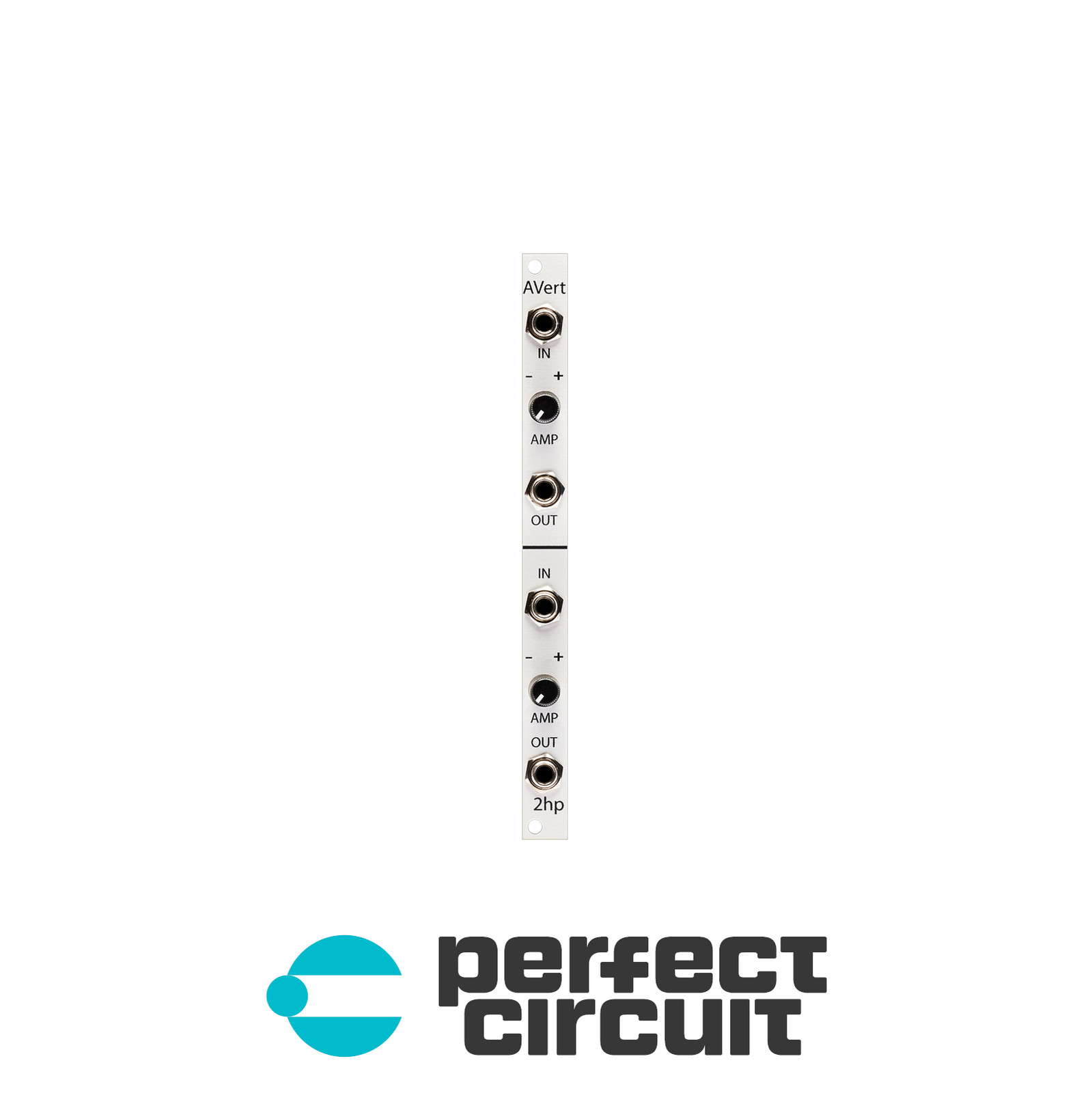
It doesn’t look like much: two knobs, four jacks, 2HP of width—barely wider than a screw. But the 2hp AVert is one of those modules that, once you’ve used it, you wonder how you ever patched without it. It’s not flashy, doesn’t make sound, and won’t win any awards for sonic innovation. But it’s the kind of utility module that quietly enables some of the most expressive moves in a modular setup—like turning an envelope into an inverted release curve, or making two LFOs dance in perfect opposition with a single source. You don’t notice it until it’s gone, and then your whole system feels off-kilter.
Each of the AVert’s two channels is a fully capable attenuverter—meaning it can reduce a signal’s amplitude all the way down to zero and then bring it back up in inverted form. Turn the knob clockwise from the center detent, and you get a normal attenuated signal. Turn it counterclockwise, and you’re in inverted territory. That zero-point tactile stop is crucial—it gives you a reliable visual and physical reference for polarity flipping, which matters when you’re trying to balance modulation depth or create push-pull control voltages. And because both channels are identical and functionally independent (except for the normalling), you can use them for anything: audio level trimming, CV scaling, gate inversion, offset generation, or even as crude mixers in a pinch.
Here’s where it gets clever: the input of channel 1 is normalled to channel 2. That means if you patch a signal into channel 1, it automatically feeds both attenuverters unless you plug something into channel 2’s input. This turns a single modulation source—say, an LFO—into two independently controlled, potentially inverted outputs. One could modulate a filter cutoff normally while the other pulls a VCA in reverse, creating a crossfaded effect without a dedicated mixer. Or use it to generate opposing waveforms for panning, FM index control, or stereo effects. The normalling isn’t just convenient; it’s generative. It encourages experimentation by making dual-path processing feel effortless.
Despite its minimal footprint, the AVert doesn’t skimp on utility. It handles both audio and CV signals with transparency—no coloration, no loading issues, no noise. It’s a passive design in function but actively powered, ensuring clean signal integrity even when dealing with low-current control voltages. And at 2HP, it’s skiff-friendly to the extreme. You could line five of them across the bottom of a 10HP panel and still have room for a power cable. That kind of density makes it a favorite among minimalists and utility hounds who treat every millimeter like gold.
Specifications
| Manufacturer | 2hp |
| Production Years | 2017– |
| Original Price | $79 |
| Width | 2hp |
| Depth | 45mm |
| Power Consumption +12V | 9 mA |
| Power Consumption -12V | 5 mA |
| Power Consumption 5V | 0 mA |
| Function | Dual attenuverter |
| Channels | 2 |
| Normalling | Input 1 normalled to Input 2 |
| Signal Type | Audio, CV, Gate |
| Inversion | Yes, per channel |
| Attenuation Range | 0% to 100% with polarity inversion |
| Knob Type | Alpha potentiometer with center detent |
| Input Impedance | 100kΩ |
| Output Impedance | 10kΩ |
| Color Options | Black, Silver |
Key Features
Center-Detent Knobs for Polarity Precision
The tactile center stop on each knob isn’t just a nice-to-have—it’s essential. When you’re inverting modulation sources, hitting true 0V is critical. Too far one way, and your filter opens when it should close; too far the other, and your panning goes haywire. The detent gives you a reliable pivot point, letting you balance attenuation and inversion with confidence. It’s especially useful when using the AVert for offset generation or when creating symmetrical modulation paths. The knobs themselves are smooth-turning Alphas, known for their durability and consistent taper, which means they’ll hold up to daily tweaking without crackling or drift.
Normalling as a Creative Tool
Most dual attenuverters treat each channel as isolated. The AVert doesn’t. By normalling channel 1’s input to channel 2, it turns a single signal into a dual-output processing hub. This isn’t just about saving cables—it’s about patching economy and creative flexibility. You can send one LFO to modulate two different parameters with opposite polarities, or split an envelope to open one VCA while closing another. The normalling also makes it easy to cascade processing: use channel 1 to attenuate and invert a clock, then feed that into channel 2 for further shaping. It’s a small feature with outsized implications for how you think about signal flow.
Ultra-Compact, High-Utility Design
At 2HP, the AVert is among the narrowest functional modules in Eurorack. It doesn’t waste space on flashy LEDs, extra jacks, or redundant features. What it does, it does cleanly and efficiently. This makes it a favorite for skiff builders and minimalists who prioritize function over form. But its size isn’t just aesthetic—it’s strategic. Because it consumes so little space, you can afford to dedicate multiple units to specific tasks: one for envelope inversion, another for LFO polarity control, a third for audio level balancing. That kind of modularity within a module is rare in such a small footprint.
Historical Context
The AVert arrived in 2017, right as Eurorack was shifting from boutique curiosity to mainstream staple. Modular wasn’t just for noise artists and academics anymore—it was being adopted by pop producers, film composers, and bedroom tinkerers. As systems grew, so did the demand for intelligent utility modules that could manage complexity without adding bulk. 2hp, known for its minimalist aesthetic and surgical functionality, was perfectly positioned to answer that need.
The AVert wasn’t the first attenuverter, nor the most feature-rich. But it was one of the first to prioritize density and elegance in a format where every millimeter counts. Competitors like Intellijel and Mutable Instruments offered multi-function utilities, but they often came in 6HP or more. The AVert proved that a dedicated, no-compromise attenuverter could live in just 2HP—challenging the assumption that utility modules had to be bulky to be useful.
It also reflected a broader trend toward “patch intelligence”—modules that don’t generate sound but shape how signals interact. In a world where anyone can buy a digital oscillator with 50 waveforms, the real magic often lies in modulation routing, inversion, and signal manipulation. The AVert doesn’t make noise, but it helps you make better noise by giving you finer control over the invisible threads that tie a patch together.
Collectibility & Value
The 2hp AVert isn’t a collector’s item in the traditional sense—it’s not rare, not discontinued, and not prone to legendary status. But it is ubiquitous, and that ubiquity speaks to its value. New units still sell for $79 direct from 2hp, and used examples typically go for $50–$65 depending on condition. There’s little price inflation because the module is still in production and widely available. But that stability makes it a reliable buy: you’re not overpaying, and you’re not gambling on scarcity.
Condition-wise, the AVert is nearly bulletproof. There are no active circuitry quirks, no temperamental ICs, no failing capacitors. The most common failure point is the potentiometers, but even those are high-quality Alphas that resist crackle and wear. If a knob starts to act up, it’s usually a simple replacement—no board-level repairs needed. The jacks are sturdy Neutrik types, and the PCB is cleanly laid out with minimal components, reducing points of failure.
When buying used, check for bent mounting tabs or deep scratches on the faceplate—cosmetic issues, but worth noting if you’re building a matching skiff. Also verify that both knobs have a crisp center detent and that the normalling works as expected (patching into channel 2 should break the link from channel 1). Since the module draws minimal power and doesn’t stress the PSU, there are no hidden maintenance costs or recapping requirements.
For new users, the AVert is a near-essential first utility module. It’s often bundled with other 2hp basics like the Switch or Unity, and for good reason: it solves real problems without complexity. For veterans, it’s a space-saving workhorse that earns its place at the bottom of every case. It may never be the star of the patch, but it’s always working behind the scenes—quiet, reliable, and absolutely indispensable.
eBay Listings


As an eBay Partner, we earn from qualifying purchases. This helps support our independent vintage technology research.