1010music Synthbox (2017–2021)
A touchscreen-powered Eurorack polyphonic synth that feels like a handheld workstation crammed into 26HP—just don’t expect analog warmth.
Overview
When you first power up the 1010music Synthbox, the screen lights up like a mini command center—bright, responsive, and immediately intuitive. There’s no hunting through menus with tiny buttons; instead, you’re greeted with a full-color touchscreen that puts wavetables, modulation routing, and effects just a tap away. It’s rare in Eurorack for something to feel this modern and user-friendly without sacrificing depth, but the Synthbox pulls it off by leaning hard into its digital brain. This isn’t a module that tries to emulate vintage analog character; it’s a clean, precise, polyphonic digital synth voice generator with the flexibility of a software instrument, but built for your rack. Four voices of polyphony mean you can play chords, sequence lush pads, or stack leads—all while maintaining tight integration with CV/Gate and MIDI.
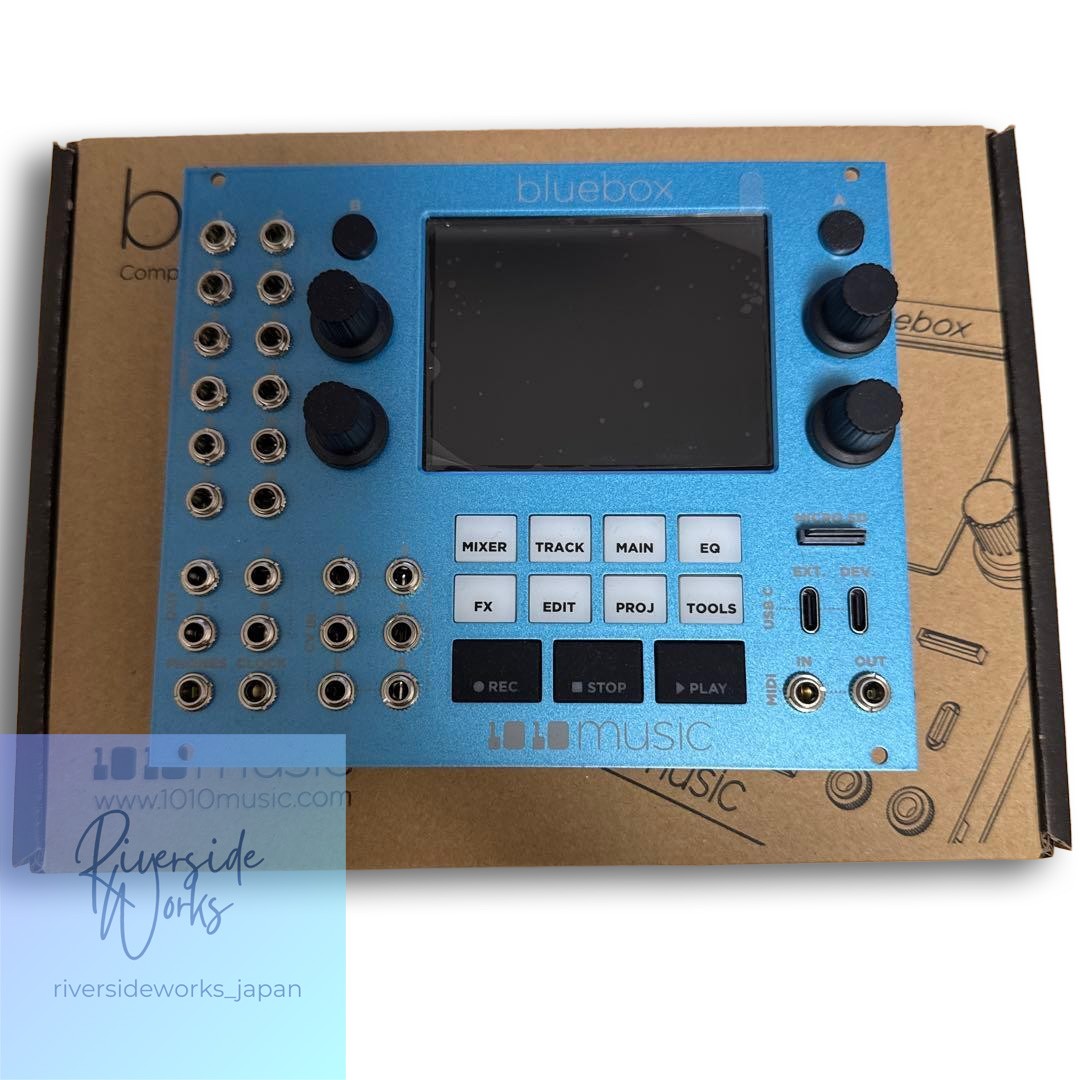
Under the hood, the Synthbox is part of 1010music’s “Series 1” family, sharing identical hardware with the Bitbox and Fxbox. The difference? Firmware. That means the module you buy as a Synthbox can become a sampler or multi-effects processor with a simple SD card swap—no soldering, no mods. This reprogrammable nature gives it a kind of future-proof appeal that’s almost unheard of in modular. But it also means that buying a used Synthbox requires extra care: you’re not just buying a synth module, you’re buying a specific configuration of firmware and content. Owners report that missing wavetables or outdated firmware can render the unit nearly useless until properly restored. And yes, that’s happened enough times on forums to be a real cautionary tale.
Sound-wise, the Synthbox splits the difference between clinical clarity and creative texture. It’s not going to give you the creamy saturation of a Moog or the gritty instability of a Roland SH series—but that’s not the point. Its strength lies in wavetable synthesis, where it offers 100 factory wavetables and the ability to load custom ones from Serum or other sources via WAV files. Each voice runs three oscillators: one classic analog-style (saw, square, triangle, sine), and two wavetable oscillators capable of scanning, morphing, and looping through waveforms. The result is a synth that excels at evolving textures, digital sweeps, and glassy leads—perfect for ambient, techno, or IDM, less so for vintage soul or rock tones.
Specifications
| Manufacturer | 1010music |
| Production Years | 2017–2021 |
| Original Price | $599.95 |
| Form Factor | Eurorack |
| HP | 26 |
| Depth | 25 mm |
| +12V Current Draw | 350 mA |
| -12V Current Draw | 0 mA |
| 5V Current Draw | 0 mA |
| Weight | 0.78 lbs |
| Dimensions | 6.75 × 6.25 × 2.125 in |
| Polyphony | 4 voices |
| Oscillators | 3 per voice (1 analog-style, 2 wavetable) |
| Filters | 2 multimode filters per voice |
| Envelopes | 2 per voice |
| LFOs | 2 per voice |
| Sequencer | 16-step sequencer per voice |
| Effects | Flanger, distortion, stereo delay (global) |
| Audio Outputs | Stereo main output, 4 individual voice outputs |
| Inputs | MIDI (TRS), CV inputs (pitch, gate, 3 assignable per voice), stereo audio inputs |
| Processing | 24-bit DACs, internal 24-bit processing |
| Display | 3.5-inch multi-touch color screen |
| Storage | microSD card slot |
| Preset Count | 50 factory presets |
| Wavetables | 100 factory wavetables, supports user WAV files |
Key Features
The Touchscreen That Changes Everything
In a world where most Eurorack modules demand cryptic button presses and LED interpretations, the Synthbox’s 3.5-inch touchscreen feels like a revelation. It’s not just a gimmick—it’s the central nervous system. You can draw modulation curves, drag LFO rates, tweak filter resonance with a swipe, and even use XY pads to control two parameters at once. The interface is so well laid out that most users report rarely needing the manual. But there’s a catch: the viewing angle from below is narrow. If you mount it low in a skiff, you’ll either crane your neck or rotate the module upside down (which flips the UI, but leaves the panel labels backward—though inverted panels are available for obsessive types). The screen’s responsiveness is excellent, but dust or moisture can cause glitches, and replacements aren’t trivial if it fails.
Firmware Flexibility: One Module, Three Personalities
The real magic of the Synthbox isn’t just what it is—it’s what it could become. Because it shares hardware with the Bitbox (sampler) and Fxbox (multi-effects), swapping firmware turns it into a completely different module. This means a used Synthbox might arrive as a blank slate without presets or wavetables unless the seller included the proper SD card content. Conversely, a savvy buyer can acquire a Bitbox, load Synthbox firmware, and save hundreds. But beware: 1010music eventually moved to Series 2 modules (like the Nanobox), which are physically incompatible. Series 1 firmware won’t run on Series 2, and vice versa. So while the Synthbox is a chameleon, it’s locked into its generation.
Polyphony Meets Patchability
True polyphony in Eurorack is still rare, and the Synthbox delivers it without compromise. Each of its four voices has independent access to two envelopes, two LFOs, two filters, and a 16-step sequencer. You can route modulation internally via the touchscreen or externally via CV. The CV implementation is smart: in “Four Voice” mode, each row of CV inputs controls a single voice, enabling complex per-voice modulation from sequencers or random sources. In “Global” mode, modulation is shared—useful for sweeping all voices at once. The ability to route each voice to its own output also opens up spatial mixing, external effects processing, or integration with modular mixers. It’s semi-modular by design: you can patch around internal routings or let the synth handle everything internally.
Historical Context
The Synthbox arrived in 2017, a time when Eurorack was exploding beyond esoteric noise boxes and into full-fledged musical instruments. Modular wasn’t just for experimentalists anymore—it was being adopted by producers, live performers, and composers who wanted hands-on control without sacrificing playability. The Synthbox answered that need by offering something most modular synths lacked: immediacy. While others required dozens of modules to achieve polyphony and effects, the Synthbox delivered it in one compact unit. It competed not with traditional analog VCO/VCF modules, but with digital powerhouses like the Mutable Instruments Plaits (discontinued) or the MakeNoise Morphagene (for sampling). Its closest rival in function might have been the Critter & Guitari Organelle, but that was a standalone device. The Synthbox’s integration into Eurorack—complete with CV, MIDI, and patch points—made it a bridge between desktop synths and modular systems.
1010music, a relatively small player, carved a niche by focusing on digital innovation within the analog-dominated modular world. The Synthbox wasn’t their first product—Bitbox came earlier—but it was their first full-featured synth voice. Its release signaled a shift: digital didn’t have to mean cold or inaccessible. With a touchscreen, intuitive UI, and firmware flexibility, it felt like a glimpse into the future of modular. But by 2021, 1010music had shifted focus to the Nanobox line, and the Synthbox was quietly retired. No direct successor emerged, leaving the Synthbox as a unique artifact of a brief window when firmware-swappable, touchscreen-driven Eurorack modules seemed like the next big thing.
Collectibility & Value
As of 2026, the Synthbox trades between $400 and $550 used, depending on condition and completeness. The sweet spot is around $450 for a working unit with original firmware, SD card, and presets loaded. Units missing wavetables or stuck on outdated firmware can be frustrating to restore—some buyers have reported spending hours digging through archived forum posts to recover factory content. There are no known hardware failure points beyond the standard Eurorack risks (overvoltage, loose power connectors), but the touchscreen is the most delicate component. If it fails, repair options are limited; 1010music no longer supports the unit directly, though firmware and documentation remain available on their forum.
Collectibility is moderate. It’s not a “holy grail” like a vintage PPG Wave, but it’s respected among digital modular enthusiasts for its versatility and build quality. The firmware-swap capability adds long-term value—owning a Synthbox is like owning three modules in one. However, its lack of analog circuitry means it doesn’t appeal to the vintage purists. The real market is among working modular musicians who want a reliable, expressive digital voice that doesn’t require a laptop. When buying, insist on a demo video showing all four voices, effects, and touchscreen responsiveness. Avoid units listed as “for parts” unless you’re prepared to troubleshoot firmware issues. And remember: if it says “Bitbox” on the panel but runs Synthbox firmware, it’s functionally identical—don’t overpay for a name.
eBay Listings
As an eBay Partner, we earn from qualifying purchases. This helps support our independent vintage technology research.