1010music Nanobox (2021–)
A synth the size of a deck of cards that somehow packs in more synthesis than your entire rack from 2005.
Overview
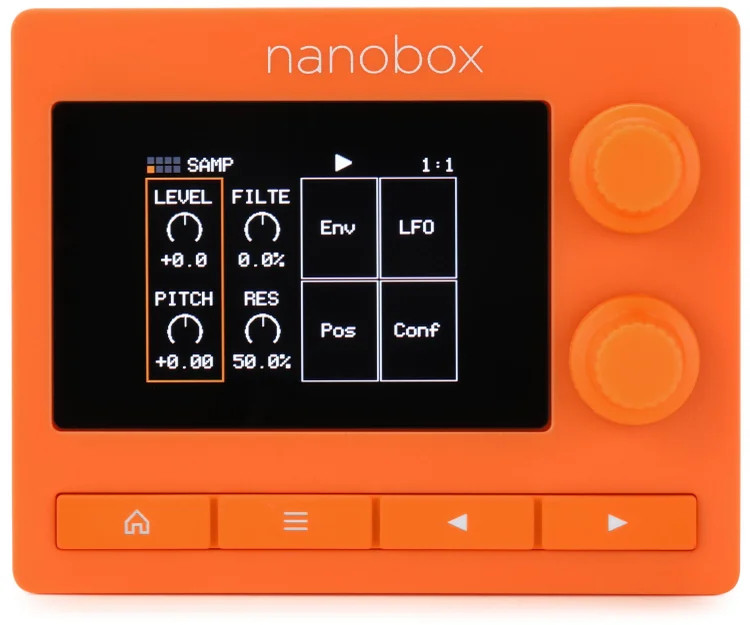
Hold one in your hand and you’ll laugh—this thing looks like a kid’s toy, a candy-colored plastic slab with a tiny screen and two knobs you could lose in a couch cushion. But power it up, tap that touchscreen, and suddenly you’re knee-deep in a granular engine or wavetable explorer with routing options that’d make a modular head blush. The 1010music Nanobox isn’t just small; it’s a genre in a box, with each variant—Lemondrop, Fireball, Razzmatazz, Tangerine—delivering a different flavor of digital synthesis in the same palm-sized chassis. It’s the rare piece of gear that feels like magic the first time you modulate a grain cloud via an XY pad the size of a postage stamp.
What makes the Nanobox line remarkable isn’t just the density of features, but how accessible they are. You’d expect menu diving to be a chore with a 2-inch screen, but 1010music’s “Stack” system—where touching a parameter opens a vertical column of related controls—keeps things surprisingly flat and responsive. The interface rewards exploration: tweak a filter, assign an LFO with a tap, draw a modulation curve with your finger, and before you know it, you’ve spent an hour lost in a morphing pad that started as a single WAV file. It’s not just a synth; it’s a sound design sandbox. And despite the toy-like appearance, the build holds up—sturdy ABS plastic, recessed jacks, and a screen that resists smudges after weeks of daily use.
These aren’t one-trick pocket synths. The Lemondrop, for instance, is a full four-voice granular powerhouse with live audio input, microSD loading, and a modulation sequencer that lets you draw evolving textures by hand. The Fireball swaps granular for wavetable synthesis with eight voices and deep morphing capabilities. Then there’s the Tangerine, which trades oscillators for sampling—streaming, slicing, looping, and multi-sampling with SP-1200 vibes in a fraction of the space. Each model shares the same DNA: two knobs, four soft buttons, a touchscreen, USB-C power, and a full complement of 3.5mm jacks for MIDI, audio, and clock. They’re not just siblings—they’re a family of compact sound engines that redefine what “desktop” means.
Specifications
| Manufacturer | 1010music LLC |
| Production Years | 2021– |
| Original Price | $399 |
| Synthesis Type | Model-dependent: granular (Lemondrop), wavetable (Fireball), FM drum synthesis (Razzmatazz), streaming sampler (Tangerine) |
| Polyphony | 4 voices (Lemondrop), 8 voices (Fireball), 8 pads (Razzmatazz), 24 notes (Tangerine) |
| Oscillators | 2 granulators + 1 digital oscillator (Lemondrop), 2 wavetable oscillators + 1 digital oscillator (Fireball), 2 FM oscillators + sample per pad (Razzmatazz) |
| Filters | 2 multimode (LP, HP, BP, Notch), serial or parallel routing |
| Envelopes | 2 ADSR |
| LFOs | 2 |
| Modulation Sequencer | 1, 32-step, drawable via touchscreen |
| Effects | Reverb, delay, flanger, chorus, phaser, distortion, bit crusher (2 slots, model-dependent combinations) |
| Touchscreen | 2-inch full-color, responsive capacitive |
| MIDI | 3.5mm TRS MIDI In/Out (DIN adapter included), MIDI CC learn function |
| Audio I/O | Stereo 3.5mm line in/out |
| Sample Input | Line input with sampling (Tangerine, Razzmatazz) |
| Storage | microSD card slot (up to 4GB per sample), 32GB card included (model-dependent) |
| Connectivity | USB-C (power only, no MIDI), clock in (3.5mm) |
| Power | 5V, 500mA via USB-C |
| Dimensions | 95 x 76 x 38 mm |
| Weight | 115 g |
Key Features
The Stack Interface: Menu Navigation That Doesn’t Suck
In a world of synth UIs that bury essential functions under layers of submenus, the Nanobox’s “Stack” system is a revelation. Tap any parameter on the screen—filter cutoff, LFO rate, grain size—and a vertical column of related controls slides in. Want to modulate that parameter? Hit the right arrow, pick a source (LFO, envelope, sequencer, MIDI CC), and assign it in two taps. The visual feedback is immediate: three small boxes to the right of each parameter fill in as modulation sources are assigned, so you always know what’s controlling what. It’s not just efficient—it’s intuitive in a way that makes deep synthesis feel approachable, even on a screen barely larger than a matchbox. And for those who hate touchscreen precision, the two physical knobs handle value changes with satisfying resolution, while the four soft buttons manage navigation without forcing you to hunt for tiny icons.
XY Touchpad as Performance Instrument
The Nanobox doesn’t just let you draw modulation curves—it turns the XY pad into a real-time performance tool. Assign any two parameters to the X and Y axes (say, grain position and filter resonance), then slide your finger across the screen to morph between extremes. The pad even remembers a “home” position, so when you lift your finger, the sound snaps back to center—perfect for dramatic sweeps during live sets. It’s a feature usually reserved for high-end synths, but here it’s baked into a $400 module that fits in your coat pocket. Musicians report using it for everything from subtle texture shifts to full-on sonic chaos, especially on the Lemondrop, where dragging across the pad can scatter grains across the stereo field like shrapnel.
Expandable Sound via microSD
Unlike most compact synths that lock you into factory waveforms, the Nanobox line invites you to bring your own audio. Load custom WAV files onto a microSD card and use them as granular sources (Lemondrop), wavetables (Fireball), or one-shots (Tangerine, Razzmatazz). The Lemondrop, for instance, supports audio files up to 30 seconds long, opening the door to field recordings, vocal snippets, or even drum loops as raw material. The Tangerine takes it further, functioning as a full streaming sampler with clip launching, slicing, and quantized looping—all from a card that came pre-loaded with over 1,500 samples. It’s a level of flexibility almost unheard of at this size, turning the Nanobox from a preset machine into a deeply personal instrument.
Historical Context
The Nanobox arrived in 2021, not into a vacuum, but into a market already crowded with pocket synths and desktop modules. What set it apart was its refusal to compromise. While competitors like Korg’s Volca series or Teenage Engineering’s PO boxes leaned into lo-fi charm or limited functionality, 1010music doubled down on depth. The company, already known for its Blackbox sampler, applied the same philosophy here: pack in professional-grade features without inflating the footprint. The timing was key—producers were increasingly working in hybrid setups, blending hardware with DAWs, and needed compact, expressive tools that didn’t sacrifice sonic complexity. The Nanobox filled that gap, offering not just another toy, but a serious sound design tool that could live on a desk, in a backpack, or on a Eurorack panel (via power adapter).
Its closest rivals weren’t other desktop synths, but software. The Lemondrop’s granular engine, for instance, competes with plugins like Output’s Portal or Ableton’s Grain, but with the immediacy of hardware. The Fireball’s wavetable morphing rivals Serum or Massive in expressiveness, albeit with fewer oscillators. And the Tangerine? It’s a direct challenger to the Roland SP-404 or Elektron Digitakt, but in a form factor that’s barely larger than a power bank. The Nanobox didn’t invent any of these synthesis methods, but it redefined their accessibility, proving that deep, modulatable sound engines could thrive outside full-sized keyboards or modular racks.
Collectibility & Value
As of 2026, the Nanobox line remains in production, so it’s not “vintage” in the traditional sense—but it’s already collectible in spirit. Each model holds its value well, with used units selling for $300–$375 depending on condition and model. The Lemondrop and Fireball are the most sought after, with the Lemondrop edging ahead for its granular flexibility. The Tangerine, while newer, has gained a cult following among sample-based producers, often trading at near-mint prices. Because these are modern digital units with no moving parts beyond the knobs, failure rates are low—service technicians observe that the most common issue is screen calibration drift after heavy use, but firmware updates usually resolve it.
Buyers should check for firmware version—1010music has issued several updates since launch, improving stability and adding features like enhanced MIDI learn and quantization options. The microSD card should be tested for read/write errors, especially on sampling models. And while the units run fine on USB power, owners report that cheap power banks can introduce noise into the audio output, so a clean 5V supply is recommended. There’s no battery inside, so true portability requires an external pack—this isn’t a dealbreaker, but it’s a limitation worth noting. For those eyeing a set, collecting multiple Nanoboxes (say, a Lemondrop for textures and a Razzmatazz for beats) is a growing trend, with users chaining them via MIDI and clock for a full pocket-sized studio.
eBay Listings



As an eBay Partner, we earn from qualifying purchases. This helps support our independent vintage technology research.