ZORKI 4K
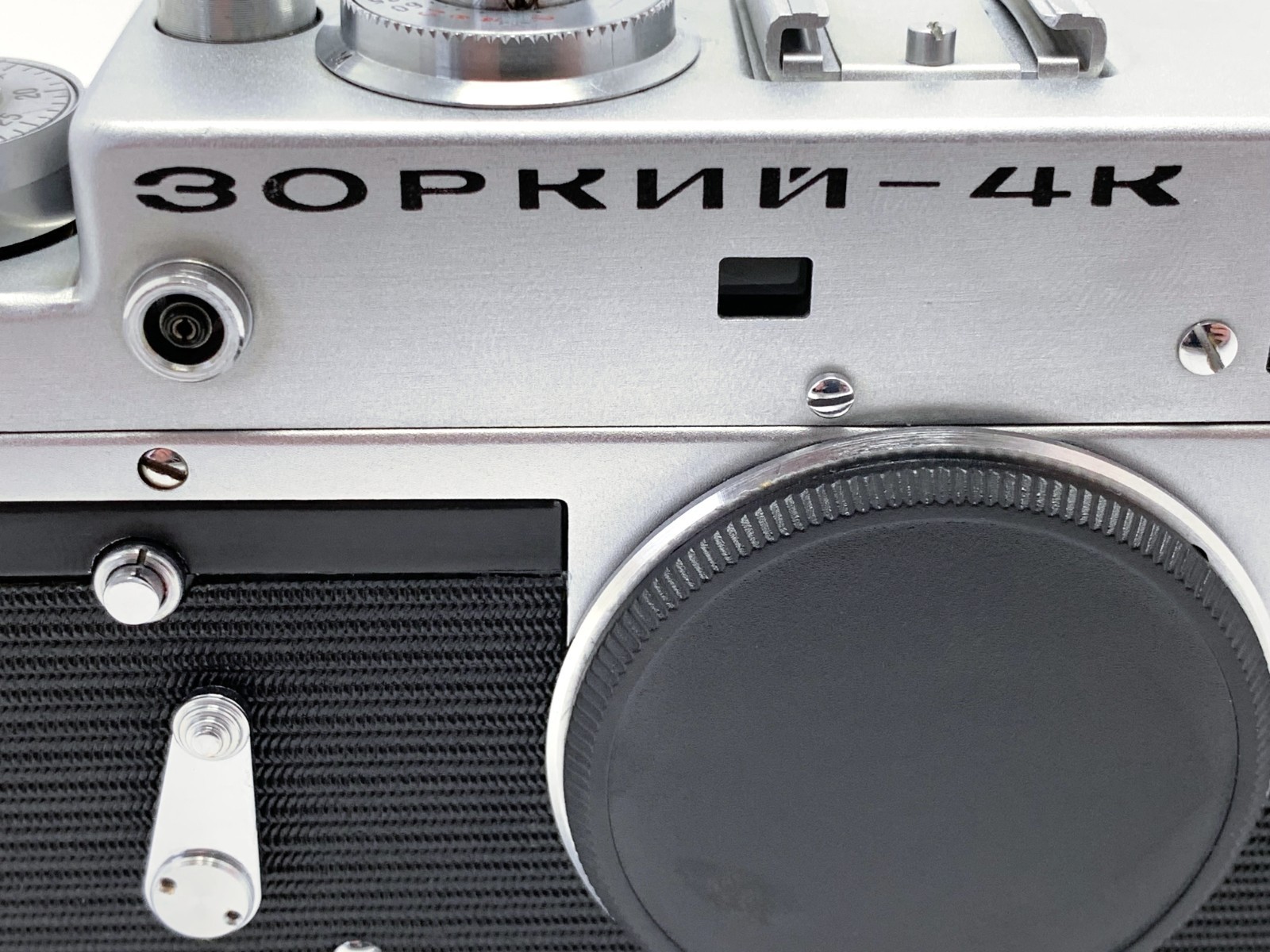
The Zorki 4K is a 35mm rangefinder camera produced by the Krasnogorsky Mekhanichesky Zavod (KMZ) in the Soviet Union from 1972 to 1978. It represents the final and most refined iteration of the Zorki 4 series, distinguished primarily by the replacement of the traditional film advance knob with a more modern lever system, improving usability and aligning it with contemporary camera design trends.
Overview
The Zorki 4K was developed as an update to the long-running Zorki 4 line, which itself was a Soviet adaptation of the pre-World War II Leica II (Model D). While earlier Zorki 4 models (produced from the 1950s through the 1960s) featured a film advance knob, the 4K introduced a lever wind mechanism, significantly improving the user experience and bringing the camera in line with global standards set by Japanese and German manufacturers. This change marked a notable evolution in Soviet camera engineering, reflecting both technical progress and an increasing focus on ergonomics.
Designed for amateur and semi-professional photographers, the Zorki 4K was marketed as a robust, mechanical rangefinder with manual controls and a durable metal body. It retained the 39mm Leica Thread Mount (LTM), allowing compatibility with a wide range of high-quality Soviet and third-party lenses, including the native Industar-50 50mm f/3.5. The camera was built entirely from metal and mechanical components, with no electronic dependencies, making it reliable in harsh conditions and appealing to users who valued mechanical simplicity.
Within the Zorki lineup, the 4K sits as the culmination of the thread-mount rangefinder series. It followed models such as the Zorki 1, 2, 3, and original Zorki 4, and preceded the short-lived Zorki-S and the ultimately unsuccessful shift toward proprietary bayonet mounts. Its production period—1972 to 1978—coincided with the rapid rise of Japanese SLRs, making the 4K a late but competent entry in the rangefinder market. Despite its outdated rangefinder design in an era shifting toward SLRs, the 4K maintained a loyal user base due to its affordability, mechanical reliability, and compatibility with Leica-thread lenses.
Specifications
| Specification | Value |
| Type | Rangefinder |
| Film Format | 35mm |
| Years Produced | 1972–1978 |
| Lens Mount | 39mm Leica Thread Mount (LTM) |
| Shutter | Cloth focal-plane shutter, speeds from 1/30 to 1/1000 sec, B, and X-sync at 1/30 sec |
| Metering | None (uncoupled light meter not integrated; later accessories available) |
| Exposure Modes | Manual only |
| Viewfinder | Combined optical viewfinder and coincident-image rangefinder, with framelines for 50mm lenses |
| Dimensions | Approx. 145 × 75 × 45 mm; weight ~650 g (without lens) |
Key Features
- Lever Wind Film Advance: Replaces the earlier knob wind system, enabling faster and more convenient film transport.
- Leica Thread Mount (LTM) Compatibility: Supports a wide array of 39mm screw-mount lenses, including Soviet Industar, Jupiter, and Zeiss Sonnar types.
- Mechanical Shutter Operation: Fully mechanical design requires no batteries, with reliable cloth shutter offering speeds up to 1/1000 sec.
- Integrated Hot Shoe: Features a standard accessory shoe for attaching external flash units with X-sync support at 1/30 sec.
- Robust Metal Construction: All-metal body and internal components ensure durability and longevity under regular use.
Historical Context
The Zorki 4K was introduced during a transitional period in the global camera market. By the early 1970s, single-lens reflex (SLR) cameras from Japanese manufacturers like Nikon, Canon, and Pentax were rapidly gaining dominance due to their through-the-lens viewing, interchangeable lens systems, and built-in metering. Rangefinders, once the preferred tool for photojournalists and street photographers, were being phased out by most Western manufacturers. In this context, the Soviet Union’s decision to update the Zorki 4 with a lever wind system in 1972 was both a modernization effort and a sign of industrial inertia—KMZ continued refining a proven but aging design rather than investing in new SLR technology.
Despite its mechanical competence, the Zorki 4K faced stiff competition not only from Japanese SLRs but also from other Soviet cameras. The FED series, also based on Leica designs and produced in Ukraine, offered similar functionality, while the Kiev rangefinders provided comparable build quality with different lens compatibility. Domestically, the Zorki 4K was widely available and relatively affordable, making it a popular choice among Soviet photographers who valued portability and mechanical reliability. However, its lack of a built-in light meter and reliance on manual exposure limited its appeal as metered and semi-automatic cameras became standard.
Collectibility & Value
Today, the Zorki 4K is a sought-after model among collectors of Soviet-era cameras and mechanical photography enthusiasts. Its lever wind mechanism makes it more desirable than earlier knob-wind Zorki 4 variants, and its status as the final evolution of the Zorki thread-mount line adds historical significance. In good working condition, with a clean viewfinder and smooth shutter operation, the Zorki 4K typically sells for $150–$250 USD, depending on lens inclusion and cosmetic condition. Fully functional units with the Industar-50 50mm f/3.5 lens command higher prices, especially if the lens coating is intact and the aperture blades are free of oil.
When purchasing a Zorki 4K, buyers should inspect several key areas: the rangefinder alignment (critical for accurate focusing), shutter consistency across all speeds (particularly 1/1000 sec, which can be unreliable in aged units), and the condition of the film advance lever mechanism, which may exhibit wear or slippage if overwound. Light seals are invariably deteriorated after 40+ years and should be replaced to prevent light leaks. Additionally, the leatherette and frame counter reset mechanism are common points of failure. While repair parts are scarce, the mechanical simplicity of the camera allows skilled technicians to service or fabricate components as needed.
Similar Cameras
- Leica IIIg (1957–1960) – The German original that inspired the Zorki design, featuring LTM mount and mechanical shutter.
- FED 5 (1970–1996) – Soviet rangefinder with built-in light meter, similar LTM compatibility and industrial heritage.
- Nikon S3 (1958–1964) – Japanese rangefinder with high build quality and excellent optics, aimed at professional photographers.
- Canon VI-L (1963–1970) – Compact rangefinder with LTM compatibility and integrated metering.
- Kiev 4 (1969–1985) – Ukrainian-built rangefinder with interchangeable viewfinders and Zeiss-derived lenses.
Repair & Maintenance
The Zorki 4K requires no batteries and operates entirely mechanically, making it functional indefinitely with proper maintenance. However, due to its age, common issues include stiff or sticky shutter blades, inaccurate rangefinder calibration, and worn film sprockets. The cloth focal-plane shutter is particularly susceptible to deterioration; speeds above 1/500 sec may be inconsistent in unrestored units. Lubricants used in the original assembly often dry out or gum up over time, necessitating a full CLA (clean, lubricate, adjust) by a technician experienced in vintage Soviet cameras.
Owners should avoid forcing the film advance lever and ensure the camera is not overwound. Replacement light seals are essential for proper light-tightness, and the viewfinder prism should be checked for haze or separation. While original spare parts are difficult to source, the mechanical design is robust and often repairable through careful disassembly and cleaning. Regular use and storage in a dry, temperature-stable environment will prolong the camera’s service life.
eBay Listings



As an eBay Partner, we earn from qualifying purchases. This helps support our independent vintage technology research.
Related Models
- Zorki 1 (1948-1956)
- Zorki 2 (1954–1956)
- Zorki 3 (1951–1956)
- Zorki 3M (1954–1956)
- Zorki 4 (1956-1973)
- Agfa Optima Sensor 1535
- Argus Argus A
- Argus Argus Autronic (1960)
- Argus Argus C-44R
- Argus Argus C