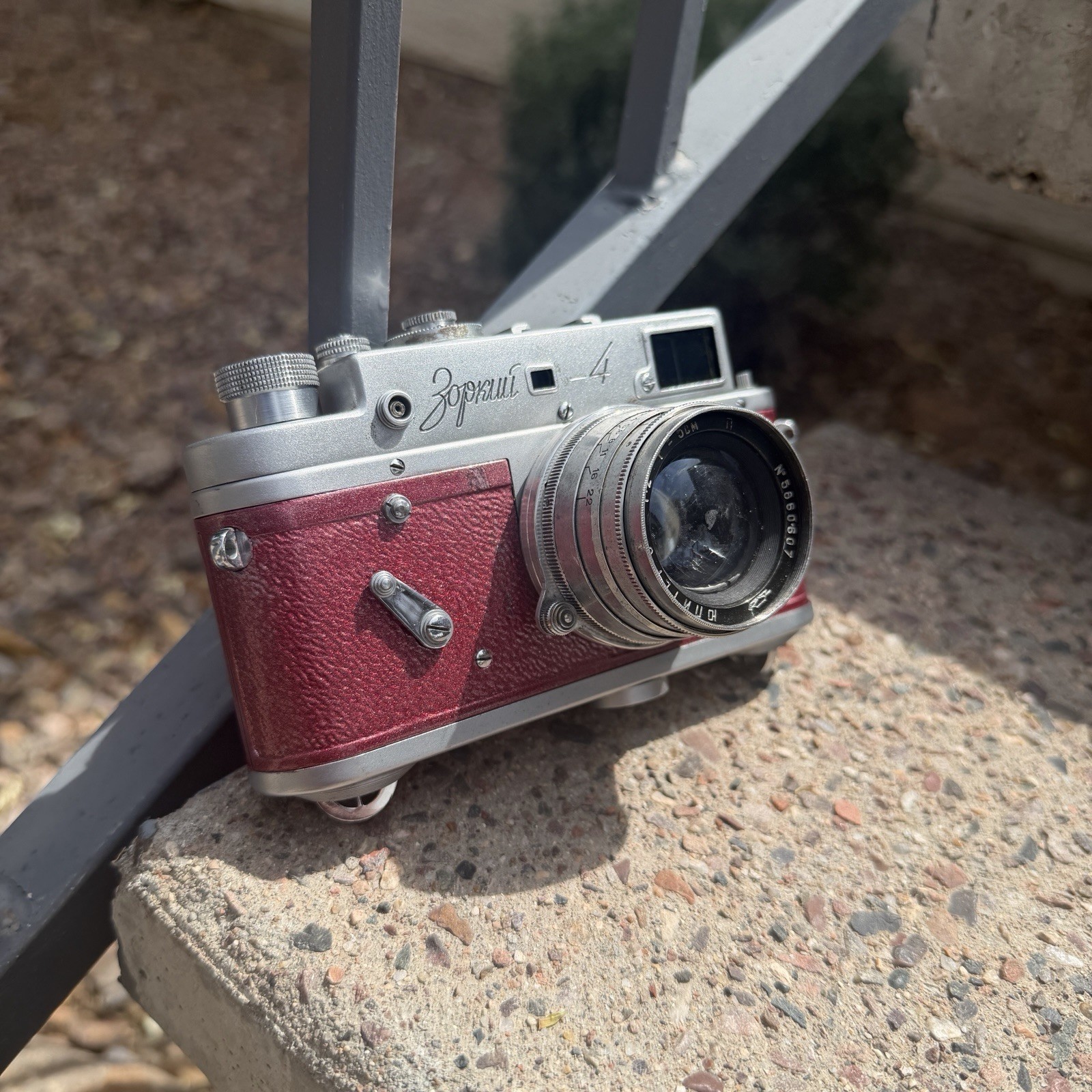
ZORKI 4
The Zorki 4 is a 35mm rangefinder camera produced by the Krasnogorsky Mechanichesky Zavod (KMZ) in the Soviet Union from 1956 to 1973. As the most successful and widely produced model in the Zorki line, it combined Leica-inspired mechanics with Soviet industrial design, offering reliable performance for amateur and professional photographers alike during the mid-20th century.
Overview
The Zorki 4 was introduced in 1956 as a direct evolution of the earlier Zorki 3 and represented a significant step forward in Soviet camera engineering. Designed primarily for the domestic market but also exported in large numbers, the Zorki 4 was positioned as an affordable yet capable alternative to Western rangefinders such as the Leica III series. It featured a robust all-metal body, a coupled rangefinder, and a focal-plane shutter, making it suitable for a wide range of photographic applications. The camera was built to last, with a mechanical design that required no batteries and could function reliably under harsh conditions.
Over its 17-year production run, more than 2.3 million units were manufactured, making it the most prolific model in the Zorki series. It served as the standard rangefinder for Soviet photojournalists, military personnel, and amateur photographers. The Zorki 4 was notable for incorporating a self-timer—a rare feature among Soviet rangefinders at the time—and for its compatibility with a range of Jupiter and Industar lenses via the Leica-screw (M39) mount. While it lacked some refinements found in its Leica counterparts—such as a slow-speed governor or a bright-line viewfinder—it offered excellent value and mechanical consistency, particularly in later production batches.
Specifications
| Specification | Value |
| Type | Rangefinder |
| Film Format | 35mm (135 cartridge) |
| Years Produced | 1956–1973 |
| Lens Mount | Leica M39 screw mount (also known as L39) |
| Shutter | Focal-plane cloth shutter, speeds 1/2 – 1/500 sec + B |
| Shutter Speeds | 1/2, 1/5, 1/10, 1/25, 1/50, 1/100, 1/250, 1/500 sec, B |
| Synchronization | PC flash sync at all speeds (X and M terminals on later models) |
| Viewfinder | Combined optical viewfinder and coincident-image rangefinder |
| Focusing | Manual, via rangefinder patch; helicoid on lens |
| Film Advance | Manual lever (single stroke), 38 mm stroke length |
| Frame Counter | Automatic reset; counts up when film is loaded |
| Exposure Modes | Manual only |
| Metering | None (uncoupled meter required) |
| Self-Timer | Yes, mechanical lever-activated (10–12 second delay) |
| Dimensions | 145 × 75 × 55 mm (approx.) |
| Weight | ~650 g (body only, no lens) |
Key Features
- Self-timer mechanism: A rare inclusion in Soviet rangefinders, aiding in self-portraits and long-exposure stability.
- Leica M39 lens compatibility: Allowed use of a wide range of Soviet and foreign lenses, including the renowned Jupiter-8 50mm f/2 and Industar-50 50mm f/3.5.
- Robust mechanical construction: Fully mechanical operation with no reliance on batteries, ensuring reliability in extreme environments.
- Coupled rangefinder: Provided accurate manual focusing, critical for fast lenses and low-light photography.
- Flash synchronization: Dual X and M flash contacts enabled use with modern electronic flashes and vintage flashbulbs.
Historical Context
The Zorki 4 was developed during the post-war expansion of Soviet consumer manufacturing, a period when KMZ sought to standardize and improve upon earlier Zorki models that were direct copies of pre-war Leica designs. Unlike the Zorki 1–3, which closely mimicked the Leica III, the Zorki 4 introduced several original design elements, most notably the self-timer and a redesigned film advance mechanism. It was engineered to be more durable and easier to mass-produce, reflecting the USSR’s emphasis on functional, utilitarian design.
In the global market, the Zorki 4 competed with cameras like the Leica IIIg, Canon VT, and early Nikon rangefinders. While it lacked the precision engineering and optical quality of its Western counterparts, it offered remarkable value for its price. Western buyers during the Cold War often acquired Zorki 4s through military exchanges or importers as budget-friendly alternatives. Despite initial quality control inconsistencies—especially in early production runs—later models (post-1960) exhibited improved tolerances and reliability. The camera remained in production until 1973, when KMZ shifted focus to the Zenit SLR line and the Zorki 4K variant for specialized use.
Collectibility & Value
Today, the Zorki 4 is a popular entry-level collectible among Soviet camera enthusiasts and rangefinder hobbyists. Due to its high production volume, it remains widely available and relatively affordable, with prices typically ranging from $50 to $150 depending on condition, lens included, and functionality. Fully working examples with clean viewfinders and smooth shutter operation command higher prices, especially when paired with a Jupiter-8 or Jupiter-9 lens.
When purchasing a Zorki 4, collectors should inspect for several common issues: shutter curtain deterioration (especially at the 1/500 speed), sticky or inaccurate rangefinder alignment, and light seals that have degraded and may cause light leaks. The self-timer mechanism is prone to jamming if not regularly exercised. Additionally, the leatherette may peel, and the frame counter can fail to reset if the internal spring is damaged. Despite these issues, the Zorki 4 is generally repairable using spare parts from donor cameras, and its simple mechanical design makes it accessible to amateur technicians. Well-maintained examples are prized for their historical significance and mechanical charm.
Similar Cameras
- Leica IIIg – The German original that inspired the Zorki series; superior build and optics but significantly more expensive.
- FED 2/3/4 – Another Soviet Leica copy, smaller and less refined, often seen as a budget alternative to the Zorki 4.
- Canon VT (1956) – Japanese rangefinder with similar shutter speeds and M39 mount; known for better ergonomics and build.
- Nikon S2 (1954) – High-quality Japanese rangefinder with bright viewfinder and excellent optics; targeted professional market.
- Minolta Hi-Matic 7 – Later Japanese rangefinder with aperture-priority automation; represents the next generation of compact 35mm cameras.
Repair & Maintenance
The Zorki 4 requires no batteries and operates entirely mechanically, making it ideal for long-term use without electronic dependencies. Common maintenance issues include worn shutter curtains, misaligned rangefinder optics, and sticky slow-speed gears. The cloth focal-plane shutter is susceptible to pinholes or tears, particularly at high speeds, and should be inspected before use. The self-timer spring may lose tension over time and can often be cleaned and re-oiled rather than replaced.
Repairing a Zorki 4 is considered moderately difficult due to tight tolerances and the complexity of the shutter mechanism, but extensive documentation and parts availability (due to high production numbers) make restoration feasible. Lubrication should be performed sparingly with high-quality clock oil to avoid gumming. Light seals degrade over time and should be replaced to prevent light leaks. Users are advised to check shutter accuracy with a timing app or oscilloscope, as speeds—especially below 1/25 sec—can vary significantly in older units. Regular use and cleaning are the best ways to preserve functionality.
eBay Listings


As an eBay Partner, we earn from qualifying purchases. This helps support our independent vintage technology research.
Related Models
- Zorki 1 (1948-1956)
- Zorki 2 (1954–1956)
- Zorki 3 (1951–1956)
- Zorki 3M (1954–1956)
- Zorki 4K (1972–1978)
- Agfa Optima Sensor 1535
- Argus Argus A
- Argus Argus Autronic (1960)
- Argus Argus C-44R
- Argus Argus C