ZORKI 3M
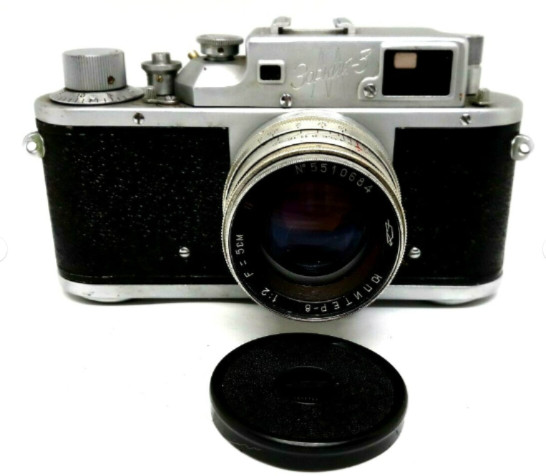
The Zorki 3M is a 35mm rangefinder camera produced by the Krasnogorskiy Mekhanicheskiy Zavod (KMZ) in the Soviet Union between 1954 and 1956. An incremental but meaningful refinement of the Zorki 3, the 3M features a combined shutter speed and film speed dial, improved ergonomics, and enhanced build quality, making it one of the more desirable early Soviet rangefinders for collectors and users alike.
Overview
The Zorki 3M was developed as an updated version of the Zorki 3, which itself was a Soviet interpretation of the German Leica IIIF, incorporating a coupled rangefinder and 39mm screw lens mount. Released in 1954, the 3M addressed several usability shortcomings of its predecessor, most notably by introducing a combined shutter speed and film speed dial—a feature that simplified exposure settings and reduced the chance of user error. The camera was manufactured at the KMZ factory in Krasnogorsk, near Moscow, during a period when the Soviet Union was actively expanding its domestic optical and mechanical industries to reduce reliance on Western imports.
Targeted primarily at amateur photographers and state-employed photojournalists, the Zorki 3M represented a practical, robust tool for everyday photography. It was not intended to rival the precision of contemporary Leica models, but rather to provide a functional, domestically produced alternative. The 3M retained the core mechanical design of the Zorki 3, including a focal-plane shutter, a combined viewfinder and rangefinder optical system, and compatibility with a wide range of Jupiter and Industar lenses via the Leica Thread Mount (LTM), also known as the M39 screw mount.
In the context of the Zorki lineup, the 3M served as a transitional model between the early Zorki 3 and the later Zorki 4 series. While outwardly similar to the Zorki 3, the 3M incorporated subtle but important refinements, including a redesigned top plate with the combined dial, improved film advance lever ergonomics, and a more reliable shutter mechanism. These changes reflected KMZ’s growing expertise in precision manufacturing and its response to user feedback from earlier models. The 3M was succeeded in 1956 by the Zorki 4, which introduced a larger viewfinder, a slower top shutter speed (1/1000 sec), and a redesigned body with a more modern aesthetic.
Specifications
| Specification | Value |
| Type | Rangefinder |
| Film Format | 35mm (135 cartridge) |
| Years Produced | 1954–1956 |
| Lens Mount | Leica Thread Mount (M39) |
| Shutter | Focal-plane cloth curtain; speeds 1/25 – 1/500 sec, B, and X-sync (1/25 sec) |
| Metering | None (uncoupled) |
| Exposure Modes | Manual only |
| Viewfinder | Combined optical viewfinder and coincident-image rangefinder |
| Dimensions | 145 × 75 × 60 mm; ~650 g (body only) |
Key Features
- Combined Shutter and Film Speed Dial: The most distinguishing feature of the 3M, this dial allows the user to set both shutter speed and film ISO (GOST) simultaneously, improving workflow and reducing misconfiguration.
- Leica Thread Mount (M39): Full compatibility with a wide range of Soviet and pre-war Leica lenses, including the highly regarded Jupiter-8 50mm f/2 and Industar-50 50mm f/3.5.
- Focal-Plane Shutter with Flash Sync: Offers X-sync at 1/25 sec for electronic flash and M-sync for bulb-type flashbulbs.
- Coincident-Image Rangefinder: Provides accurate manual focusing via a central patch visible in the viewfinder.
- Manual Film Advance and Rewind: Lever advance with automatic frame counter increment; manual rewind via crank on the base.
Historical Context
The Zorki 3M was introduced during a period of significant development in Soviet camera manufacturing. Following World War II, the USSR acquired tooling and technical documentation from German optical firms, including Leitz, which enabled KMZ to produce Leica-inspired cameras domestically. The Zorki series was central to this effort, with each model incorporating lessons from its predecessor. The 3M, though produced for only two years, represented a maturation of this design philosophy—offering improved usability without radical redesign.
At the time of its release, the 3M competed indirectly with Western rangefinders such as the Leica IIIf, Zeiss Ikon Contax IIa, and later models like the Canon VT. However, due to limited export and state-controlled distribution, the 3M was primarily used within the Eastern Bloc. It was never officially marketed as a luxury item but rather as a reliable, serviceable camera for practical photography. Despite its utilitarian origins, the 3M gained a reputation for solid build quality and mechanical reliability, particularly when compared to earlier Zorki models, which were prone to shutter and rangefinder issues.
Collectibility & Value
Today, the Zorki 3M is considered a collectible item among vintage camera enthusiasts, particularly those interested in Soviet optical engineering. Its relatively short production run (approximately 40,000 units) and the transition to the more common Zorki 4 contribute to its moderate rarity. In good working condition, with a clean viewfinder and responsive shutter, the 3M typically sells for $150–$300 USD, depending on lens inclusion and cosmetic state.
When purchasing a Zorki 3M, collectors should inspect several key areas: the rangefinder alignment (often misadjusted due to impact or age), shutter accuracy across all speeds (especially at 1/500 sec, where cloth shutters may show inconsistency), and the condition of the leatherette and top plate dials. The combined shutter/film speed dial is unique to the 3M and should rotate smoothly. Light seals are invariably deteriorated and should be replaced for proper light-tightness. While not as refined as Leica counterparts, a well-maintained 3M is fully capable of producing excellent 35mm images and remains a functional piece of photographic history.
Similar Cameras
- Leica IIIf (Germany, 1950–1957) – Direct design inspiration; superior build and optics, but significantly more expensive.
- Zorki 4 (USSR, 1956–1973) – Successor model with improved viewfinder and 1/1000 sec shutter; more common and less rare.
- FED 2/3 (USSR, 1955–1965) – Another Soviet Leica copy, smaller and lighter, produced in Kharkiv.
- Canon VT (Japan, 1956–1961) – Japanese rangefinder with similar feature set and M39 mount.
- Nikon I (Japan, 1948–1950) – Early Nikon rangefinder with M39 mount, rare and highly collectible.
Repair & Maintenance
The Zorki 3M requires no batteries and operates entirely mechanically, making it suitable for long-term use without electronic dependencies. However, like all vintage mechanical cameras, it benefits from periodic servicing. Common issues include sticky shutter curtains, inaccurate shutter speeds due to dried lubricants, and misaligned rangefinder mechanisms. The cloth focal-plane shutter is particularly sensitive to humidity and age, and replacement is complex and costly.
Routine maintenance should include cleaning of the viewfinder and rangefinder optics, inspection of the film pressure plate, and verification of the frame counter reset mechanism. The film advance lever may develop play over time due to wear in the winding gears. While repair parts are scarce, skilled technicians familiar with Soviet cameras can often refurbish existing components. Due to the camera’s mechanical simplicity and robust construction, the Zorki 3M remains one of the more repairable early Soviet rangefinders, especially when compared to later, more tightly toleranced models.
eBay Listings


As an eBay Partner, we earn from qualifying purchases. This helps support our independent vintage technology research.
Related Models
- Zorki 1 (1948-1956)
- Zorki 2 (1954–1956)
- Zorki 3 (1951–1956)
- Zorki 4 (1956-1973)
- Zorki 4K (1972–1978)
- Agfa Optima Sensor 1535
- Argus Argus A
- Argus Argus Autronic (1960)
- Argus Argus C-44R
- Argus Argus C