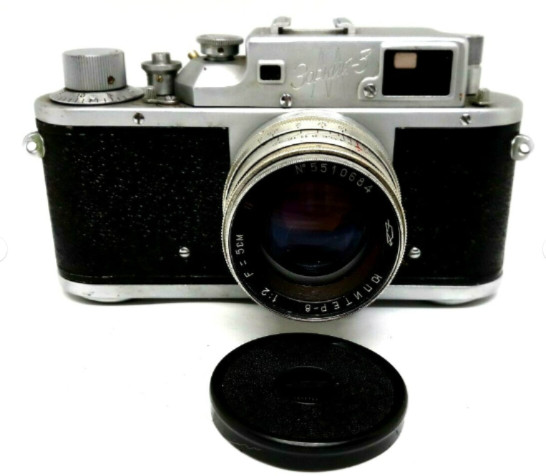
ZORKI 2
Born in the post-war hum of Soviet industry, the Zorki 2 emerged in 1955 as a quiet evolution in KMZ’s line of Leica-inspired rangefinders. More than just another copy, it refined the raw mechanics of its predecessors with thoughtful touches—a self-timer, fixed strap lugs—hinting at a growing awareness of photographer needs. Built like a tank in Krasnogorsk, this 35mm mechanical workhorse bridged the gap between wartime imitation and genuine domestic innovation, all while staying true to the 39mm Leica Thread Mount legacy.
Overview
The mid-1950s marked a turning point for Soviet camera manufacturing. No longer content with crude reproductions, KMZ began fine-tuning its designs for real-world use. The Zorki 2 arrived right on time—a no-frills, fully mechanical rangefinder aimed at amateurs and enthusiasts who demanded reliability without extravagance. It wasn’t flashy, but it was honest: solid construction, intuitive operation, and a lineage that traced back to the legendary Leica II (Model D), reinterpreted through a Soviet lens.
What set the Zorki 2 apart wasn’t a revolution under the hood, but practical upgrades that showed KMZ was listening. The addition of a self-timer gave photographers a rare luxury for self-portraits or long exposures without shake. Gone were the screw-in strap lugs of earlier models; now, fixed lugs were built directly into the body, making it safer and simpler to carry. And while the camera kept the trusted 39mm LTM mount—welcoming everything from the standard Industar-50 50mm f/3.5 to foreign Leica and Canon lenses—it remained stubbornly analog, with no built-in metering to complicate its mechanical soul.
Short-lived but significant, the Zorki 2 laid groundwork for what followed. Produced in modest numbers from 1954 to 1956, its brief run reflects the rapid pace of Soviet engineering at the time—each model iterated quickly, learning from the last. Overshadowed by the more popular Zorki 3 and 4, the Zorki 2 remains a subtle milestone: the moment Soviet cameras began to grow up.
Specifications
| Specification | Value |
| Type | Rangefinder |
| Film Format | 35mm (135 cartridge) |
| Years Produced | 1954–1956 |
| Lens Mount | 39mm Leica Thread Mount (LTM) |
| Shutter | Cloth focal-plane shutter, speeds from 1/10 to 1/500 sec and B; sync speed 1/25 sec |
| Metering | None (uncoupled light meter required) |
| Exposure Modes | Manual only |
| Viewfinder | Combined optical viewfinder and coincident-image rangefinder |
| Dimensions | Approx. 140 × 75 × 55 mm; weight approx. 590 g (body only) |
Key Features
- Self-timer mechanism: A mechanical delay lever on the front of the camera allows for exposures up to 10 seconds after release, useful for self-portraits or long-exposure stability.
- Integrated strap lugs: Unlike earlier Zorki models that required add-on strap attachments, the Zorki 2 features fixed lugs on the camera body for secure strap mounting.
- Leica Thread Mount (LTM) compatibility: Supports a wide range of 39mm screw-mount lenses, including Soviet Industar, Jupiter, and foreign Leica, Canon, and Nikon LTM optics.
- Coincident-image rangefinder: Provides accurate manual focusing via a split-image patch visible in the viewfinder.
- Manual film advance and rewind: Operated via a knurled thumb lever and bottom-mounted crank, typical of mechanical rangefinders of the period.
Historical Context
By the early 1950s, the Soviet Union was determined to master photographic technology on its own terms. KMZ, the optical powerhouse in Krasnogorsk, had already launched the Zorki 1 in 1948—a functional but rough-edged clone of the pre-war Leica II. As demand grew for more refined tools, KMZ responded not with reinvention, but with steady, pragmatic improvement. The Zorki 2 was the result: a camera shaped by user experience, not just engineering blueprints.
It didn’t dazzle with innovation, but it answered real complaints. The self-timer and fixed strap lugs brought it closer in spirit to Western contemporaries like the Leica IIIg and Canon VT—cameras that balanced precision with usability. Yet the Zorki 2 remained unapologetically analog, skipping the built-in light meters that were becoming common elsewhere. This wasn’t oversight; it was philosophy. KMZ prioritized mechanical reliability over convenience, building a camera that could function anywhere, anytime, without batteries or delicate circuits.
On the global stage, the Zorki 2 faced rising competition. Japanese manufacturers like Nikon and Canon were pushing boundaries in build quality and optical performance, often at similar price points. Domestically, it occupied a middle ground—more capable than the FED series, yet soon outpaced by the improved mechanics of the Zorki 3. Still, in its brief window, the Zorki 2 signaled a shift: Soviet cameras were no longer just copies. They were becoming their own thing.
Collectibility & Value
Today, the Zorki 2 is a quiet favorite among collectors who appreciate its transitional role in Soviet camera history. With a production run limited to just a few years, it’s less common than its successors, though not rare. What it lacks in fame, it makes up for in character—especially in well-preserved, fully functional examples.
When hunting for one, pay close attention. The self-timer is a known weak point, often gummed up by decades-old lubricants. Rangefinder optics can haze or delaminate if stored poorly, and the leatherette tends to crack or peel with age—replacements can diminish value if not done carefully. The cloth shutter is another critical component; inspect for pinholes or tears, especially if the camera was left cocked. For serious use, a full CLA from a technician familiar with Soviet mechanics is almost always worth it. Treat it right, and the Zorki 2 will reward you with crisp focus, smooth winding, and the satisfying clack of a shutter that’s stood the test of time.
Similar Cameras
- Leica II (Model D) – The German original upon which the Zorki design is based; superior build and optics but significantly more expensive.
- FED 2 – Another Soviet Leica copy, produced in Kharkiv; similar specifications but with different styling and minor mechanical differences.
- Canon VT – Japanese rangefinder with LTM mount, offering improved ergonomics and optional metering.
- Nikon S – High-quality Japanese rangefinder with excellent optics and robust construction, aimed at professional photographers.
- Zorki 3 – Direct successor with improved film advance and more reliable shutter mechanism.
Repair & Maintenance
Entirely mechanical and battery-free, the Zorki 2 thrives on simplicity. Most issues—sticky shutter speeds, misaligned rangefinders, sluggish self-timer—stem from dried grease or long dormancy. A thorough CLA can restore it to smooth operation. Parts are scarce, but donor bodies sometimes turn up in the used market. The cloth shutter demands special care: store it uncocked, keep it dry, and inspect regularly for light leaks. With regular use and smart storage, this is a camera built to last another half-century.
eBay Listings



As an eBay Partner, we earn from qualifying purchases. This helps support our independent vintage technology research.
Related Models
- Zorki 1 (1948-1956)
- Zorki 3 (1951–1956)
- Zorki 3M (1954–1956)
- Zorki 4 (1956-1973)
- Zorki 4K (1972–1978)
- Agfa Optima Sensor 1535
- Argus Argus A
- Argus Argus Autronic (1960)
- Argus Argus C-44R
- Argus Argus C