ZEISS IKON CONTAFLEX SUPER B
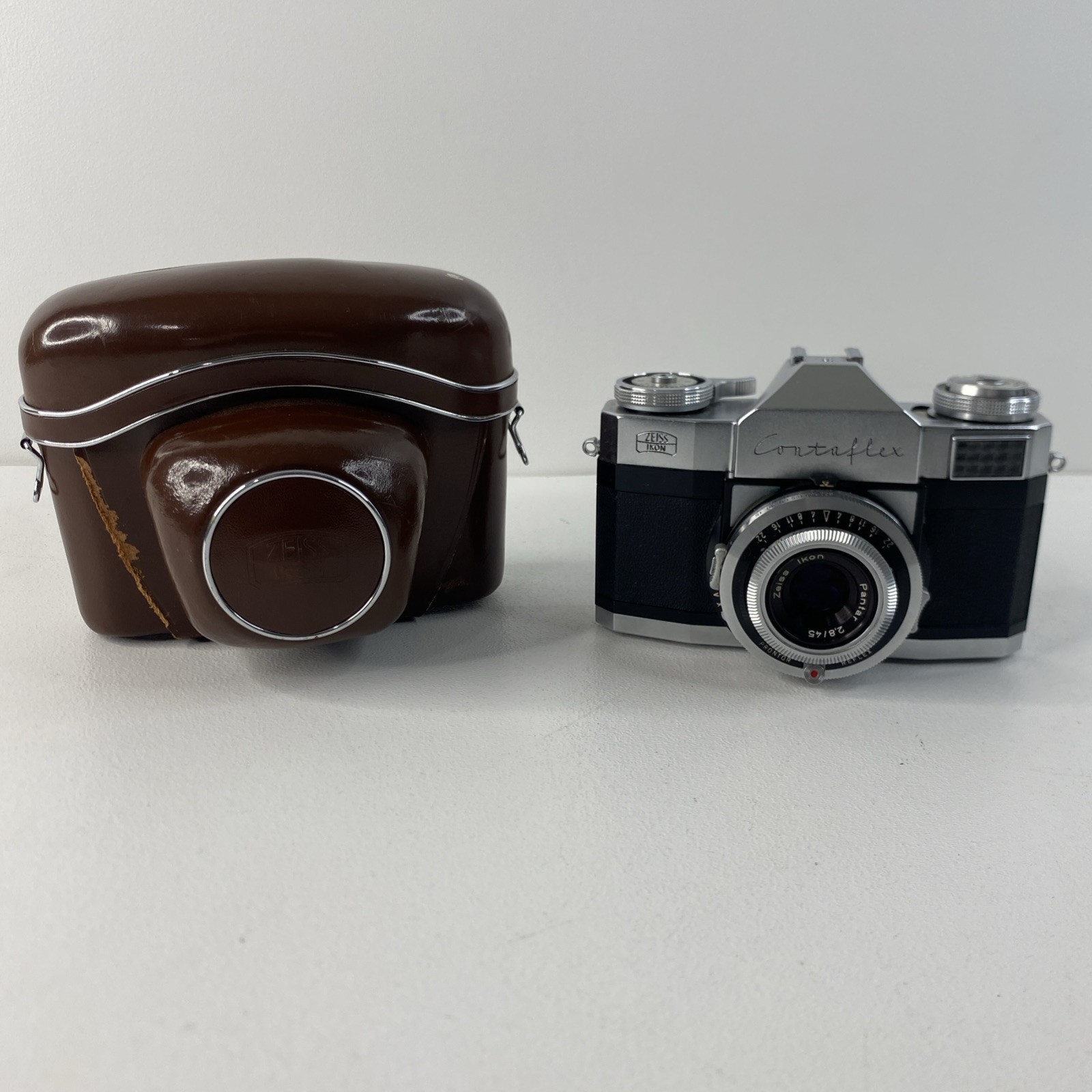
The Zeiss Ikon Contaflex Super B is a 35mm single-lens reflex (SLR) camera introduced in 1963 as an advanced iteration within the Contaflex line of compact leaf-shutter SLRs. It was the first model in the series to feature automatic exposure (AE) via a built-in selenium-cell meter and shutter-priority operation, marking a significant technological leap for Zeiss Ikon in the transition toward automation in consumer photography.
Overview
The Contaflex Super B was developed during a period of rapid innovation in SLR design, when manufacturers were exploring ways to integrate metering and exposure automation without sacrificing optical quality or mechanical reliability. Positioned as a premium compact SLR, the Super B targeted serious amateur photographers and professionals seeking a portable yet sophisticated system camera. It combined the high-quality optics of Carl Zeiss with a mechanically robust body and an innovative exposure system for its time.
One of the defining characteristics of the Contaflex series was its use of a fixed, non-interchangeable lens with a unique dual-lens reflex-like design: a front-taking lens and a rear viewing lens, both housed in a single optical unit that moved in unison. The Super B continued this design, featuring the Carl Zeiss Tessar f/2.8 45mm lens, renowned for its sharpness and compactness. Unlike most SLRs of the era that used focal-plane shutters, the Contaflex employed a leaf shutter located within the lens assembly, enabling flash synchronization at all shutter speeds—a major advantage for studio and flash photography.
The Super B was the first in the Contaflex line to offer automatic exposure, using a selenium-cell exposure meter mounted around the lens barrel. This meter powered a "match-needle" system visible in the viewfinder, guiding the user to manually adjust the shutter speed until the needle aligned with the correct exposure value. While not fully automatic in the modern sense, this system represented a pioneering step toward exposure automation in German camera engineering.
Specifications
| Specification | Value |
| Type | Single-Lens Reflex (SLR) |
| Film Format | 35mm (135 film), 24x36mm frame size |
| Years Produced | 1963–1967 |
| Lens Mount | Fixed Carl Zeiss Tessar 45mm f/2.8 (non-interchangeable) |
| Shutter | Compur-Rapid leaf shutter, speeds 1–1/500 sec, B, X-sync at all speeds (1/30 sec) |
| Aperture Range | f/2.8 to f/22 |
| Metering | Selenium-cell meter with match-needle indication in viewfinder |
| Exposure Modes | Shutter-priority semi-automatic (manual shutter speed selection with automatic aperture via match-needle guidance) |
| Viewfinder | Ground-glass focusing screen with Fresnel lens, central microprism spot, exposure needle display |
| Focusing | Manual focus via helical focusing mount (lens extends forward) |
| Flash Sync | PC terminal, X-sync at all shutter speeds (1/30 sec) |
| Battery | None required (selenium cell self-powered) |
| Dimensions | 138 x 80 x 65 mm (WxHxD) |
| Weight | Approx. 710 g (with film) |
Key Features
- Selenium-cell TTL metering with match-needle display: Enabled exposure guidance without batteries, with needle alignment in the viewfinder indicating correct exposure.
- Shutter-priority semi-automatic exposure: User selected shutter speed; meter indicated correct aperture via needle, streamlining exposure decisions.
- Leaf shutter with flash sync at all speeds: Allowed flash use at maximum shutter speed (1/500 sec), a rare advantage over focal-plane shutter SLRs.
- High-quality Carl Zeiss Tessar 45mm f/2.8 lens: Delivered excellent sharpness and contrast, with smooth bokeh and reliable close-focusing (down to 0.8m).
- Compact, integrated SLR design: Unusual for its era, combining SLR functionality in a relatively small body with fixed lens and pop-up rewind crank.
Historical Context
The Contaflex Super B was released in 1963 at a time when Japanese manufacturers like Nikon, Canon, and Pentax were advancing rapidly with interchangeable-lens SLRs using focal-plane shutters. In contrast, Zeiss Ikon maintained a conservative but refined engineering philosophy, emphasizing optical precision and mechanical durability over modularity. The Super B represented Zeiss Ikon’s attempt to modernize the Contaflex line in response to growing demand for metered and semi-automatic cameras.
It competed directly with models like the Kodak Retina Reflex IV and the Braun Paxette Reflex, though its primary rivals were emerging Japanese SLRs such as the Pentax Spotmatic (1964) and Canon FX (1964). While those models offered interchangeable lenses, the Super B countered with superior build quality, a leaf shutter advantage for flash, and a sleek, compact form factor. However, the fixed-lens design limited its appeal to professionals, restricting its market to affluent amateurs and enthusiasts.
Despite its technical merits, the Super B had a relatively short production run, ending in 1967. This was due in part to declining market share for German 35mm SLRs, rising production costs, and the industry-wide shift toward through-the-lens (TTL) metering with CdS cells—technology the selenium-based Super B could not easily adopt.
Collectibility & Value
Today, the Contaflex Super B is a sought-after collectible among vintage camera enthusiasts, particularly those interested in the evolution of exposure automation and German optical engineering. Its combination of Zeiss optics, mechanical sophistication, and historical significance as Zeiss Ikon’s first AE SLR contributes to its appeal. Units in excellent working condition typically sell for $400–$700 USD, with higher prices for fully serviced examples with strong meter response.
Collectors should be cautious of degraded selenium cells, which can lose sensitivity over time or leak and damage surrounding components. While the meter does not require batteries, a non-functional cell diminishes the camera’s usability and value. Other common issues include stiff shutter speeds, sticky aperture blades, and deterioration of the leatherette. Because spare parts are scarce and repair expertise limited, functional examples are prized. The pop-up rewind knob and film advance lever are also prone to wear, so smooth operation should be verified before purchase.
Similar Cameras
- Kodak Retina Reflex IV (1960–1966): German-built 35mm SLR with interchangeable lenses, leaf shutter, and built-in meter.
- Pentax Spotmatic (1964–1976): Japanese SLR with M42 screw mount, TTL metering, and fully manual exposure.
- Canon FX (1964): Early Canon 35mm SLR with built-in CdS meter and fixed prism.
- Braun Paxette Reflex (1953–1960): German-designed SLR with interchangeable lenses and innovative styling.
- Yashica Mat-124G (1970): TLR with built-in CdS meter and automatic exposure, though medium format.
Repair & Maintenance
The Contaflex Super B requires no batteries, as its selenium-cell meter generates power directly from light. However, these cells degrade over time, often resulting in underexposure or complete meter failure. While replacement with a modern CdS meter is possible, it requires extensive modification and is not reversible. The Compur-Rapid shutter is generally reliable but may require cleaning and lubrication if speeds are inaccurate. Aperture blades should be checked for oil or stiffness, especially if the camera has been stored for decades. Given the complexity of the leaf shutter and coupled metering system, servicing should be performed by technicians experienced with vintage German cameras. Regular use, proper storage, and periodic CLA (clean, lubricate, adjust) services are recommended to maintain functionality.
eBay Listings



As an eBay Partner, we earn from qualifying purchases. This helps support our independent vintage technology research.
Related Models
- Zeiss Ikon Contaflex Alpha (1957-1959)
- Zeiss Ikon Contaflex Beta (1957-1959)
- Zeiss Ikon Contaflex I (1953-1958)
- Zeiss Ikon Contaflex II (1954-1958)
- Zeiss Ikon Contaflex III (1956–1959)
- Alpa 6 (1948-1953)
- Agfa Agfaflex
- Agfa Ambiflex
- Agfa Easy
- Agfa Futura Af zoom