ZEISS IKON CONTAFLEX SUPER
The Zeiss Ikon Contaflex Super is a 35mm single-lens reflex (SLR) camera introduced in 1959 as an upgraded version of the original Contaflex line. It features a newly designed vertical-travel focal-plane shutter and a built-in, through-the-lens (TTL) exposure meter with a needle indicator visible in the viewfinder, marking a significant advancement in usability and precision for amateur and professional photographers alike.
Overview
The Contaflex Super was developed during a transitional period in 35mm camera design, bridging the gap between compact rangefinders and the emerging generation of system SLRs. Manufactured by Zeiss Ikon in Stuttgart, Germany, the Super model replaced the earlier Contaflex III and IV models and represented a refinement of the innovative "pseudo-rangefinder" SLR concept first introduced in 1953. Unlike conventional SLRs of the era that used interchangeable lenses, the Contaflex series featured fixed, high-quality Carl Zeiss lenses—specifically the 45mm f/2.8 Tessar—housed in a compact, die-cast alloy body with a rigid folding design. The Super model’s most notable upgrade was the replacement of the previous leaf shutter with a new vertical-travel metal focal-plane shutter, enabling faster flash synchronization (up to 1/300 sec) and a broader shutter speed range.
Targeted at advanced amateurs and photojournalists seeking precision and portability, the Contaflex Super offered TTL metering via a selenium cell mounted around the lens, eliminating the need for external meters. The meter’s needle was projected into the viewfinder, allowing real-time exposure assessment. This feature, combined with the camera’s robust build and sharp optics, positioned it as a premium alternative to both Leica rangefinders and emerging SLRs like the Asahi Pentax. It was part of Zeiss Ikon’s final wave of high-end 35mm cameras before the company’s gradual retreat from the consumer market in the mid-1960s.
Specifications
| Specification | Value |
| Type | Single-Lens Reflex (SLR) |
| Film Format | 35mm (135 cartridge) |
| Years Produced | 1959–1963 |
| Lens Mount | Fixed Carl Zeiss Tessar 45mm f/2.8 (non-interchangeable) |
| Shutter | Vertical-travel metal focal-plane shutter; speeds 1–1/500 sec + B, with X and M flash sync |
| Aperture Range | f/2.8 to f/22 |
| Metering | Selenium-cell TTL meter with center-weighted averaging |
| Exposure Modes | Manual only (shutter-priority auto exposure not available) |
| Viewfinder | Fixed pentaprism SLR viewfinder with central split-image rangefinder spot and microprism collar |
| Focusing | Manual via helical focusing mount (lens extends forward) |
| Flash Sync | PC terminal with X and M settings; sync at all shutter speeds up to 1/300 sec |
| Film Advance | Lever wind (single stroke), frame counter automatic reset on back opening |
| Frame Size | 24 × 36 mm |
| Aspect Ratio | 3:2 |
| Exposure Count | 36 exposures (standard 135 cassette) |
| Dimensions | 140 × 85 × 55 mm (W×H×D, closed) |
| Weight | Approx. 780 g (with lens, body only) |
Key Features
- Vertical Focal-Plane Shutter: Replaced the leaf shutter of earlier models, enabling faster shutter speeds (up to 1/500 sec) and improved flash sync performance.
- TTL Selenium Meter with Needle Indicator: Provided real-time exposure feedback via a needle visible in the viewfinder, a rare feature in 1959.
- Fixed Carl Zeiss Tessar 45mm f/2.8 Lens: Renowned for its sharpness, compactness, and color-corrected optics, optimized for the short flange distance.
- Integrated Split-Image Focusing Aid: Enhanced manual focusing precision with a central split-image rangefinder and surrounding microprism collar.
- Compact Folding Design: Lens and viewfinder retracted into the body for portability, with a rigid lock when extended for shooting.
Historical Context
The Contaflex Super was released at a time of intense innovation in the 35mm camera market. Japanese manufacturers like Asahi (Pentax), Nikon, and Canon were rapidly advancing SLR technology with interchangeable lens systems, while German companies like Zeiss Ikon and Leica clung to precision engineering and premium build quality. The Super model was Zeiss Ikon’s response to the growing demand for integrated metering and faster operation, directly competing with cameras like the Rectaflex and early Praktica models. However, unlike its Japanese rivals, the Contaflex retained a fixed lens, limiting its appeal to photographers seeking system flexibility.
Despite its advanced features, the Contaflex Super faced challenges in market adoption. Its high price, limited lens options, and the complexity of its mechanical shutter made it less accessible than simpler rangefinders or emerging SLRs. Production ceased in 1963, succeeded by the Contaflex Super B (with a 50mm f/2.8 Pantar lens) and later the S, which introduced a CdS meter. The Super model’s short production run—approximately four years—and relatively low output contribute to its status as a niche classic today.
Collectibility & Value
The Zeiss Ikon Contaflex Super is a sought-after model among collectors of vintage German cameras, particularly those interested in the evolution of SLR technology. Its combination of Zeiss optics, mechanical sophistication, and early TTL metering makes it a standout in pre-digital camera history. In excellent working condition, with a clear viewfinder, responsive shutter, and functional meter (though selenium cells often degrade over time), the Contaflex Super typically commands prices between $400 and $700 on the secondary market. Models with original cases, manuals, and accessories can exceed $800, especially if verified as low-production variants.
When purchasing, collectors should inspect for common issues: degraded selenium meter cells (which cannot be easily repaired), shutter inaccuracies at high speeds, lubricant drying in the focusing helix, and fungus or haze in the viewfinder prism. The folding mechanism should operate smoothly without play, and the film advance lever must engage consistently. Due to the complexity of the focal-plane shutter and the lack of readily available spare parts, repair is best left to specialists in vintage German cameras. Despite these challenges, well-maintained examples remain functional and capable of producing excellent image quality, particularly when paired with modern ISO 100–400 films.
Similar Cameras
- Pentax Spotmatic (1964) – Japanese SLR with interchangeable lenses, TTL metering, and M42 screw mount.
- Konica Auto-Reflex (1965) – Another fixed-lens SLR with auto-exposure, though later and more automated.
- Yashica TL Electro (1973) – Early electronic SLR with CdS metering, representing the next evolution in metering tech.
- Rectaflex Reflexa Special (1958) – Italian SLR with through-the-lens metering, a direct contemporary.
- Praktica FX2 (1965) – East German SLR with leaf shutter and selenium meter, similar target market.
Repair & Maintenance
The Contaflex Super requires no batteries—the selenium-cell meter generates its own power—but these cells often lose sensitivity over time, rendering the meter inaccurate or non-functional. While replacement is not feasible, the camera can still be used with an external meter. The focal-plane shutter is prone to uneven speeds if dried or gummed, especially at 1/250 and 1/500 sec, and may require professional cleaning and re-timing. The selenium cell assembly can delaminate, causing viewfinder obstruction, so inspection is crucial. Lubrication of the focusing mechanism and film transport should be done sparingly during CLA (clean, lubricate, adjust) services to avoid contamination. Due to the camera’s mechanical complexity and limited service infrastructure, repairs are best handled by technicians experienced with vintage Zeiss Ikon models. Regular use and storage in a dry environment help preserve functionality.
eBay Listings
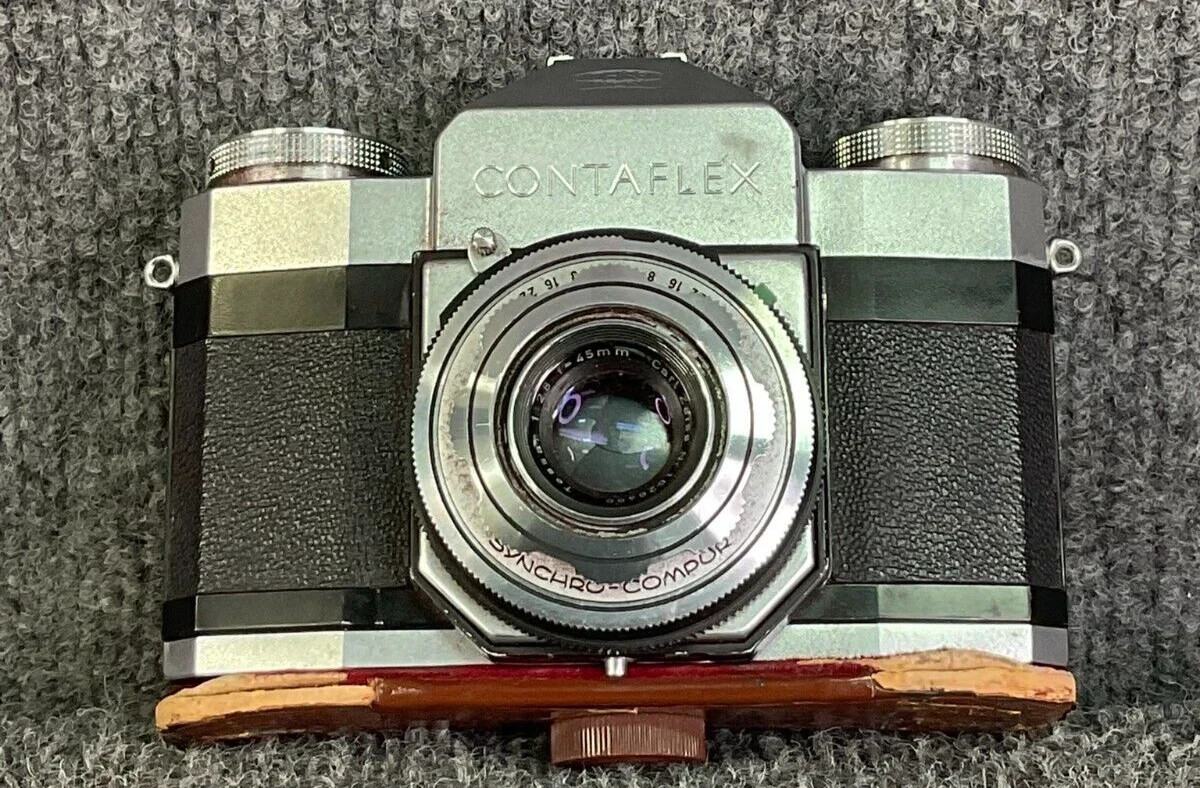


As an eBay Partner, we earn from qualifying purchases. This helps support our independent vintage technology research.
Related Models
- Zeiss Ikon Contaflex Alpha (1957-1959)
- Zeiss Ikon Contaflex Beta (1957-1959)
- Zeiss Ikon Contaflex I (1953-1958)
- Zeiss Ikon Contaflex II (1954-1958)
- Zeiss Ikon Contaflex III (1956–1959)
- Alpa 6 (1948-1953)
- Agfa Agfaflex
- Agfa Ambiflex
- Agfa Easy
- Agfa Futura Af zoom