ZEISS IKON CONTAFLEX ALPHA
Meet the Contaflex Alpha: Zeiss Ikon’s no-frills gateway into 35mm SLR photography. Released in 1957, this compact, fixed-lens reflex wasn’t built to dazzle with specs—but to deliver honest, mechanical precision at a price more amateurs could stomach. With its folding body, waist-level finder, and leaf-shutter simplicity, the Alpha strips SLR design down to its essentials. It’s a camera of quiet confidence, built in Stuttgart during a pivotal moment when German engineering met rising global competition—and chose to answer with elegance, not excess.
Overview
When Zeiss Ikon launched the Contaflex line in 1953, it set a high bar for 35mm SLRs. By 1957, the company refined its approach with the Contaflex Alpha—the most affordable model in the series. Positioned beneath the Tessar- and Planar-equipped Contaflex I, II, and III, the Alpha traded premium optics and advanced features for accessibility, targeting photographers who wanted SLR accuracy without the premium tag. Yet even in its simplified form, the Alpha never feels cheap. Its rigid folding body, precise mechanics, and clean lines speak to the same meticulous craftsmanship that defined its costlier siblings.
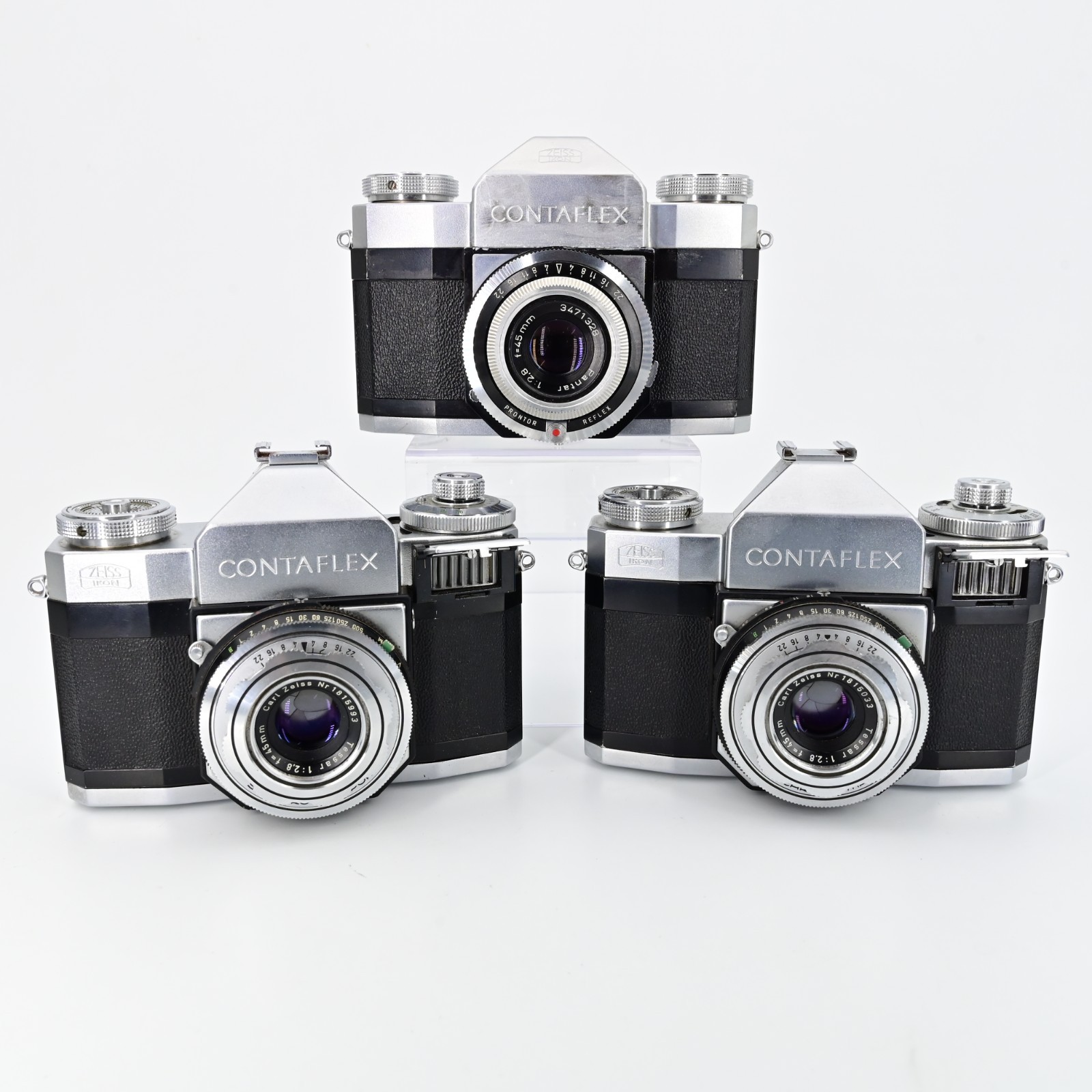
The design is instantly familiar to Contaflex fans: a front standard that retracts into the body for transport, locking solid when extended for shooting. But inside, the cuts are clear. Instead of a Tessar or Planar, the Alpha carries a 45mm f/2.8 Zeiss-Opton Pantar triplet—a modest but capable lens that keeps production costs low while delivering sharp central performance. The Prontor Reflex leaf shutter (built under license by Alfred Gauthier) offers speeds from B to 1/300 sec, but omits a self-timer and flash sync. No matter—its quiet operation and lack of focal-plane vibration give it a distinct character. For all its economy-minded choices, the Alpha still feels like a Zeiss: over-engineered, solid, and built to last.
Production lasted just two years, ending in 1959 when the Contaflex I took over as the new entry-level model. That brief run, combined with its no-frills reputation, makes the Alpha a less common sight today. But for those who appreciate the roots of SLR design, it’s a quiet milestone—a German engineering house proving that precision doesn’t have to come at a premium.
Specifications
| Specification | Value |
| Type | Single-Lens Reflex (SLR) |
| Film Format | 35mm (135 cartridge) |
| Years Produced | 1957–1959 |
| Lens Mount | Fixed (non-interchangeable) |
| Shutter | Prontor Reflex leaf shutter, speeds: B, 1–1/300 sec |
| Aperture Range | f/2.8 to f/22 |
| Focal Length | 45mm |
| Lens | Zeiss-Opton Pantar 3-element triplet, f/2.8 |
| Focus | Manual, via front standard extension (helical focus) |
| Metering | None (uncoupled light meter required) |
| Exposure Modes | Manual only |
| Viewfinder | Waist-level reflex finder with ground-glass screen |
| Flash Sync | None |
| Film Advance | Lever wind (single stroke), frame counter automatic reset |
| Frame Size | 24 × 36 mm |
| Frames per Roll | 36 (standard 135 roll) |
| Dimensions | 130 × 75 × 65 mm (closed); 130 × 75 × 105 mm (open) |
| Weight | Approx. 680 g (body only) |
Key Features
- Fixed 45mm f/2.8 Pantar triplet lens: A streamlined optical formula that balances cost and clarity, delivering crisp center performance ideal for everyday shooting.
- Prontor Reflex leaf shutter: Nestled in the lens, it enables silent operation and avoids the vibration of focal-plane shutters—perfect for discreet photography.
- Compact folding body: Collapses neatly for transport, then locks rigid when open, blending portability with stability.
- Waist-level SLR viewfinder: Lets you compose and focus directly through the lens, with a ground-glass screen that rewards careful technique.
- Manual exposure control: Full command over aperture and shutter speed—no automation, no distractions, just pure mechanical control.
Historical Context
The mid-1950s were a turning point for 35mm SLRs. Once tools for specialists, they were becoming real options for serious amateurs. Japanese brands like Asahi (soon to be Pentax) and Nikon were charging into the space with nimble, innovative designs. Zeiss Ikon, steeped in optical tradition, responded not with flash, but with focus—literally. The Contaflex Alpha offered the core SLR advantage: seeing exactly what the film sees—without the price of a Tessar lens or complex shutter system.
Still, the Alpha arrived at a crossroads. It lacked a built-in meter, flash sync, and the faster f/2.0 or f/1.8 lenses that were gaining favor. Meanwhile, Japanese SLRs like the Asahiflex IIb were pushing ahead with interchangeable lenses and faster production cycles. Then came the pentaprism, first seen in the 1958 Contaflex Super, flipping the image right-side-up and making waist-level finders feel instantly outdated. The Alpha, with its classic top-down view, was already a step behind. By 1959, Zeiss Ikon quietly retired it, letting the Contaflex I take the entry-level throne. The Alpha’s short life wasn’t a failure—it was a calculated move in a shifting market.
Collectibility & Value
Today, the Contaflex Alpha is a sleeper among Zeiss Ikon collectors. Its short production run and “economy model” label mean fewer survived, and fewer still were cherished. Yet that’s part of its charm. In working condition—with a haze-free lens, smooth focus, and reliable shutter—it typically sells for $300 to $600. Condition is everything: a clean Pantar lens and crisp shutter response drive value, while fog, fungus, or sticky speeds can quickly sink it.
Watch for telltale age issues. The Prontor Reflex shutter can gum up at slower speeds if neglected—especially 1 sec and below. The waist-level finder’s ground glass may show silvering loss or scratches, dimming the image. The leatherette wears thin over time, and the folding hinge, while tough, can loosen, affecting lens alignment. No replacement parts are made, but the shutter is serviceable by specialists familiar with vintage leaf mechanisms. And since the Alpha runs on pure mechanics—no batteries, no circuits—it can live decades longer with a little care.
Similar Cameras
- Konica IIA (1957) – A compact 35mm rangefinder with interchangeable lenses, offering similar build quality but lacking SLR functionality.
- Fujica Six (1958) – A medium format SLR with folding body, sharing the waist-level finder and mechanical simplicity.
- Asahiflex IIb (1957) – An early Japanese SLR with interchangeable lenses and focal-plane shutter, representing direct competition in the SLR space.
- Voigtländer Bessa I (1950s) – A 35mm rangefinder with high-quality optics, appealing to similar amateur markets.
- Rolleiflex SL35 (later, 1970) – Though much later, it reflects the evolution of German SLR design from fixed-lens to system cameras.
Repair & Maintenance
Entirely mechanical and battery-free, the Contaflex Alpha thrives on use. The Prontor Reflex shutter benefits from regular firing—especially at slower speeds—to prevent oil from hardening. Sticking blades or a dead bulb setting often mean it’s overdue for a full service: disassembly, cleaning, and relubrication with modern, stable oils. Done right, these shutters can last another half-century.
The Pantar triplet lens is robust—less prone to separation than complex designs—but not immune. Store it dry; humidity invites haze or fungus. The helicoid can stiffen with age, needing a careful cleaning and fresh grease. The folding hinge is overbuilt by design, but if it develops play, alignment suffers. Adjustments are delicate, often requiring donor parts or custom work. With no factory support, repairs rely on skill and patience. But that’s part of the ritual: keeping a piece of 1950s engineering alive, one careful turn of the screwdriver at a time.
eBay Listings

As an eBay Partner, we earn from qualifying purchases. This helps support our independent vintage technology research.
Related Models
- Zeiss Ikon Contaflex Beta (1957-1959)
- Zeiss Ikon Contaflex I (1953-1958)
- Zeiss Ikon Contaflex II (1954-1958)
- Zeiss Ikon Contaflex III (1956–1959)
- Zeiss Ikon Contaflex IV (1956-1959)
- Alpa 6 (1948-1953)
- Agfa Agfaflex
- Agfa Ambiflex
- Agfa Easy
- Agfa Futura Af zoom