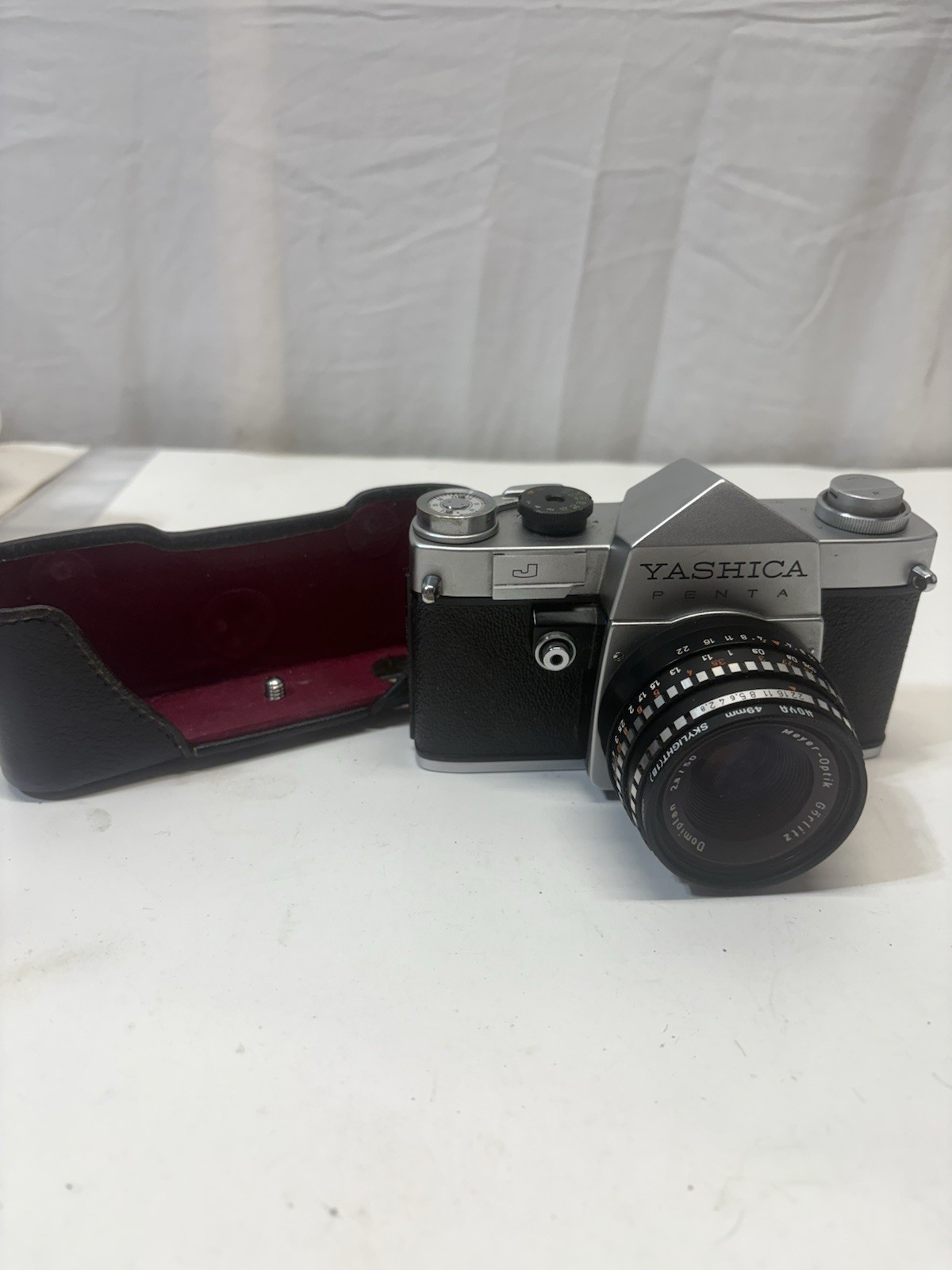
YASHICA PENTA J
The Yashica Penta J burst onto the scene in 1962 as Yashica’s bold debut in the 35mm SLR world—a no-frills, all-metal workhorse built for photographers ready to step up from rangefinders. With its adoption of the M42 screw mount, it wasn’t just a new camera; it was a declaration of intent. Yashica was aligning itself with a universal standard, opening the door to a universe of lenses and signaling its arrival as a serious contender in the rapidly evolving Japanese SLR race.
Overview
Produced from 1962 to 1965, the Penta J carved out a niche as an accessible yet rugged SLR for amateurs and enthusiasts who valued reliability over automation. It was never meant to dazzle with features—instead, it delivered solid mechanics, clean ergonomics, and seamless compatibility with the booming ecosystem of M42 glass. At a time when many brands were locking users into proprietary mounts, Yashica chose openness, embracing the quasi-standard M42×1mm thread popularized by Pentax. That decision paid off: suddenly, owners could mix and match lenses from Takumar, Soligor, Zeiss Jena, and more, turning the Penta J into a flexible, future-ready tool.
Beneath its modest exterior lies a fully mechanical heart: a vertically traveling cloth focal-plane shutter, manual exposure control, and a fixed pentaprism that offers bright, eye-level framing through a ground-glass screen. No light meter, no batteries—just pure mechanical precision. The body is built like a tank, with a metal chassis, leatherette grip, and tactile controls that inspire confidence. While later models would add meters and automation, the Penta J thrives on simplicity. It’s the kind of camera that teaches you to *see* light, not just rely on a needle.
More than just a standalone model, the Penta J laid the foundation for Yashica’s entire SLR lineage. It kicked off a family that would grow to include the metered Penta JC, the Penta Mat, and eventually the groundbreaking Electro series. For a first attempt, it was remarkably assured—earning respect for its build, balance, and no-nonsense performance in a crowded postwar market.
Specifications
| Specification | Value |
| Type | Single-Lens Reflex (SLR) |
| Film Format | 35mm (135 cartridge) |
| Years Produced | 1962–1965 |
| Lens Mount | M42×1mm screw mount (universal) |
| Shutter | Vertically-traveling focal-plane cloth shutter; speeds from 1 sec to 1/1000 sec, plus B (bulb) |
| Metering | None (unmetered) |
| Exposure Modes | Manual only (shutter speed and aperture set manually) |
| Viewfinder | Fixed pentaprism with ground-glass focusing screen, no split-image or microprism aids |
| Dimensions | Approx. 145 × 95 × 90 mm; weight approx. 680 g (body only, no lens) |
| Film Advance | Single-stroke lever (approx. 135° throw), frame counter automatic reset on back opening |
| Flash Sync | PC terminal with X-M sync selector; sync speed 1/60 sec |
| Self-Timer | Mechanical self-timer with lever on front body and audible tick |
| Accessories | Interchangeable focusing screens (via service), optional waist-level finder, motor drive (rare) |
Key Features
- First Yashica SLR with M42 mount, enabling broad lens compatibility with third-party manufacturers.
- Mechanically robust vertical-travel cloth shutter offering reliable performance from 1 sec to 1/1000 sec.
- Fully manual operation with intuitive controls, ideal for learning photographic fundamentals.
- Fixed pentaprism provides bright, upright, and laterally correct viewing—uncommon in budget SLRs of the era.
- Compact and durable metal body with ergonomic lever wind and well-placed controls for its time.
Historical Context
The early 1960s were a battleground for SLR dominance, and the M42 screw mount was becoming the weapon of choice. The Asahi Pentax had already proven the format’s appeal, and Yashica—previously known for rangefinders like the Yashica Electro 35 series—wasn’t about to be left behind. The Penta J was their answer: a purpose-built, M42-native SLR that prioritized compatibility, durability, and value.
It entered a market teeming with competition: the Pentax Spotmatic loomed on the horizon, Fujica and Praktica were making moves, and every brand was racing to balance innovation with affordability. The Penta J didn’t try to win on features—it won on fundamentals. By skipping the light meter, Yashica kept costs down and reliability up, targeting students, hobbyists, and photographers who didn’t want electronics dictating their craft. And it worked. The camera earned a loyal following for its consistent mechanics and open lens policy, paving the way for the Penta JC in 1965—a direct evolution that added CdS metering and cemented Yashica’s SLR future.
Collectibility & Value
Today, the Penta J isn’t a daily shooter, but it’s a compelling artifact of Yashica’s transition from rangefinder specialist to SLR innovator. Collectors prize it as a milestone—a no-compromise entry into the M42 world that reflects the raw, mechanical soul of early Japanese SLR design. In good working order, prices range from $75 to $150, with higher valuations for clean viewfinders, crisp shutter timing, and original lenses like the Yashinon or Kaligar.
When hunting for one, test everything. High-speed shutter performance—especially 1/500 and 1/1000 sec—is critical; cloth curtains can develop pinholes or uneven travel over time. The self-timer often sticks after decades of dormancy, and the film advance lever may feel loose if internal gears are worn. Light seals around the back door are almost certainly degraded, so replacement is essential to avoid light leaks. The good news? No batteries are needed. With a proper CLA from a vintage-savvy technician, a Penta J can keep ticking for another 60 years.
Similar Cameras
- Pentax Spotmatic (1964) – The definitive M42 SLR with through-the-lens metering; more advanced but contemporaneous.
- Fujica FT – Fujifilm’s early M42 SLR, similar in layout and target market.
- Praktica PLC 3 – East German SLR with M42 mount, known for rugged build and mechanical simplicity.
- Topcon Uniflex – Japanese M42 TLR/SLR hybrid, less common but technically innovative.
- Zenit-E – Soviet-built M42 SLR, widely exported and extremely durable, though less refined.
Repair & Maintenance
Entirely mechanical and battery-free, the Penta J is a repair-friendly classic. Most issues stem from age: sluggish shutters, gummed-up self-timers, or worn film advance linkages. Cloth shutter curtains are the Achilles’ heel—especially at high speeds—and may need replacement by a specialist. While no internal meter exists, external metering accessories (like handheld CdS units) can use a 1.5V PX625 battery. Light seals and mirror bumpers should be replaced during servicing to ensure blackout integrity and reduce vibration. Thanks to shared components with later Penta models, parts are relatively easy to source—though rare bits like original screws or viewfinder assemblies might require donor bodies. For a camera of its era, it’s refreshingly serviceable.
eBay Listings


As an eBay Partner, we earn from qualifying purchases. This helps support our independent vintage technology research.
Related Models
- Yashica FX-3 (1979-1985)
- Yashica FX-D (1981-1985)
- Yashica TL Electro-X (1968-1974)
- Alpa 6 (1948-1953)
- Agfa Agfaflex
- Agfa Ambiflex
- Agfa Easy
- Agfa Futura Af zoom
- Agfa Isoflash-Rapid C
- Agfa Mini