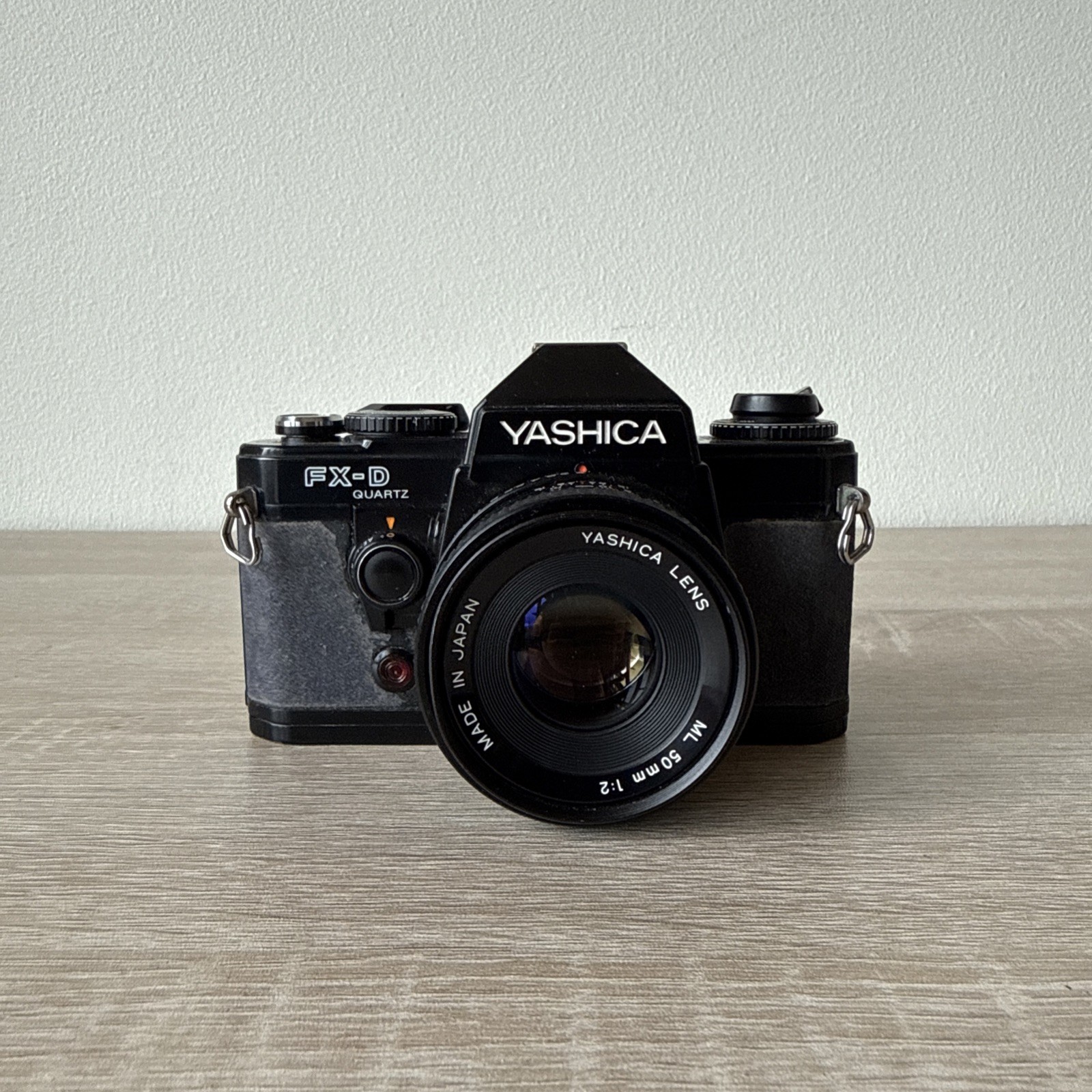
YASHICA FX-D
Step into the early 1980s, and you’ll find the Yashica FX-D quietly bridging two eras: the rugged mechanical SLRs of the past and the electronic age dawning in camera design. Released in 1981, this 35mm SLR wasn’t built to dazzle with cutting-edge features, but to deliver dependable, no-nonsense performance for photographers who wanted automation without losing control. Riding the Contax/Yashica (C/Y) lens mount ecosystem, the FX-D gave enthusiasts access to some of the finest optics of the time—Zeiss-designed glass, no less—all wrapped in a compact, polycarbonate-clad body that felt solid in the hand without weighing you down.
Overview
The FX-D arrived at a turning point. As Japanese manufacturers raced to embed microprocessors into SLRs, Yashica carved out a niche with a camera that balanced simplicity and sophistication. Positioned between the entry-level FX-3 and the more advanced FX-7 and FX-1, the FX-D offered aperture-priority autoexposure as its core mode, with a clever twist: just turn the shutter speed dial to lock in a manual setting, and you’re in full manual control. No menu diving, no hidden buttons—just intuitive, tactile operation.
Beneath its sleek exterior lies a metal chassis wrapped in textured polycarbonate, striking a rare balance between lightness and durability. The fixed pentaprism viewfinder delivers a bright, 0.95x image with a split-image rangefinder surrounded by a microprism collar—ideal for nailing focus with fast primes. Metering happens through the lens via a CdS cell, activated the moment a C/Y lens clicks into place. That means you can compose, meter, and shoot at full aperture, then stop down automatically at the moment of exposure—smooth, seamless, and precise.
While it didn’t boast shutter-priority or program modes like its flashier rivals, the FX-D stood out for its reliability and clean execution. It wasn’t a pro tool, but for the serious amateur, it was a trusted companion—especially one who valued sharp optics, consistent exposure, and the freedom to step in and take control when needed.
Specifications
| Specification | Value |
| Type | 35mm Single-Lens Reflex (SLR) |
| Film Format | 35mm (135) |
| Years Produced | 1981–1985 |
| Lens Mount | Contax/Yashica (C/Y) bayonet |
| Shutter | Vertical-travel focal-plane shutter; speeds 1 sec to 1/1000 sec + B, electronically controlled |
| Metering | TTL open-aperture CdS metering, center-weighted |
| Exposure Modes | Aperture-priority AE, Manual (via shutter speed dial) |
| Viewfinder | Fixed pentaprism, 0.95x magnification, split-image/microprism focusing aid |
| Dimensions | 140 × 87 × 53 mm; ~580 g (body only, no battery) |
Key Features
- Aperture-Priority Automation: Let the camera pick the shutter speed—from 1 second to 1/1000—based on your aperture and the available light. Results are consistent, exposure is predictable, and the learning curve is gentle.
- C/Y Mount Compatibility: Snap on any Contax or Yashica C/Y lens and go. The FX-D plays perfectly with Yashinon DS and DSM series optics, supporting automatic diaphragm coupling and open-aperture metering right out of the gate.
- TTL Center-Weighted Metering: A CdS cell measures light through the lens, giving you accurate readings you can trust. The viewfinder needle tells you at a glance if you’re under, over, or spot on.
- Manual Mode Option: Turn the shutter dial to any speed, and autoexposure disengages. Use stop-down metering for full manual control—ideal for long exposures or tricky lighting.
- Compact and Lightweight Design: At under 600 grams, it’s easy to carry all day. The slim profile slips into a bag without hassle, yet it feels substantial when raised to your eye.
Historical Context
The early '80s were all about electrons overtaking springs. The FX-D entered a market where cameras like the Pentax ME Super, Canon AE-1 Program, and Minolta XG series were redefining what a consumer SLR could do. Unlike the all-mechanical workhorses of the '70s, the FX-D relied on two tiny SR44 batteries to run its shutter and metering brain—no power, no exposure. That shift marked a new era: one where convenience and precision came at the cost of battery dependency.
Yashica’s partnership with Zeiss gave it a secret weapon—the C/Y mount and its stellar lens lineup. The FX-D wasn’t badged as a Contax, but it could use those same high-performance lenses, making it a budget-conscious gateway to Zeiss-quality optics. It didn’t match Canon’s processing power or Minolta’s low-light sensitivity, but it didn’t need to. For photographers who preferred aperture-first thinking and a clean, functional design, the FX-D was a quiet standout.
Collectibility & Value
Today, the FX-D isn’t a trophy camera. It won’t fetch hundreds unless it’s mint and boxed. But in the right hands, it’s a working gem—functional, affordable, and deeply satisfying to use. Expect to pay $50–$100 for a tested, working body, maybe more if it comes with a Yashinon DS 50mm f/1.7. Its value lies in usability, not rarity. It’s the kind of camera you buy not to shelve, but to shoot.
When hunting one down, test everything: shutter speeds, film advance, rewind, and meter response. Common gremlins include sluggish shutters (thanks to dried lubricants), dim or dead meter needles (from aging CdS cells), and corroded battery contacts. And don’t skip the battery issue—modern SR44s are 1.55V, not the 1.35V of the old mercury cells. That small difference can throw off shutter timing. Use Wein Silver Zinc batteries or a step-down adapter to stay true to spec.
Similar Cameras
- Pentax ME Super – Offers aperture and shutter-priority modes, compact design, and K-mount compatibility.
- Minolta XG-7 – Electronically controlled aperture-priority SLR with similar feature set and build quality.
- Canon AE-1 Program – Popular microprocessor-controlled SLR with shutter-priority and program modes.
- Nikon EM – Compact aperture-priority Nikon SLR aimed at enthusiasts, known for its lightweight build.
- Olympus OM-2 – Mechanically robust, aperture-priority OM system camera with advanced metering for its time.
Repair & Maintenance
Power comes from two stacked SR44 (or PX76) silver oxide batteries, delivering 3V to the shutter and meter circuits. Without the original mercury cells, voltage drift can cause overexposure—especially at slower speeds. Wein SR44s are the go-to fix, mimicking the old 1.35V output. Over time, the shutter may drag at 1 second or falter at 1/1000, a sign of hardened lubricants in the mechanism. The CdS cell can also fade, leaving the meter needle lifeless. Cleaning the mirror, focusing screen, and lens contacts often brings a sluggish unit back to life. While spare parts are scarce, the FX-D’s modular design means skilled hands can rebuild the shutter or replace the meter. Donor cameras? They’re not a luxury—they’re essential for serious restoration.
eBay Listings

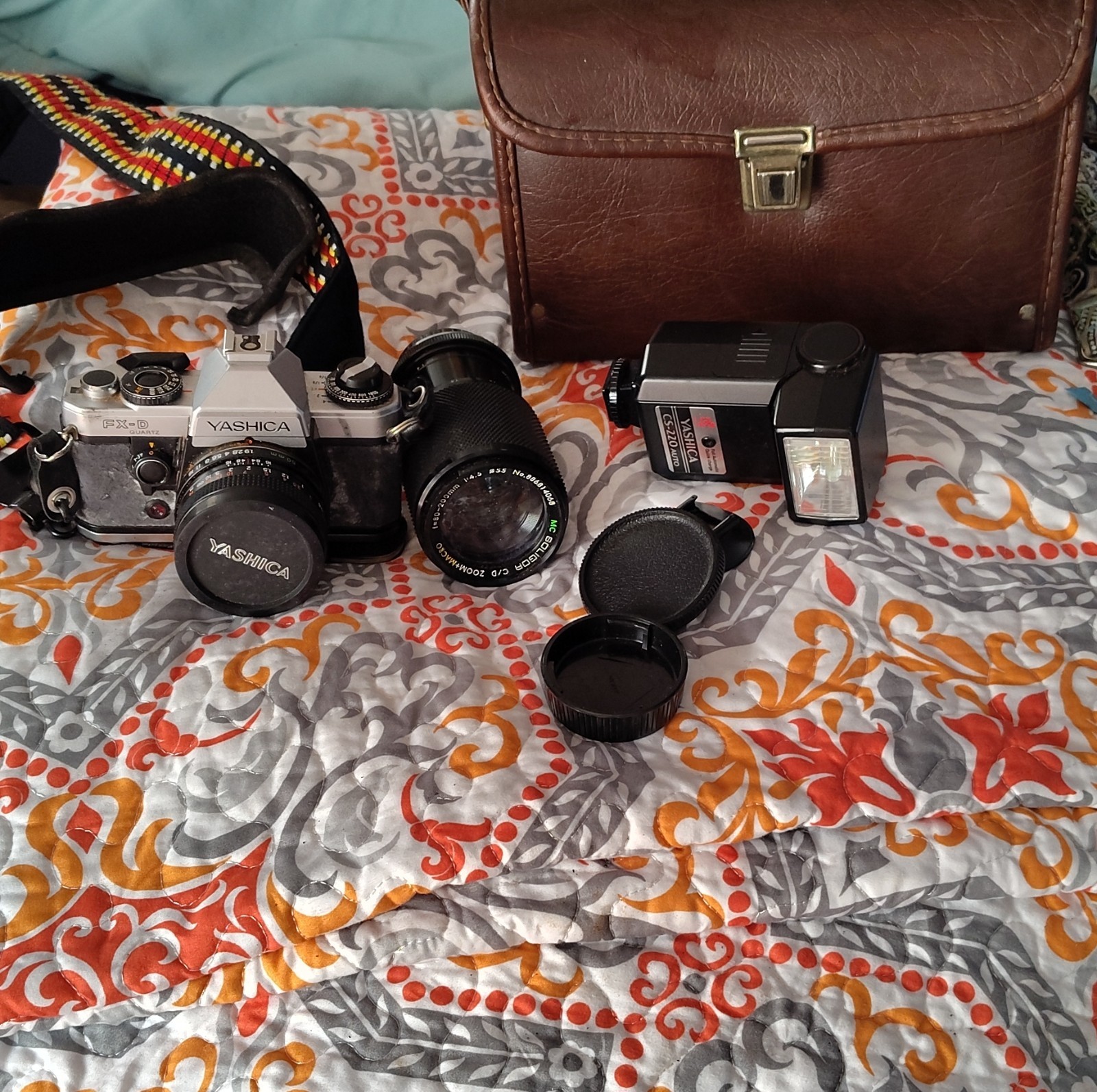

As an eBay Partner, we earn from qualifying purchases. This helps support our independent vintage technology research.
Related Models
- Yashica FX-3 (1979-1985)
- Yashica Penta J (1962-1965)
- Yashica TL Electro-X (1968-1974)
- Alpa 6 (1948-1953)
- Agfa Agfaflex
- Agfa Ambiflex
- Agfa Easy
- Agfa Futura Af zoom
- Agfa Isoflash-Rapid C
- Agfa Mini