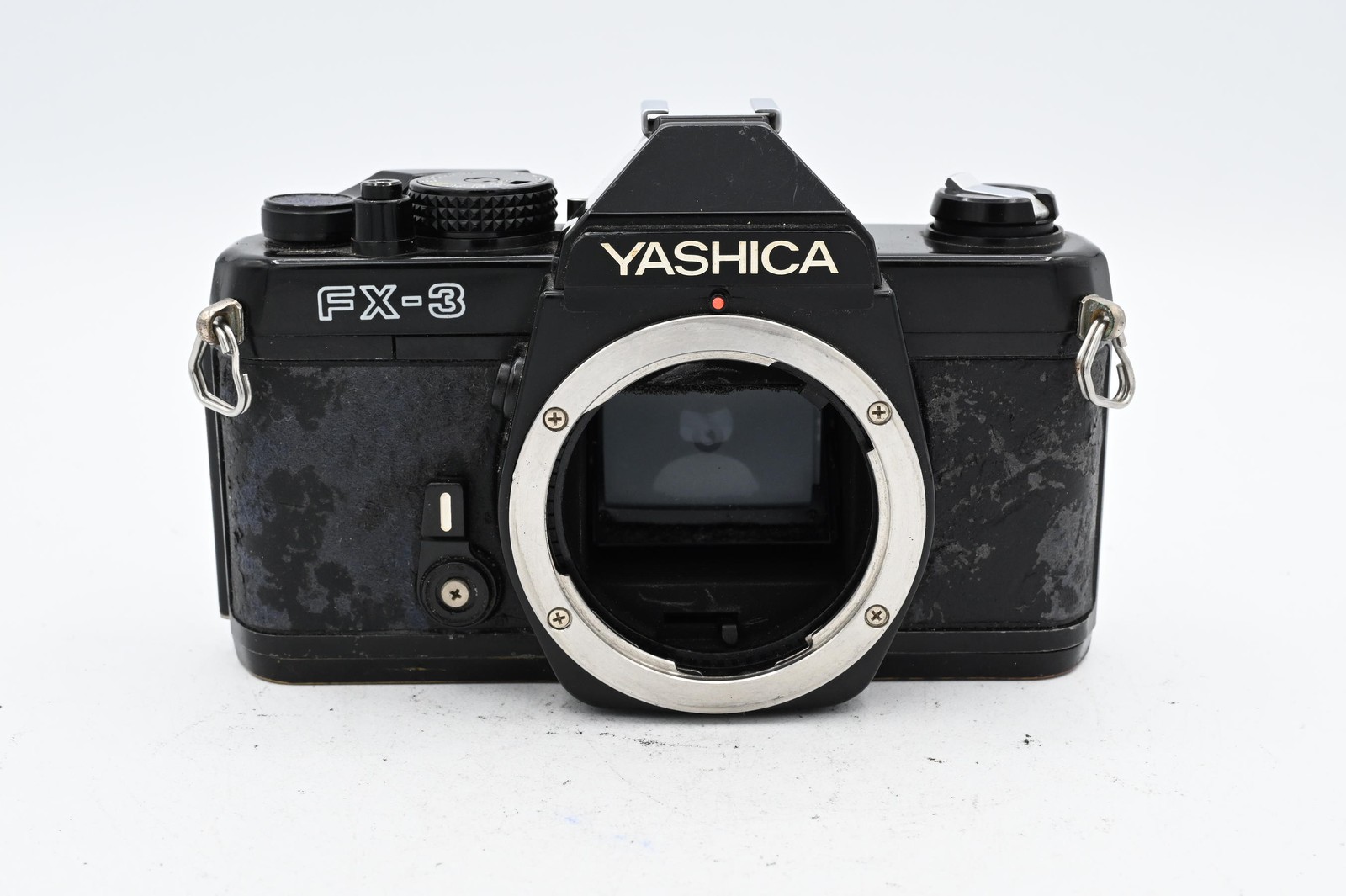
YASHICA FX-3
Step into the golden age of analog photography with the Yashica FX-3—a no-nonsense, fully manual 35mm SLR that brought serious optics within reach of students and hobbyists. Launched in 1979, this compact workhorse offered TTL metering, a rugged build, and full compatibility with Carl Zeiss glass, all wrapped in an unpretentious package built to last. For those who learned exposure the old-school way—by dialing in shutter and aperture by hand—the FX-3 wasn’t just a camera. It was a teacher.
Overview
When Yashica released the FX-3 in 1979, it wasn’t chasing the pro market. Instead, it aimed straight at photographers who wanted quality without complexity. Built around the Contax/Yashica (C/Y) bayonet mount—a collaboration with Carl Zeiss for the high-end Contax RTS—the FX-3 gave budget-conscious shooters access to some of the finest manual lenses ever made. It was a smart move: leverage premium optics, strip away automation, and deliver a reliable tool for learning the craft.
Inside, the FX-3 runs on simplicity. Its vertical-travel metal focal-plane shutter spans 1 to 1/1000 second, plus Bulb, all mechanically driven but electronically timed. There’s no aperture priority, no program mode—just you, the lens, and a center-weighted TTL CdS meter. Press the metering button on the front, then match the needle in the viewfinder to the fixed index. It’s hands-on, deliberate, and refreshingly free of distractions.
Despite its entry-level status, the build feels solid: a metal chassis wrapped in durable polycarbonate, a hallmark of Yashica’s efficient engineering. In 1982, the FX-3 Super arrived with DX film speed recognition and a redesigned dial, but the core design stayed unchanged. Production continued until around 1985, holding its ground even as autofocus and electronic wizardry began to dominate the SLR world. For those who valued control over convenience, the FX-3 remained a quiet favorite.
Specifications
| Specification | Value |
| Type | 35mm Manual Focus SLR |
| Film Format | 35mm (135 cartridge) |
| Years Produced | 1979–1985 |
| Lens Mount | Contax/Yashica (C/Y) bayonet |
| Shutter | Vertical-travel metal focal-plane shutter; speeds 1–1/1000 sec, plus B (Bulb) |
| Metering | TTL center-weighted CdS metering |
| Exposure Modes | Manual only (no auto-exposure) |
| Viewfinder | Fixed pentaprism, 0.92x magnification, 94% coverage; split-image rangefinder with microprism collar |
| Dimensions | 140 mm (W) × 88 mm (H) × 50 mm (D); approx. 520 g (body only, no battery) |
Key Features
- Contax/Yashica Mount Compatibility: Full support for C/Y mount lenses, including high-end Zeiss and Yashinon optics, enabling access to a wide range of manual prime and zoom lenses.
- TTL Center-Weighted Metering: Accurate exposure measurement via a CdS cell, with a match-needle display in the viewfinder for precise manual exposure control.
- Mechanical Shutter with Electronic Timing: Shutter operates mechanically at all speeds, but relies on a 1.35V mercury battery (PX625 or equivalent) for accurate timing and metering.
- Simple, Durable Design: Minimal electronics and robust construction ensure long-term reliability and ease of repair.
- Bulb Mode for Long Exposures: Enables extended shutter durations for night or low-light photography when used with a cable release.
Historical Context
The late 1970s were a turning point for SLRs. Electronics were creeping into camera bodies, and automation was becoming a selling point. Against that backdrop, the FX-3 stood out by doing the opposite: it embraced mechanical reliability and user control. While Nikon, Canon, and Minolta pushed semi-automatic models, Yashica doubled down on the fundamentals.
After co-developing the Contax RTS with Zeiss in 1975, Yashica had a high-end lens system to work with. The FX-3 was their way of opening that door to everyone. Priced well below the RTS, it competed with the Pentax K1000, Canon AE-1, and Minolta X-700—but with a key difference. No auto-exposure. No gimmicks. Just manual everything. That purity made it a staple in photo classrooms, where learning exposure meant understanding light, not trusting a circuit.
It wasn’t flashy, but it was respected. Solid construction, accurate metering, and the ability to mount legendary Zeiss lenses gave the FX-3 quiet credibility. By the mid-1980s, though, the tide had turned. Autofocus arrived, and manual SLRs like the FX-3 faded from the mainstream. It was discontinued around 1985, just as the analog world began its slow shift toward automation.
Collectibility & Value
Today, the FX-3 is a sleeper hit among vintage SLR fans. It’s not as iconic as the Pentax K1000 or as compact as the Olympus OM-1, but it’s a capable, honest camera with a loyal following. C/Y mount collectors especially appreciate it—few other entry-level bodies offer such direct access to Zeiss optics at this price.
On the used market, working FX-3 bodies typically sell for $50–$100. Fully restored units or those bundled with lenses can climb higher—up to $230 for a professionally serviced example. Condition matters. Test the shutter at all speeds, and make sure the meter responds to light. CdS cells degrade over time, and a dead meter turns the FX-3 into a hunch-based shooter. The original PX625 mercury battery is long obsolete, but 1.35V substitutes like the Wein Cell MRB625 keep the electronics honest. If the camera’s been sitting for years, a CLA (clean, lubricate, adjust) is wise—dried grease can gum up slow-speed timing.
Similar Cameras
- Pentax K1000 – Iconic manual SLR with similar simplicity and durability; slightly more common and widely supported.
- Olympus OM-1 – Compact, fully mechanical SLR with excellent Zuiko lenses; favored for its size and optical quality.
- Canon FTb – Mechanically robust SLR with stop-down TTL metering; popular among vintage Canon lens users.
- Minolta XG-M – Entry-level Minolta with aperture-priority automation; more advanced but less manual-focused.
- Nikon FM – Higher-end manual SLR with excellent build and NIKKOR lens compatibility; more expensive and sought-after.
Repair & Maintenance
Power comes from a 1.35V PX625 mercury battery—or a modern replacement. Alkaline 1.5V substitutes can throw off meter readings, leading to underexposed frames. The Wein Cell MRB625, which delivers the correct voltage, is the best drop-in fix. Some users recalibrate the meter for 1.5V operation, but sticking to 1.35V avoids guesswork.
Beyond the battery, the FX-3 is a technician’s friend. Shutter issues usually involve slow speeds sticking due to dried lubricant—common in stored units. Light seals degrade over time and should be replaced to prevent fogging. The CdS meter can fail from age or corroded contacts, but repairs are straightforward. With its serviceable design and common parts, the FX-3 is one of the easier vintage SLRs to bring back to life. A CLA goes a long way toward ensuring smooth, reliable performance for years to come.
eBay Listings


As an eBay Partner, we earn from qualifying purchases. This helps support our independent vintage technology research.
Related Models
- Yashica FX-D (1981-1985)
- Yashica Penta J (1962-1965)
- Yashica TL Electro-X (1968-1974)
- Alpa 6 (1948-1953)
- Agfa Agfaflex
- Agfa Ambiflex
- Agfa Easy
- Agfa Futura Af zoom
- Agfa Isoflash-Rapid C
- Agfa Mini