WERRA MAT
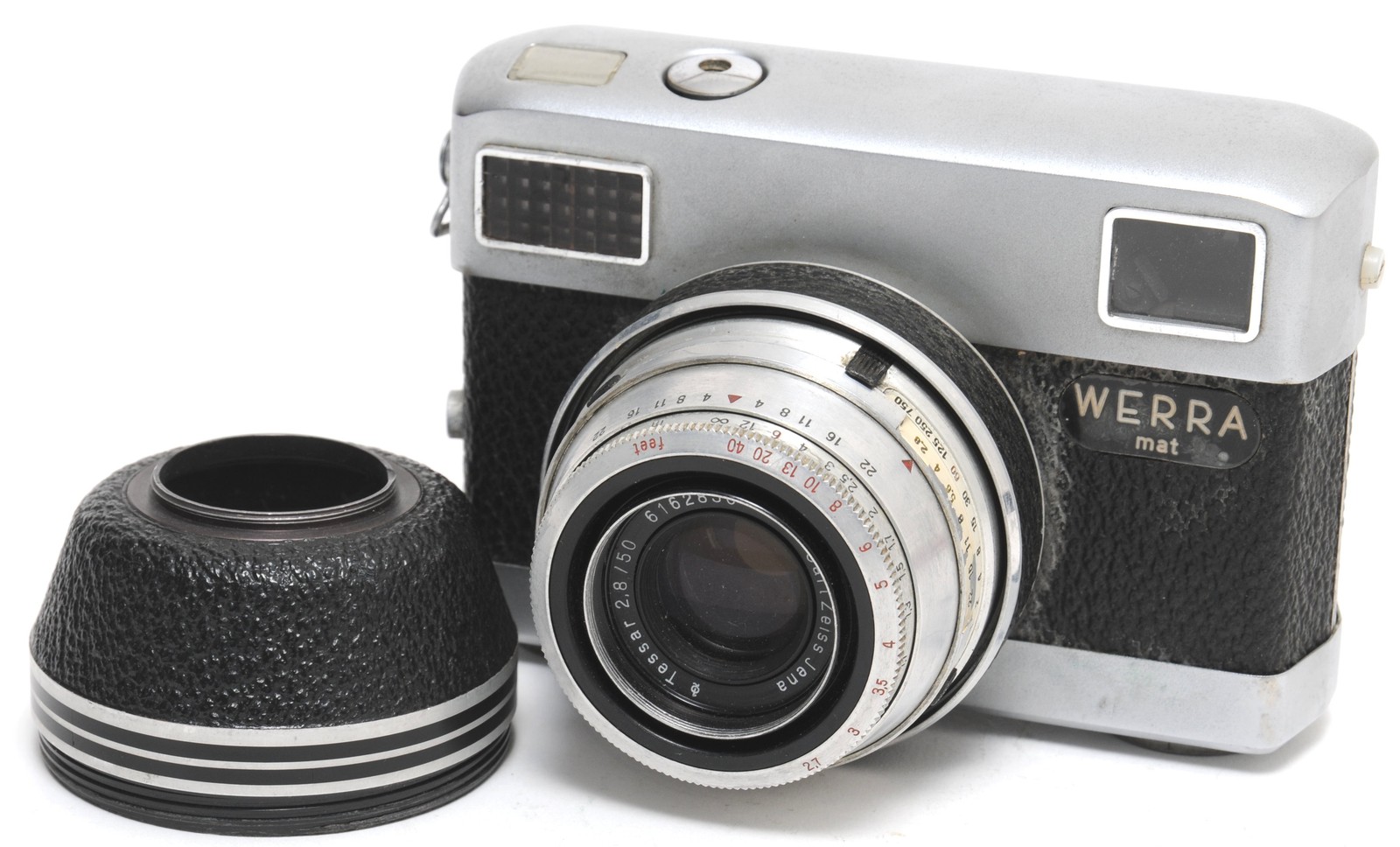
The Werra Mat is a compact, fixed-lens 35mm viewfinder camera produced by Werra Werk, a German optical manufacturer based in Bad Rodach, East Germany. Released in 1959, it represents an evolution of the earlier Werra series, distinguished primarily by the addition of a built-in selenium light meter, marking Werra’s attempt to modernize its product line during a period of increasing competition in the postwar camera market.
Overview
The Werra Mat was introduced at a transitional moment in amateur photography, as consumer demand shifted toward more automated exposure systems and integrated metering. It succeeded the basic Werra I, II, and III models—simple, un-metered 35mm cameras popular in the 1950s for their reliability and affordability. The Mat was designed to appeal to amateur photographers seeking greater exposure accuracy without the complexity or cost of rangefinder or SLR systems. Manufactured between 1959 and 1965, the Werra Mat was one of the final models produced by Werra Werk before the company was absorbed into the Pentacon conglomerate under the East German state-owned VEB conglomerate system.
The camera features a fixed 45mm f/2.8 Carl Zeiss Tessar-type lens, a hallmark of German optical quality, paired with a Prontor Reflex shutter. Its most notable upgrade over earlier Werra models is the selenium cell exposure meter, mounted around the lens barrel, which provides a needle-based exposure reading visible in the top plate window. This meter operates without batteries, relying solely on ambient light, making it both innovative and practical for its time. The Werra Mat retains the simple, utilitarian design typical of East German cameras of the era, with a metal body, leatherette covering, and manual film advance via a knob.
Despite its modest feature set by modern standards, the Werra Mat holds historical significance as one of the few metered compact 35mm cameras produced in East Germany. It reflects the technical capabilities and economic constraints of the GDR’s optical industry during the Cold War, where innovation often lagged behind the West due to limited access to materials and export restrictions. Nevertheless, the Mat remains a competent tool camera, valued today for its solid build, Zeiss-derived optics, and historical provenance.
Specifications
| Specification | Value |
| Type | Fixed-lens compact viewfinder |
| Film Format | 35mm (135 cartridge) |
| Years Produced | 1959–1965 |
| Lens Mount | Fixed Carl Zeiss Tessar 45mm f/2.8 (4-element, 3-group) |
| Shutter | Prontor Reflex shutter, speeds 1–1/300 second + B; flash sync at 1/30 |
| Aperture Range | f/2.8 to f/16 (manual selection via aperture ring) |
| Metering | Selenium cell exposure meter (no battery required), center-weighted |
| Exposure Modes | Manual only; meter used as guide via match-needle system |
| Viewfinder | Optical direct-vision viewfinder with parallax correction marks |
| Focusing | Scale focusing (0.9m to ∞) via lens barrel |
| Flash | PC sync socket; X-sync only |
| Film Advance | Manual knob wind |
| Frame Counter | Manual reset (advances on film loading) |
| Dimensions | Approx. 140mm (W) × 80mm (H) × 55mm (D) |
| Weight | Approx. 540g (body only, no film) |
Key Features
- Integrated Selenium Light Meter: One of the first Werra models to include a built-in, battery-free exposure meter with a top-plate match-needle display.
- Carl Zeiss Tessar 45mm f/2.8 Lens: High-quality fixed lens offering sharp, contrast-rich images with smooth bokeh.
- Prontor Reflex Shutter: Reliable mechanical shutter with speeds up to 1/300 second, suitable for daylight and flash photography.
- Scale Focusing System: Simple zone focusing ideal for snapshot photography, with marked distances from 0.9m to infinity.
- Compact Metal Chassis: Durable construction with leatherette covering, designed for portability and long-term use.
Historical Context
The Werra Mat was developed during a period of consolidation in the East German optical industry. By the late 1950s, Werra Werk—originally established in the 1920s—was operating under increasing state control, eventually being folded into the VEB Pentacon Dresden combine in 1964. The Mat was likely conceived as a stopgap model to extend the life of the Werra brand while maintaining production at the Bad Rodach facility. Its design reflects a balance between cost efficiency and technical capability, incorporating proven components such as the Prontor shutter and Zeiss-derived lens to ensure reliability.
In the broader market, the Werra Mat competed with Western European compact cameras like the Kodak Retina IIIS, Zeiss Ikon Contaflex Super B, and various Braun and Wirgin models. However, it was priced lower and offered fewer features than most of its West German counterparts. Its primary market was domestic (GDR consumers) and Eastern Bloc countries, where access to Western imports was limited. While it lacked the prestige of Zeiss Ikon or Leica products, the Werra Mat provided a practical, metered 35mm solution for everyday photographers. It did not achieve significant export success, particularly in Western markets, due to competition from Japanese manufacturers like Canon, Minolta, and Nikon, who were rapidly advancing compact camera technology with coupled meters and faster lenses.
Collectibility & Value
Today, the Werra Mat is a niche collectible, sought after primarily by enthusiasts of East German photographic equipment and Cold War-era technology. Complete examples in working condition typically sell for $120–$200 USD, with higher prices for cameras exhibiting pristine cosmetics, functional meters, and original leather cases. The selenium meter is a key factor in valuation; while it requires no battery, many have degraded over time, resulting in inaccurate or non-functional readings. A working meter significantly increases desirability and resale value.
When purchasing a Werra Mat, collectors should inspect the shutter operation across all speeds, check for lens haze or fungus (particularly on the rear element), and verify that the film advance and frame counter function correctly. The selenium cell should be examined for cracking or delamination, common issues after decades of exposure to light and moisture. While repair parts are scarce, the Prontor shutter is serviceable by experienced technicians familiar with vintage German shutters. Due to its mechanical simplicity, the Werra Mat is relatively robust, but long-term storage in humid environments can lead to corrosion of internal components.
Similar Cameras
- Kodak Retina IIIC (1954–1960) – A West German 35mm rangefinder with integrated meter and interchangeable lenses.
- Wirgin Edinex 35M (1960s) – Another East German compact with selenium meter and fixed lens, similar in target market.
- Braun Paxette Reflex IV (1959) – German-built TLR alternative, though larger and more complex.
- Zenit-3M (USSR, 1964) – While an SLR, it shared the Werra Mat’s reliance on selenium metering and manual controls.
- Ansco Cadet II (USA, 1950s) – American compact 35mm camera with similar form factor and simplicity.
Repair & Maintenance
The Werra Mat requires no batteries for operation, as the selenium light meter generates its own current from ambient light. However, prolonged exposure to sunlight can degrade the selenium cells over time, leading to reduced sensitivity or complete failure. Shutter maintenance is critical: the Prontor Reflex mechanism should be serviced every 5–10 years to prevent oil drying or sticking, especially at high speeds. Common issues include slow shutter speeds, sticky aperture blades, and film counter misalignment. Cleaning the viewfinder and lens elements with appropriate solvents is recommended, but disassembly should be avoided without proper tools and expertise. Due to the scarcity of original spare parts, repair often involves donor cameras or custom fabrication. Overall, the Werra Mat is moderately difficult to repair but remains a durable and historically significant example of mid-century East German engineering.
eBay Listings



As an eBay Partner, we earn from qualifying purchases. This helps support our independent vintage technology research.