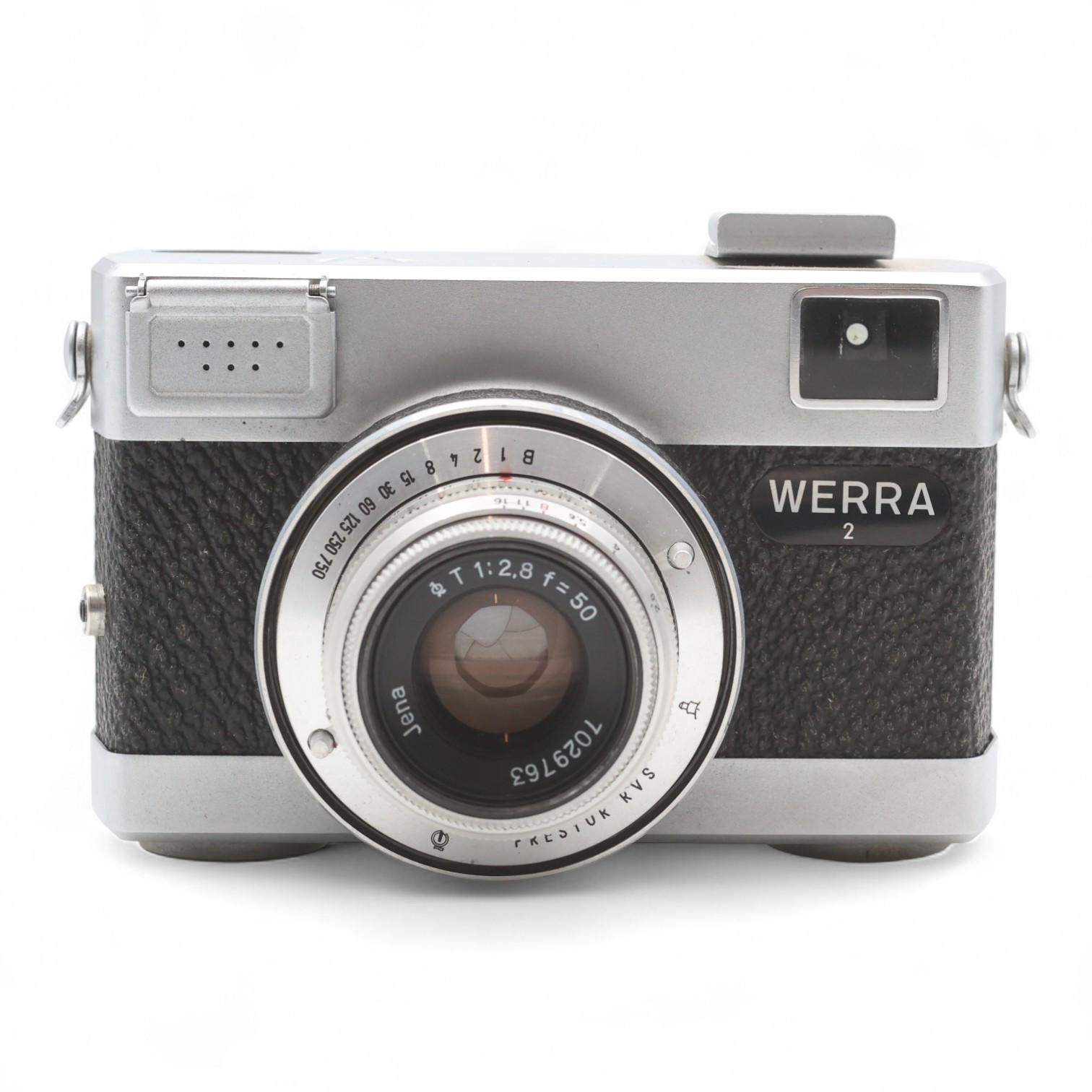
WERRA 2
The Werra 2 is a compact, fixed-lens 35mm viewfinder camera produced by Werra Werk, a German optical manufacturer based in Bad Rodach, Bavaria. Introduced in 1957 as an updated version of the Werra 1, it represents a modest but meaningful evolution in the company’s line of affordable, entry-level 35mm cameras aimed at amateur photographers.
Overview
The Werra 2 was released during a period of rapid expansion in the postwar European camera market, where numerous small manufacturers sought to capitalize on the growing popularity of 35mm photography among middle-class consumers. Werra Werk, though not as prominent as contemporaries like Zeiss Ikon or Wirgin, positioned itself as a producer of simple, reliable, and cost-effective cameras. The Werra 2 was designed as a straightforward, easy-to-use camera for snapshot photography, emphasizing mechanical reliability and clean optical performance over advanced features.
Externally, the Werra 2 closely resembles its predecessor, the Werra 1, but incorporates several internal refinements that improve usability and build quality. Most notably, it features a redesigned shutter mechanism with a slightly expanded speed range and a more durable film transport system. The camera retains the same top-mounted film advance lever and integrated rewind knob, but with improved gearing for smoother operation. The body is constructed from pressed steel with leatherette covering, typical of budget-oriented cameras of the era, and includes a folding film reminder dial on the baseplate.
The Werra 2 fits into Werra Werk’s product lineup as a mid-tier compact model, sitting above the basic Werra 1 and below the more advanced Werra 3 and Werra 4 models, which offered features such as rangefinder focusing and interchangeable lenses. It was marketed primarily in West Germany and exported in limited numbers to neighboring European countries, though it never achieved widespread international distribution. Despite its modest specifications, the Werra 2 is notable for its solid German engineering and use of high-quality coated optics for the price point.
Specifications
| Specification | Value |
| Type | Fixed-lens compact viewfinder |
| Film Format | 35mm (135 cartridge) |
| Years Produced | 1957–1960 |
| Lens Mount | Fixed Zeiss Tessar-type lens |
| Lens | 45mm f/2.8 Carl Zeiss Jena Tessar (4 elements in 3 groups), coated |
| Aperture Range | f/2.8 to f/16 (6 settings) |
| Shutter | Compur-Matic leaf shutter |
| Shutter Speeds | B, 1–1/300 second (1, 1/2, 1/5, 1/10, 1/25, 1/50, 1/100, 1/200, 1/300) |
| Metering | None (uncoupled light meter required) |
| Exposure Modes | Manual only (shutter- and aperture-priority not available) |
| Focus | Scale focusing (1m to ∞) via front lens ring |
| Viewfinder | Combined optical viewfinder and frame lines (parallax-corrected) |
| Flash Sync | PC terminal with X-sync only (1/30 sec or slower) |
| Film Speed Range | Manually set ASA 6–400 via calculator dial |
| Film Advance | Single-stroke lever (top plate) |
| Rewind | Knob with folding crank (top plate) |
| Dimensions | 130 × 75 × 55 mm (W×H×D) |
| Weight | Approx. 480 g (with lens cap, no battery) |
Key Features
- Carl Zeiss Jena 45mm f/2.8 Tessar lens: A high-quality, coated lens known for sharpness and excellent contrast, rare in cameras at this price point.
- Compur-Matic leaf shutter: Offers a wide range of speeds up to 1/300 sec, with precise mechanical timing and low vibration.
- Scale focusing with depth-of-field scale: Enables zone focusing and hyperfocal distance use for greater depth of field in street and travel photography.
- Parallax-corrected viewfinder: Includes automatic frame adjustment for close focusing distances.
- Integrated film reminder dial: Located on the baseplate, useful for tracking multiple film loads.
Historical Context
The Werra 2 was introduced in 1957 at a time when the 35mm camera market in West Germany was highly competitive, with dozens of manufacturers offering compact viewfinder cameras. Companies such as Wirgin (Edixa), Braun, and Voigtländer were producing similar models, often with comparable specifications but higher price tags. Werra Werk distinguished itself by offering Zeiss-branded optics in an affordable body, leveraging the prestige of Carl Zeiss Jena glass to attract budget-conscious enthusiasts.
Despite its solid construction and optical quality, the Werra 2 faced stiff competition from more advanced cameras like the Kodak Retina IIa and the Zeiss Ikon Contaflex Super B, which offered rangefinder or SLR systems. However, the Werra 2 found a niche among amateur photographers who valued simplicity and reliability. It was not widely advertised or exported, and production ceased around 1960 as Werra Werk shifted focus toward more advanced models and eventually exited the camera market in the mid-1960s. Fewer than 25,000 units of the Werra 2 are estimated to have been produced, making it a relatively rare model today.
Collectibility & Value
The Werra 2 is considered a niche collectible among vintage camera enthusiasts, particularly those interested in postwar German engineering and Zeiss optics. Its combination of a coated Tessar lens and Compur shutter places it above many contemporaneous budget models, and well-preserved examples are sought after for both use and display. In the current collector market (2024), a fully functional Werra 2 in good cosmetic condition typically sells for $250–$400 USD, with mint examples reaching up to $550 if accompanied by original case, manual, and lens cap.
When purchasing a Werra 2, collectors should inspect the shutter for consistency across all speeds, as the Compur-Matic mechanism can suffer from lubricant hardening or speed inaccuracy if not serviced. The lens should be free of haze, fungus, and separation—though coated Tessar units are generally robust. The leatherette is prone to peeling, and the viewfinder glass may exhibit minor scratches. Functionality of the film advance and rewind mechanisms is critical, as worn gears can lead to frame spacing issues. Due to the lack of a light meter, users should pair the camera with a handheld meter or smartphone app for accurate exposure.
Similar Cameras
- Kodak Retina II (Type 015) – 35mm viewfinder with Schneider Xenar lens, similar era and quality.
- Wirgin Edinex 35 – German-made compact with coated lens and leaf shutter, slightly more advanced.
- Braun Colorette II – Stylish design, 45mm f/2.8 lens, and similar feature set.
- Zeiss Ikon Contessa 35 – Another compact Zeiss-branded camera with Tessar lens and high build quality.
- Rollei 35 (later) – Though introduced in 1966, it shares the philosophy of compact size and premium optics.
Repair & Maintenance
The Werra 2 requires no batteries, as all functions are fully mechanical. This makes it highly reliable but also necessitates regular servicing for optimal performance. The Compur-Matic shutter should be cleaned and re-lubricated every 10–15 years, especially if the camera has been in storage. Common issues include stiff shutter release, inaccurate slow speeds, and film counter misalignment. Replacement parts are scarce, so repairs should be handled by specialists in vintage German cameras. The lens is sealed and not user-serviceable; disassembly risks damaging the coating or alignment. For regular use, store the camera with the shutter cocked and lens cap on to prevent light leaks and dust accumulation.
eBay Listings


As an eBay Partner, we earn from qualifying purchases. This helps support our independent vintage technology research.