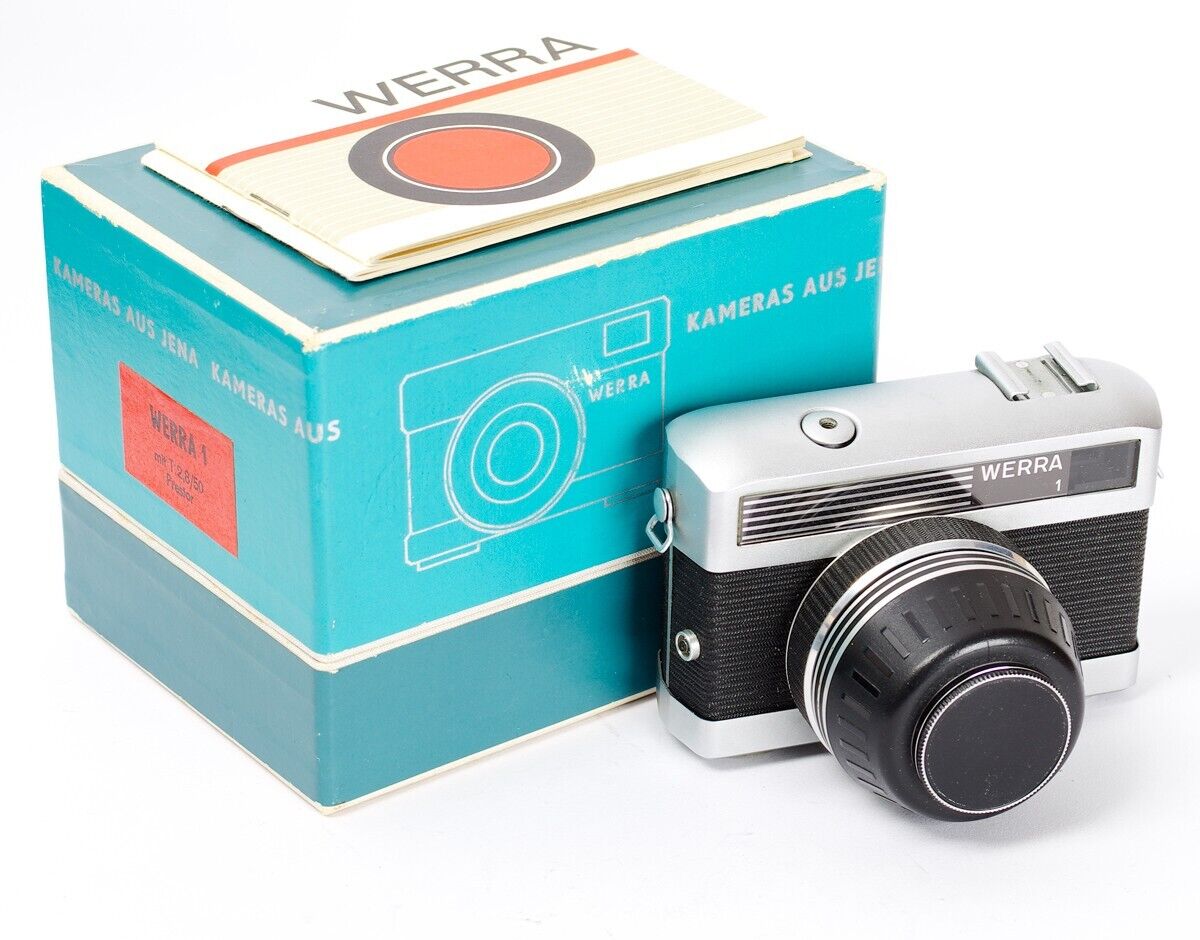
WERRA 1
The Werra 1 is a compact, fixed-lens 35mm rangefinder camera produced in East Germany by VEB Werk für Feinmechanik und Optik, Sonneberg, under the Werra brand. Introduced in 1954, it features a high-quality Carl Zeiss Tessar 50mm f/2.8 lens and represents a postwar attempt to deliver precision-engineered, affordable 35mm photography equipment from the former German optical industry.
Overview
The Werra 1 was developed during the early years of East German state-controlled optical manufacturing, a period marked by the reorganization of pre-war German optical firms following World War II. Manufactured in Sonneberg, Thuringia—a historic center of German optics—the Werra 1 was part of a broader effort by the East German government to rebuild its photographic industry under centralized production. The camera was aimed at the amateur and enthusiast market, offering a balance of compact design, mechanical reliability, and optical quality. While not as widely exported as its West German counterparts like the Leica or Contax, the Werra 1 gained recognition for its solid build and use of the renowned Carl Zeiss Tessar lens, a hallmark of German optical excellence.
The Werra 1 occupies a modest but notable position in the Werra lineup, which included several models differentiated primarily by lens quality and shutter mechanisms. The Werra 1 sits above the base Werra models (such as the Werra 2 and 3) that used slower lenses (e.g., f/3.5) and simpler shutters, but below the more advanced Werra 5 and Werra 6, which featured faster lenses and more refined rangefinder systems. Its design reflects a transitional phase in East German camera engineering—retaining pre-war mechanical principles while adapting to postwar material constraints and economic planning.
Specifications
| Specification | Value |
| Type | Rangefinder |
| Film Format | 35mm (135 cartridge) |
| Years Produced | 1954–1957 |
| Lens Mount | Fixed Carl Zeiss Tessar 50mm f/2.8 (screw-cell construction) |
| Shutter | Compur-Rapid shutter, B, 1–1/300 sec (in 1/3 stop increments) |
| Aperture Range | f/2.8 to f/16 |
| Metering | None (uncoupled; exposure estimated via external meter or table) |
| Exposure Modes | Manual only |
| Viewfinder | Combined optical viewfinder and coincident-image rangefinder (center patch) |
| Focusing | Manual via rangefinder patch, coupled to lens |
| Film Advance | Manual knob wind (not interlocked; double exposure possible) |
| Frame Counter | Manual reset (pre-wind to 1) |
| Flash Sync | PC terminal and M-sync at 1/30 sec |
| Dimensions | Approx. 140mm (W) × 75mm (H) × 55mm (D) |
| Weight | Approx. 580g (without film) |
Key Features
- Carl Zeiss Tessar 50mm f/2.8 lens: A four-element, high-resolution lens renowned for sharpness, contrast, and compact design—considered one of the finest normal lenses of its era.
- Compur-Rapid shutter: A high-quality, leaf shutter offering precise speeds from 1 to 1/300 second, known for reliability and low vibration.
- Coupled coincident-image rangefinder: Provides accurate manual focusing, with a central yellow-green patch for easy target alignment.
- Compact and durable chassis: Constructed from die-cast metal with leatherette covering, designed for portability and long-term mechanical stability.
- Interchangeable back (rare): Some late-production models featured a removable back for quicker film loading, though most units had fixed backs.
Historical Context
The Werra 1 was introduced in 1954, during a period of intense industrial reorganization in East Germany. After the division of Germany, many optical engineers and factories from the former Zeiss complex in Jena were split between East and West. The East German Zeiss operations, under state control, were consolidated into VEB Carl Zeiss Jena and associated firms, including those in Sonneberg. The Werra brand emerged as a secondary line to distribute high-quality optics under more modest branding, avoiding direct competition with the flagship Zeiss Ikon models.
In the mid-1950s, the 35mm rangefinder market was dominated by Leica, Contax, and emerging Japanese models like the Nikon I and Minolta-35. The Werra 1 competed in the mid-tier segment, offering Zeiss-quality optics at a lower price point. It was marketed primarily within the Eastern Bloc and to budget-conscious photographers in Western Europe. While it lacked the prestige of a Leica, it was praised in contemporary reviews for its build quality and lens performance. However, limited export capacity, lack of marketing, and the rise of Japanese SLRs in the 1960s curtailed its long-term success.
Collectibility & Value
Today, the Werra 1 is a niche collectible, valued by enthusiasts of East German optics and Cold War-era photographic technology. Complete, functional units in good condition typically sell for $250–$450 USD, with higher prices for rare variants (e.g., those with removable backs or special engravings). The camera’s collectibility stems from its association with Carl Zeiss, its mechanical precision, and its historical significance as a product of postwar socialist industry.
When purchasing a Werra 1, collectors should inspect the shutter operation across all speeds, as the Compur-Rapid mechanism can suffer from lubricant degradation or cocking issues after decades of inactivity. The rangefinder alignment is also critical—misalignment renders accurate focusing difficult. The leatherette often deteriorates, and replacement parts are scarce. Additionally, the film pressure plate may warp, affecting flatness of film exposure. While the lens is typically in good condition due to its sealed construction, internal haze or fungus can occur if stored poorly. Servicing requires specialized knowledge of vintage leaf shutters and rangefinder calibration.
Similar Cameras
- Zeiss Ikon Contessa 35: West German 35mm rangefinder with Tessar lens, similar era and lens quality.
- Kodak Retina I (Type 117): German-made 35mm rangefinder with Schneider or Rodenstock lens, comparable size and market position.
- FED 2 or 3 (USSR): Soviet Leica copies with 50mm f/2.8 Industar lenses, similar political context and target market.
- Zorki 4 (USSR): Rangefinder based on Leica II, more advanced but from the same Eastern Bloc ecosystem.
- Alka Rangefinder (East Germany): Lesser-known East German camera with similar Tessar-type lenses and mechanical construction.
Repair & Maintenance
The Werra 1 requires no batteries, as it is fully mechanical. Shutter maintenance is the most common need—especially cleaning and re-lubrication of the Compur-Rapid shutter, which uses a complex series of springs and timing gears. The rangefinder system may require recalibration if the linkage between the viewfinder and lens becomes misaligned, typically due to impact or wear. The film advance mechanism is robust but can develop resistance if the take-up spool gear is gummed with old lubricant. Cleaning the lens exterior is safe, but disassembly is not recommended due to the cemented Tessar elements. For long-term storage, keep the camera in a dry, temperature-stable environment with the shutter uncocked and aperture wide open to preserve spring tension. Professional servicing is advised for full overhauls, as parts are not readily available and require skilled fitting.
eBay Listings



As an eBay Partner, we earn from qualifying purchases. This helps support our independent vintage technology research.