WELTA PERLE
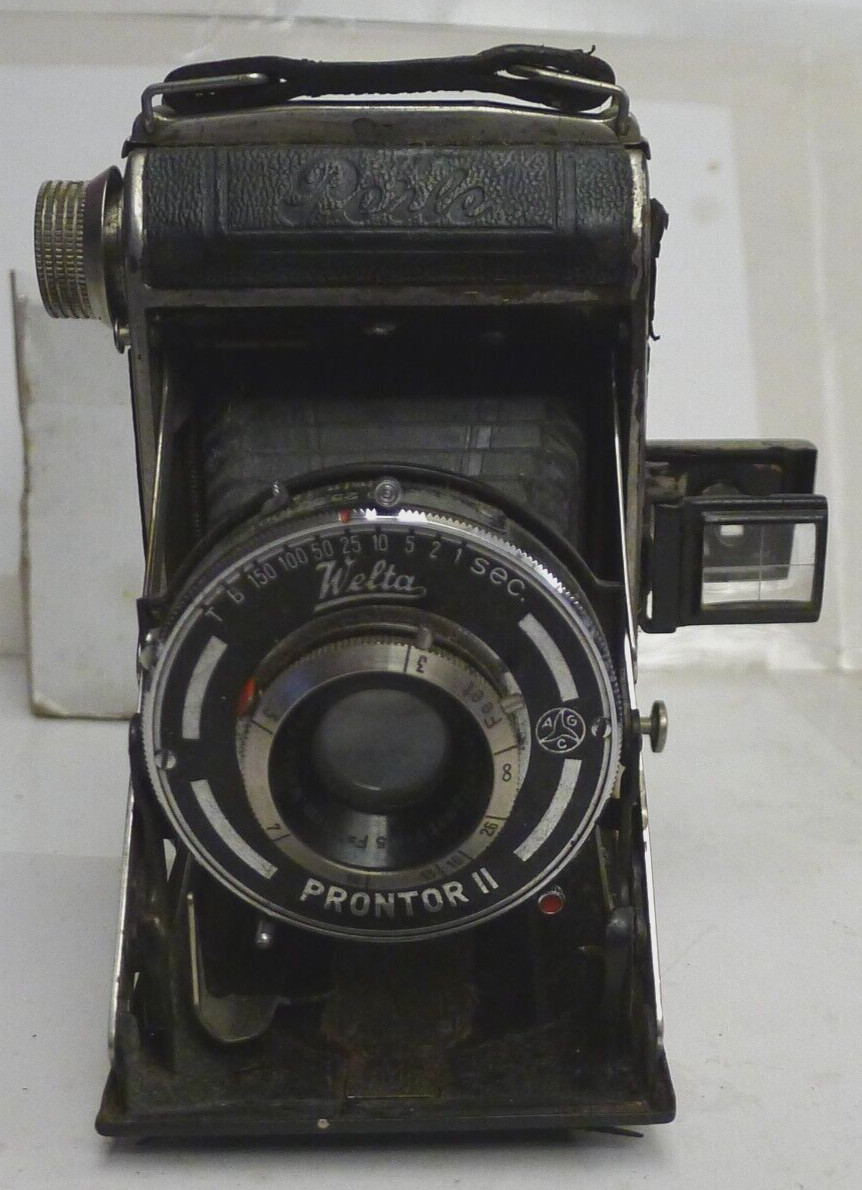
The Welta Perle is a compact, folding vest pocket camera produced by Welta Werke of Freiburg, Germany, beginning in 1931. Designed for use with 127 roll film, the Perle delivers 4×6.5 cm exposures and exemplifies the high-quality engineering and elegant design typical of German camera manufacturing in the interwar period.
Overview
The Welta Perle was introduced during a period of growing popularity for small-format roll film cameras, offering an accessible yet refined alternative to larger 35mm and medium format systems. Marketed primarily to amateur photographers and travelers, the Perle capitalized on the convenience of the 127 film format, which provided a balance between image quality and portability. As a folding vest pocket camera, it collapses into a slim, pocketable form, making it ideal for personal and snapshot photography. The Perle was part of Welta’s broader strategy to compete with established names like Kodak and Agfa in the burgeoning consumer camera market.
Welta Werke, founded in the 1920s, was known for producing well-crafted, precision-coupled folding cameras and later, 35mm rangefinders. The Perle occupied a mid-tier position in Welta’s lineup, offering superior build quality compared to budget models while remaining more affordable than high-end professional systems. It featured a rigid front standard mounted on a metal folding bed, with a leather bellows enclosure and a collapsible viewfinder. The camera’s top plate includes a manually cocked shutter release and a frame counter that must be advanced manually via a red window on the back.
The Perle was offered with a range of lenses and shutters depending on the model variant, from basic meniscus optics to high-grade anastigmats. Higher-end versions included coupled rangefinders and Compur or Prontor shutters, while entry-level models used simpler rotary shutters and fixed-focus lenses. Despite its compact size, the Perle provided solid optical performance for its class, particularly when equipped with the 65mm f/4.5 anastigmat lens.
Specifications
| Specification | Value |
| Type | Folding Vest Pocket Camera |
| Film Format | 127 roll film (4×6.5 cm negative size) |
| Years Produced | 1932–1940 |
| Lens Mount | Fixed lens (non-interchangeable) |
| Shutter | Various: Ibsor, Prontor, or Compur; speeds from B, 1/25 to 1/300 sec |
| Lens Options | 65mm f/4.5 Meniscus (basic), 65mm f/4.5 Anastigmat (premium); f/3.5 versions were not standard on Perle models |
| Aperture Range | f/4.5 to f/16 (varies by model) |
| Metering | None (uncoupled) |
| Exposure Modes | Manual (Bulb and timed speeds) |
| Viewfinder | Frame-type optical viewfinder (collapsible) |
| Focusing | Scale focusing only; the Welta Perle did not have any factory-produced models with coupled rangefinders |
| Dimensions | Approx. 10 × 7 × 3.5 cm (folded); weight: ~250–300 g depending on configuration |
Key Features
- Compact Folding Design: Collapses into a pocket-sized unit, ideal for travel and discreet photography.
- High-Quality Lens Options: Available with premium 65mm anastigmat lenses, delivering sharp images for a small format.
- Precision Shutters: Equipped with Prontor or Compur leaf shutters offering speeds up to 1/300 sec, rare in vest pocket models.
- Rangefinder Models:
- Durable Construction: Brass and steel body with leather covering and robust folding struts.
Historical Context
The Welta Perle was launched in 1932 at a time when roll film cameras were becoming increasingly popular among amateur photographers. The 127 film format, introduced by Kodak in 1912, had matured into a reliable standard, offering larger negatives than 120 while remaining compact. Welta positioned the Perle as a premium alternative to the Kodak Vest Pocket models and Agfa’s popular box cameras. Unlike many competitors that used stamped metal or plastic bodies, the Perle featured machined metal components and high-grade optics, appealing to discerning users who valued both portability and image quality.
The Perle competed directly with models like the Kodak Vest Pocket Autographic, the Agfa Solida, and the Wirgin Edinex. However, Welta distinguished itself through superior build quality and optical performance. The inclusion of Compur shutters and anastigmat lenses on higher trims gave the Perle a professional edge, while its elegant design and German engineering enhanced its prestige. Production continued until 1940, when wartime material shortages and factory retooling for military production halted civilian camera manufacturing in Germany. As a result, the Perle was discontinued and never revived post-war.
Collectibility & Value
Today, the Welta Perle is a sought-after collector’s item, particularly models equipped with coupled rangefinders, Compur shutters, and high-speed anastigmat lenses. Complete examples in working condition typically sell for $150 to $300, with higher-end lens/shutter combinations reaching up to $400. The 'Perle III with rangefinder' does not exist and should not be cited. The camera’s value is highly dependent on lens quality, shutter functionality, and the integrity of the leather and bellows.
Collectors should inspect the bellows for pinholes or brittleness, ensure the shutter fires accurately across all speeds, and verify that the lens is free of haze, fungus, or separation. The red window on the back must be intact and transparent for proper frame counting. Due to the age of these cameras, lubricants in the shutter may have dried, requiring servicing by a specialist in vintage leaf shutters. Original cases, instruction manuals, and accessories can significantly increase value.
Similar Cameras
- Kodak Vest Pocket Autographic (1912–1926) – Iconic American vest pocket camera using 127 film.
- Agfa Solida I (1930s) – German folding camera with 127 film and scale focus.
- Wirgin Edinex (1930s) – Compact folder with interchangeable lenses and high build quality.
- Plaubel Makina 67 (later, but shares design philosophy) – Precision German folder, though in 120 format.
- Bench V.P. (UK, 1930s) – British-made 127 folder with similar form factor.
Repair & Maintenance
The Welta Perle requires no batteries and operates entirely mechanically. The most common issues involve shutter malfunction due to dried lubricants, particularly in Prontor and Ibsor shutters, which may stick at slower speeds. Regular cleaning and lubrication by a qualified technician are recommended for reliable operation. The leather bellows are prone to cracking or developing pinholes over time; replacement requires careful craftsmanship due to the small size. The folding struts and hinges should be checked for stiffness or misalignment, as bent struts can prevent proper lens alignment. Lens cleaning should be performed with appropriate solutions to avoid damaging coatings (on later models). As 127 film is still produced by specialty suppliers (e.g., Rollei), the Perle remains a functional and enjoyable camera for vintage film enthusiasts.
eBay Listings


As an eBay Partner, we earn from qualifying purchases. This helps support our independent vintage technology research.