TOPCON UNIREX
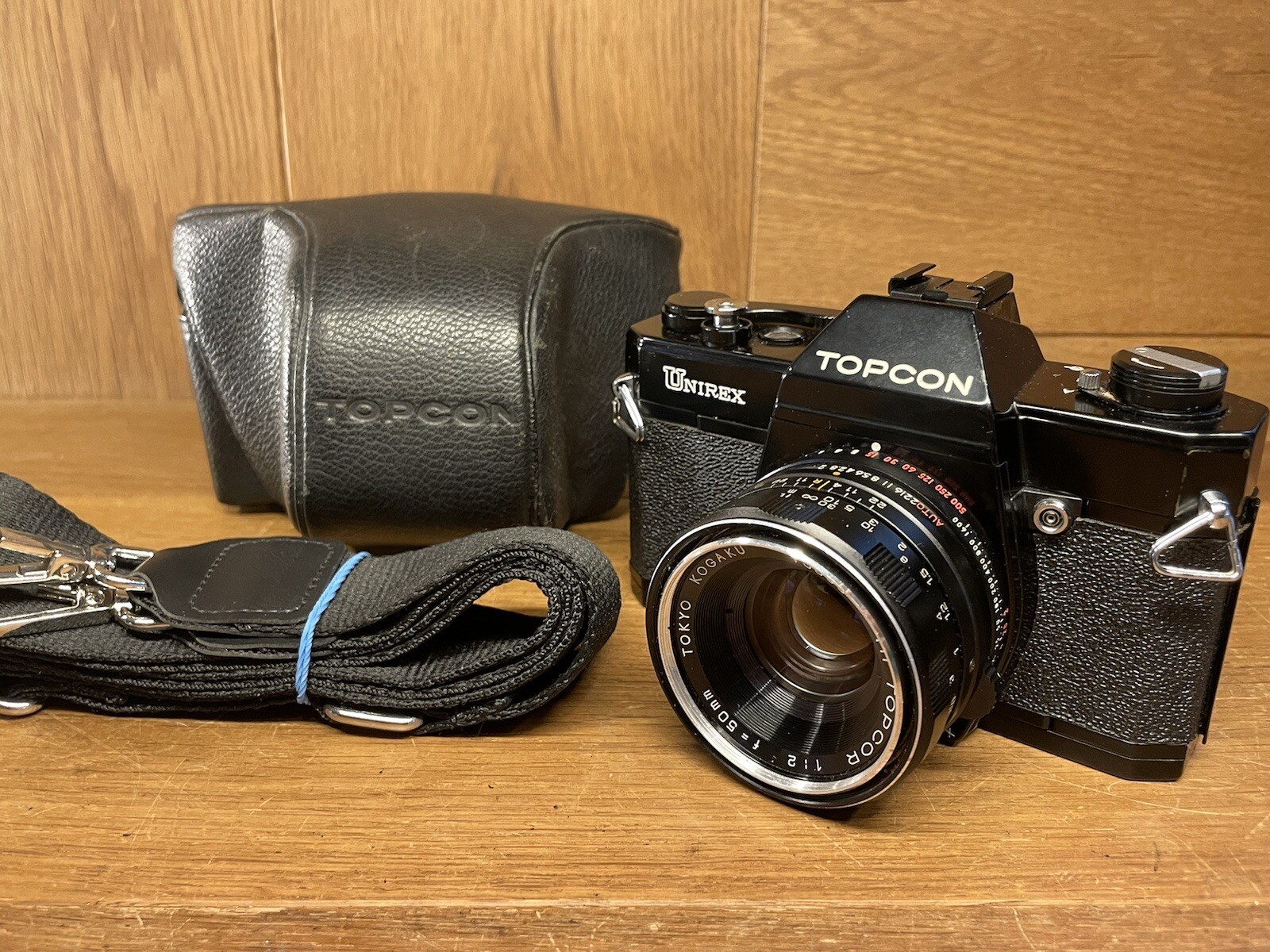
The Topcon Unirex is a 35mm single-lens reflex (SLR) camera introduced in 1969 as an economy-oriented model in Topcon’s SLR lineup. Designed to offer essential SLR functionality at a lower price point, it features a built-in CdS (Cadmium Sulfide) through-the-lens (TTL) exposure meter, making it accessible to amateur photographers seeking reliable metering without advanced automation.
Overview
Released during a period of rapid expansion in the 35mm SLR market, the Topcon Unirex served as a simplified alternative to the more sophisticated and expensive Topcon RE series, particularly the RE Super and RE II. Manufactured from 1969 to 1973, the Unirex was positioned as an entry-level SLR for consumers who desired the optical quality and interchangeable lens capabilities of a professional system camera but at a reduced cost. It retained the robust build quality associated with Topcon cameras while omitting certain high-end features such as instant-return mirror, full aperture TTL metering, and motor drive compatibility.
The Unirex shares the same proprietary Topcon RM bayonet lens mount as its higher-end siblings, ensuring compatibility with the extensive range of Topcon RE Auto and RE-B lenses. This allowed users to leverage high-quality optics like the RE. Auto-Topcor series, known for their sharpness and durable construction. However, the camera lacks aperture-priority or shutter-priority automation, relying instead on manual exposure control with stop-down metering. The TTL CdS meter provides center-weighted exposure reading, activated by a stop-down lever on the lens mount, requiring the user to press a metering button to stop down the lens for accurate measurement.
Despite its simplified design, the Unirex maintains Topcon’s reputation for mechanical reliability and solid metal construction. It features a horizontally-traveling focal-plane shutter with cloth curtains and a standard PC sync socket for flash synchronization. The viewfinder offers a fixed matte screen with a split-image rangefinder spot and microprism collar for manual focusing, typical of mid-tier SLRs of the era. While it lacks some refinements of its contemporaries—such as match-needle metering in the viewfinder—the Unirex delivers a functional and durable SLR experience aimed at budget-conscious photographers and students.
Specifications
| Specification | Value |
| Type | 35mm Single-Lens Reflex (SLR) |
| Film Format | 35mm (135 film) |
| Years Produced | 1969–1973 |
| Lens Mount | Topcon RM bayonet (compatible with RE Auto lenses) |
| Shutter | Focal-plane, cloth curtains; speeds 1 sec to 1/1000 sec + B |
| Metering | TTL CdS (Cadmium Sulfide), center-weighted, stop-down metering |
| Exposure Modes | Manual only (stop-down metering via button) |
| Viewfinder | Fixed pentaprism, 0.92x magnification, split-image/microprism focus aid |
| Dimensions | Approx. 145 × 95 × 55 mm; Weight: ~710 g (body only, no battery) |
Key Features
- TTL CdS Stop-Down Metering: Provides accurate exposure readings through the lens using a center-weighted CdS cell, activated by a metering button that stops the lens down to the selected aperture.
- Topcon RM Bayonet Mount: Ensures full compatibility with the high-performance RE Auto and RE-B series lenses, including automatic diaphragm operation.
- Manual Exposure Control: Full manual shutter speed and aperture selection with no automation, appealing to photographers seeking full creative control.
- Robust Mechanical Construction: All-metal body with mechanical shutter operation (no battery required for shutter function), enhancing reliability.
- Integrated Flash Sync: PC terminal for flash synchronization at all shutter speeds, with X and M settings for bulb and electronic flash compatibility.
Historical Context
The Topcon Unirex was introduced at a time when Japanese SLR manufacturers were aggressively expanding their product lines to capture different market segments. By the late 1960s, brands like Nikon, Canon, Pentax, and Minolta were offering both professional and consumer-grade SLRs, often differentiated by features like metering systems, automation, and build quality. Topcon, known for its precision engineering and high-end models like the RE Super, sought to compete in the growing amateur market with a simplified yet reliable SLR.
The Unirex filled a niche between the fully-featured RE Super and the more basic Topcon Y series. It lacked the RE Super’s open-aperture metering and instant-return mirror but retained the same lens mount and core mechanical integrity. Competitors during this period included the Pentax Spotmatic SP, Canon FX, and Nikkormat FT, all of which offered similar stop-down TTL metering. However, the Unirex struggled to gain widespread international distribution compared to these models, particularly in North America and Europe, limiting its market presence.
Despite its technical merits, the Unirex was discontinued by 1973 as Topcon shifted focus and eventually exited the 35mm SLR market. The brand’s inability to keep pace with rapid advancements in electronic automation and marketing contributed to its decline, making the Unirex one of the last manually-operated, non-automated SLRs in the Topcon lineup.
Collectibility & Value
Today, the Topcon Unirex is considered a niche collectible, prized by enthusiasts of vintage Japanese SLRs and Topcon aficionados. Its rarity stems from relatively low production numbers and limited export, particularly compared to mainstream models from Nikon or Pentax. In the current collector market (as of 2024), a fully functional Unirex in good condition typically sells for $150–$250, with higher prices for examples accompanied by original lenses and accessories.
When purchasing a Unirex, collectors should inspect the shutter operation across all speeds, check for light seals degradation (common in cameras of this age), and verify the functionality of the CdS meter. The meter requires a 1.35V mercury battery (PX625 or equivalent), which is no longer manufactured; modern substitutes like zinc-air or voltage-adjusted alkaline batteries may require recalibration for accurate readings. Additionally, the stop-down metering mechanism should be tested with a compatible RE Auto lens to ensure proper linkage and meter response.
Common issues include stiff shutter speeds (due to dried lubricants), cloudy or delaminated viewfinder prisms, and sticky aperture blades in older lenses. While repair parts are scarce, the camera’s mechanical simplicity allows skilled technicians to service it using tools and techniques common to vintage SLRs. Due to its solid build and compatibility with excellent Topcon lenses, the Unirex remains a functional and historically interesting camera for users who appreciate mechanical precision and analog photography.
Similar Cameras
- Pentax Spotmatic SP (1965–1973) – Similar stop-down TTL metering, M42 mount, broader lens compatibility.
- Nikkormat FT (1965–1975) – Nikon’s manual SLR with robust build, F-mount, and match-needle metering.
- Canon FX (1964) – Early Canon SLR with stop-down TTL metering, FL/F-mount compatibility.
- Yashica TL Electro-X (1970) – Electronically controlled but manual-focused SLR with CdS metering.
- Praktica PLC 2 (1973) – M42 mount SLR with stop-down metering and rugged East German construction.
Repair & Maintenance
The Topcon Unirex operates mechanically and does not require batteries for shutter function; however, the CdS exposure meter requires a 1.35V PX625 mercury battery. Modern replacements include Wein Cell (zinc-air) or alkaline PX625A batteries, though the latter may cause overexposure due to higher voltage (1.5V). A voltage reducer circuit or meter recalibration is recommended for accuracy.
Common maintenance issues include sluggish shutter speeds, often due to dried lubricants on the shutter curtains or timing mechanism. The self-timer mechanism, if present, may also require cleaning. The mirror movement should be smooth, and the film advance lever should operate without excessive resistance. Lens mount contacts and aperture coupling levers should be inspected for wear, especially when using with older RE Auto lenses.
Repair difficulty is moderate: while the camera shares design elements with the RE Super, parts are not widely available. Enthusiasts are advised to source working units or seek technicians experienced with vintage Japanese SLRs. Regular use, proper storage, and periodic CLA (Clean, Lubricate, Adjust) servicing can ensure long-term functionality.
eBay Listings



As an eBay Partner, we earn from qualifying purchases. This helps support our independent vintage technology research.
Related Models
- Topcon R (1957-1963)
- Topcon RE Super (1963-1971)
- Topcon Super D (1973-1978)
- Topcon Uni (1964-1969)
- Alpa 6 (1948-1953)
- Agfa Agfaflex
- Agfa Ambiflex
- Agfa Easy
- Agfa Futura Af zoom
- Agfa Isoflash-Rapid C