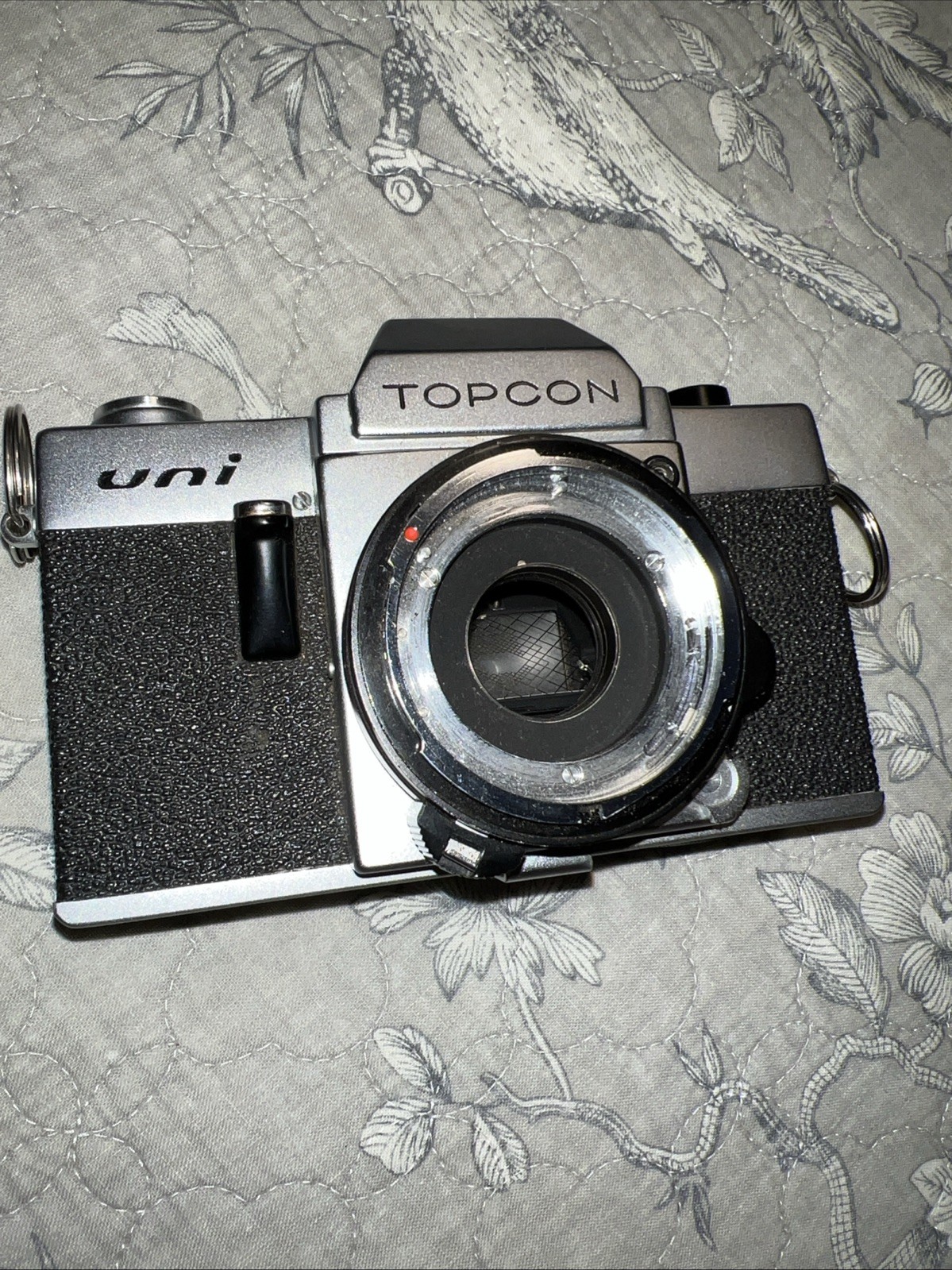
TOPCON UNI
The Topcon Uni is a 35mm single-lens reflex (SLR) camera introduced in 1964 as one of the earliest Japanese SLRs to feature fully automatic exposure control. Designed and manufactured by Tokyo Kogaku (later known as Topcon), the Uni represented a bold step toward simplifying photographic exposure for amateur and professional photographers alike, combining precision engineering with cutting-edge electronic automation for its era.
Overview
The Topcon Uni was launched at a pivotal moment in photographic history, when SLR technology was rapidly evolving from mechanical systems to electronically augmented designs. Released between 1964 and 1969, the Uni was positioned as a technologically advanced alternative to manual-exposure SLRs that dominated the market. It targeted advanced amateurs and semi-professional photographers who sought automation without sacrificing optical quality. As Topcon’s first foray into automatic exposure, the Uni stood apart from the company’s earlier manual-focus, manual-exposure models such as the RE Super, emphasizing ease of use while retaining the brand’s reputation for robust build and high-quality optics.
One of the Uni’s defining characteristics was its integration of a selenium-cell light meter and an automatic exposure system that adjusted shutter speed based on scene luminance and user-selected aperture. This system, while rudimentary by modern standards, was innovative for its time—predating the widespread adoption of through-the-lens (TTL) metering and aperture-priority automation in consumer SLRs. The camera featured a fixed 53mm f/1.8 Topcor lens, which was not interchangeable, marking a significant departure from Topcon’s traditional F-mount SLRs. This fixed-lens design streamlined the camera’s operation and reduced mechanical complexity, allowing Topcon to focus on perfecting the auto-exposure mechanism. Despite its niche positioning, the Uni laid the groundwork for future automated designs and demonstrated Topcon’s willingness to experiment with emerging technologies.
Specifications
| Specification | Value |
| Type | Single-Lens Reflex (SLR) |
| Film Format | 35mm |
| Years Produced | 1964–1969 |
| Lens Mount | Fixed-integral 53mm f/1.8 Topcor lens (non-interchangeable) |
| Shutter | Horizontal-travel focal-plane shutter; speeds from 1 sec to 1/500 sec, plus B; auto mode adjusts shutter between 1/30 sec and 1/500 sec |
| Metering | Selenium-cell light meter (center-weighted), mounted on the front of the lens housing |
| Exposure Modes | Manual (full shutter speed range), Auto (aperture-priority automation with variable shutter from 1/30 to 1/500 sec) |
| Viewfinder | Fixed pentaprism eye-level finder with central split-image rangefinder spot and microprism collar |
| Dimensions | Approximately 145 mm (W) × 95 mm (H) × 55 mm (D); weight ~710 g (body with lens, no battery) |
Key Features
- Aperture-priority automatic exposure system: One of the first Japanese SLRs to offer automatic shutter speed selection based on user-set aperture and ambient light.
- Integrated 53mm f/1.8 Topcor lens: A high-speed, fixed prime lens known for sharpness and smooth bokeh, optimized for the camera’s metering and focusing systems.
- Selenium-cell metering with no battery required: The light meter operates entirely on selenium power, eliminating the need for batteries but limiting low-light sensitivity over time as cells degrade.
- Split-image focusing screen: Provides precise manual focus confirmation via a central rangefinder patch surrounded by a microprism collar.
- Compact, all-metal body with ergonomic film advance lever and shutter release: Designed for intuitive handling despite its automated functions.
Historical Context
The Topcon Uni was introduced during a period of rapid innovation in SLR design, coinciding with the rise of Japanese camera manufacturers in global markets. While brands like Nikon and Canon were refining manual-exposure professional SLRs, Topcon pursued a different strategy by targeting mid-level users with automation. The Uni predated the more famous Pentax Spotmatic (1964) and Canon FX (1964), though unlike those models, it did not feature interchangeable lenses. Its closest contemporary in terms of automation was the 1963 Konica Auto S, though that was a rangefinder. The Uni thus occupied a unique space as one of the earliest auto-exposure SLRs from Japan.
Despite its innovation, the Uni did not achieve widespread commercial success. Its fixed lens limited appeal among serious photographers who valued system flexibility, and the auto-exposure mechanism, while novel, was less reliable in low-light conditions due to the limitations of selenium cells. Additionally, Topcon’s marketing presence outside Japan was weaker than competitors like Nikon or Minolta, limiting international distribution. Nevertheless, the Uni served as an important technical prototype, influencing later Topcon models and demonstrating the feasibility of automated exposure in SLR platforms.
Collectibility & Value
Today, the Topcon Uni is a rare and sought-after collector’s item, prized for its historical significance as an early auto-exposure SLR and its unique place in Topcon’s product lineage. Few units were produced relative to mainstream SLRs of the era, and surviving examples in working condition are uncommon. Market value typically ranges from $250 to $500 USD, depending on cosmetic condition, functionality of the selenium meter, and lens clarity. Cameras with responsive meter needles and clean, haze-free lenses command premium prices.
When purchasing a Topcon Uni, collectors should carefully inspect the selenium meter cell for signs of deterioration—common issues include a sluggish or stuck needle, which often indicates cell fatigue or internal corrosion. The shutter mechanism should be tested across all speeds, particularly in manual mode, as the mechanical linkage can stiffen over time. The lens should be checked for fungus, scratches, or separation, though the 53mm f/1.8 Topcor is generally well-preserved due to its sealed design. Given the age and complexity, servicing is best left to specialists familiar with vintage Japanese electronics and mechanical shutters.
Similar Cameras
- Konica Auto S (1963) – Rangefinder with aperture-priority auto exposure and high-quality Hexanon lens.
- Pentax Spotmatic (1964) – Interchangeable-lens SLR with TTL metering, manual exposure, and broad lens compatibility.
- Yashica Electro 35 (1966) – Compact 35mm rangefinder with fully automatic exposure, popular for its reliability.
- Canon FX (1964) – Early Canon SLR with open-aperture metering, though manual exposure only.
- Minolta SR-T 101 (1966) – Robust SLR with CLC metering and manual exposure, known for durability.
Repair & Maintenance
The Topcon Uni requires no battery for operation, as its selenium-cell meter generates power directly from light. However, this also means the meter becomes less effective over decades as the selenium degrades, often resulting in inaccurate readings or complete failure. While the shutter and film transport are mechanically reliable, they may require lubrication and cleaning after prolonged storage. Common issues include sticky shutter curtains, sluggish film advance, and oxidation in the meter linkage. Repair is challenging due to the camera’s hybrid electro-mechanical design and limited availability of service manuals or replacement parts. Enthusiasts are advised to seek technicians experienced in vintage Japanese SLRs, particularly those familiar with selenium meter systems and focal-plane shutter calibration. Regular use and storage in a dry, temperature-stable environment can extend the life of both the meter and mechanical components.
eBay Listings



As an eBay Partner, we earn from qualifying purchases. This helps support our independent vintage technology research.
Related Models
- Topcon R (1957-1963)
- Topcon RE Super (1963-1971)
- Topcon Super D (1973-1978)
- Topcon Unirex (1969-1973)
- Alpa 6 (1948-1953)
- Agfa Agfaflex
- Agfa Ambiflex
- Agfa Easy
- Agfa Futura Af zoom
- Agfa Isoflash-Rapid C