TOPCON SUPER D
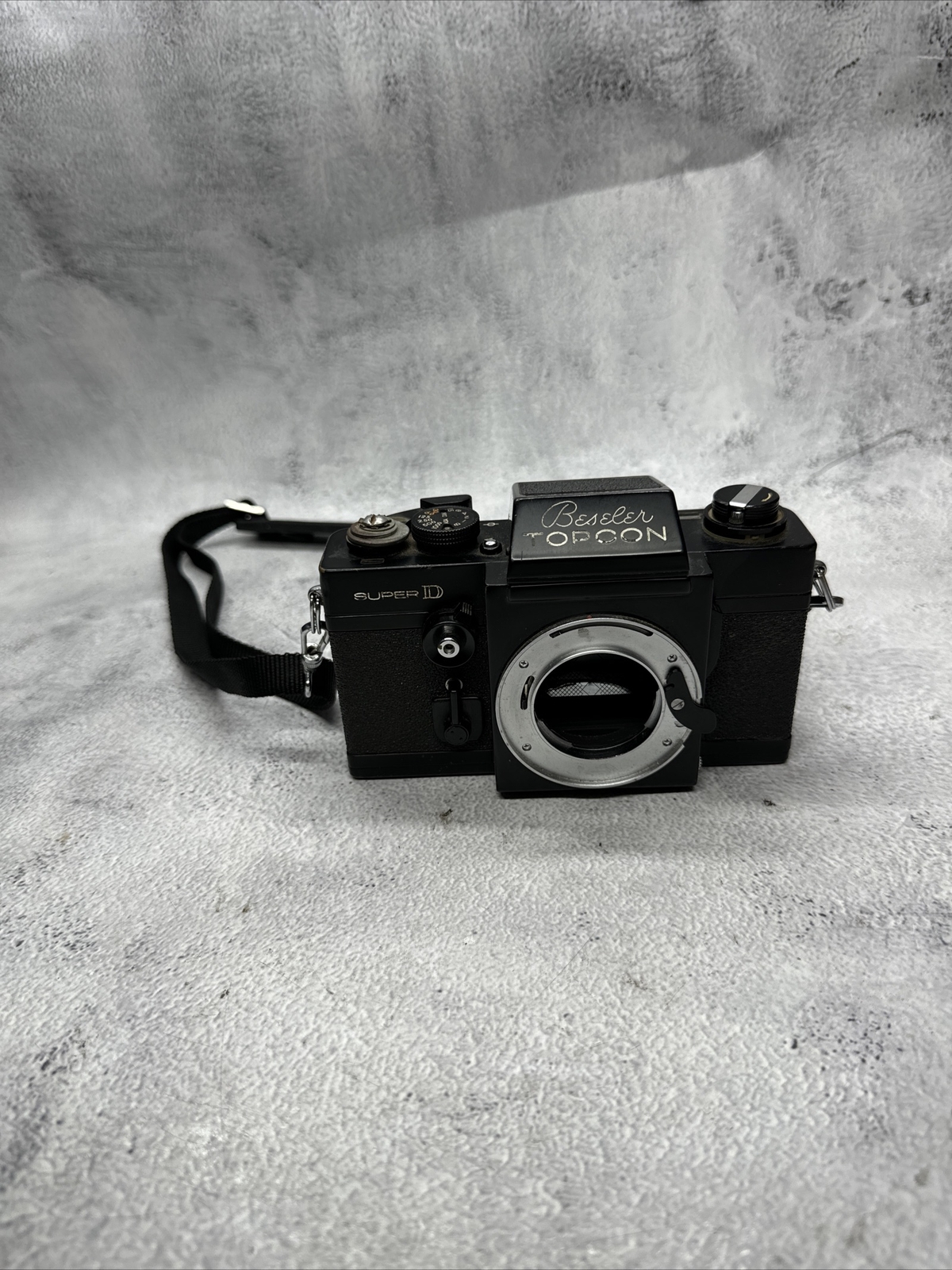
The Topcon Super D is a professional-grade 35mm single-lens reflex (SLR) camera introduced in 1973 as the flagship model in Topcon’s RE-mount SLR lineup. Designed for advanced amateurs and professional photographers, it features full-aperture through-the-lens (TTL) metering, a robust mechanical construction, and compatibility with the comprehensive Topcon RE Auto lens system.
Overview
The Topcon Super D was released during a transitional period in SLR development, when manufacturers were refining TTL metering systems and improving ergonomics for professional use. As the successor to the highly regarded Topcon RE Super and Super DM models, the Super D represented the culmination of Topcon’s mechanical SLR engineering before the company shifted focus away from the professional market. It was positioned as a precision instrument, emphasizing reliability, accurate exposure control, and compatibility with a wide range of high-quality RE Auto lenses.
One of the Super D’s defining characteristics is its full-aperture TTL metering system, which allows metering at the lens’s maximum aperture for brighter viewing and accurate exposure calculation before stopping down. This system, combined with a large, bright viewfinder and a horizontal-travel cloth focal-plane shutter, made the Super D particularly suitable for photojournalism, studio work, and field photography. The camera retains a fully mechanical shutter mechanism with a battery-independent 1/125 sec. flash sync speed, ensuring operational reliability even without power.
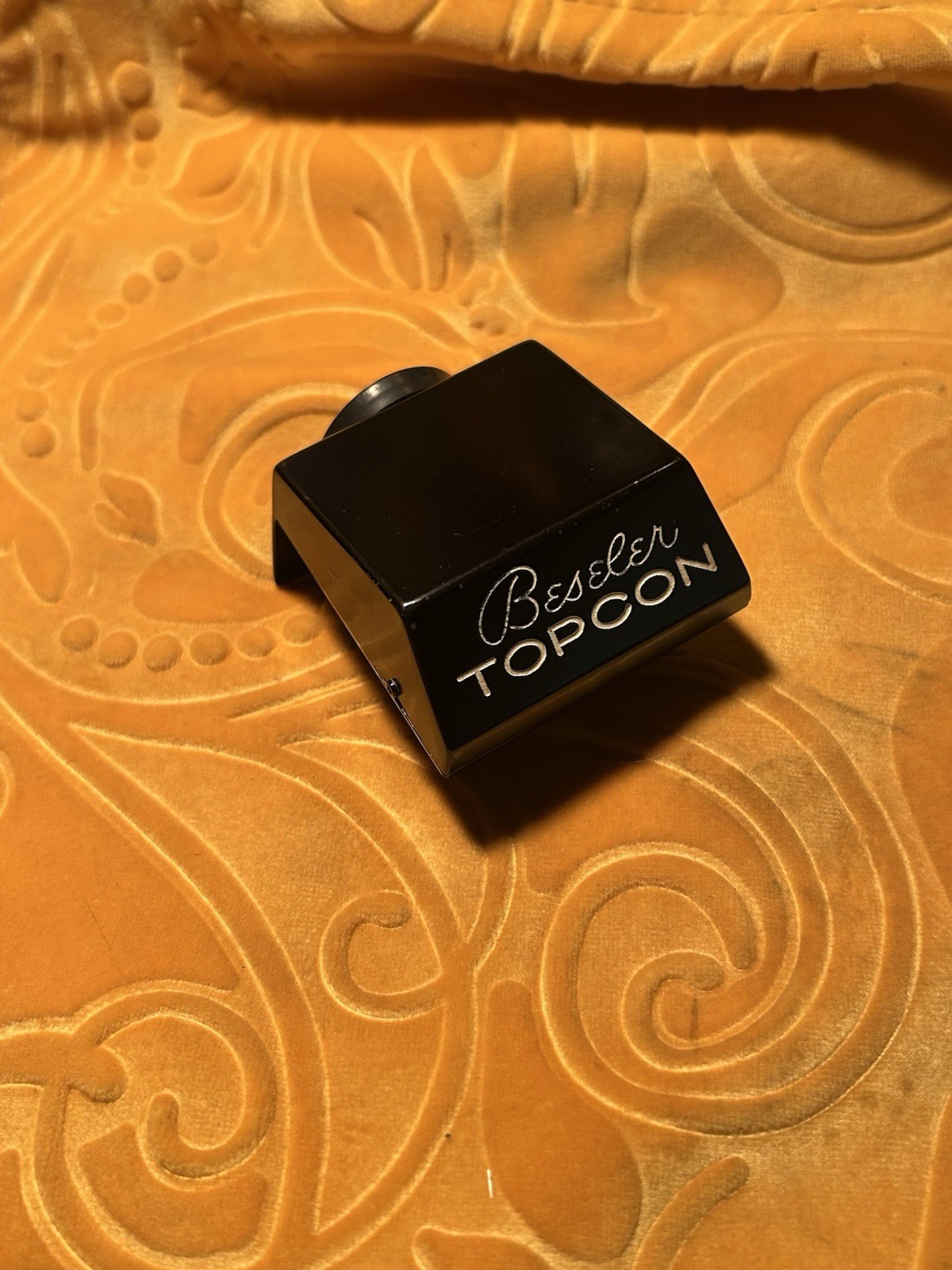
In Topcon’s product hierarchy, the Super D stood at the top of the line, offering improvements over the RE Super and Super DM, including a redesigned pentaprism housing with a more ergonomic eyepiece, enhanced metering circuitry, and a refined film advance mechanism. Despite its advanced features, Topcon’s declining market presence in the mid-1970s limited the Super D’s international distribution, particularly in North America, where it faced stiff competition from Nikon, Canon, and Pentax.
Specifications
| Specification | Value |
| Type | 35mm Single-Lens Reflex (SLR) |
| Film Format | 35mm (135) |
| Years Produced | 1973–1978 |
| Lens Mount | Topcon RE Auto (bayonet) |
| Shutter | Horizontal-travel cloth focal-plane; speeds 1 sec to 1/1000 sec, plus B; flash sync at 1/125 sec |
| Metering | TTL full-aperture center-weighted metering via CdS cell |
| Exposure Modes | Manual exposure with stop-down metering option; no aperture-priority or autoexposure |
| Viewfinder | Fixed pentaprism with microprism collar and split-image rangefinder spot; approx. 94% coverage; 0.95x magnification (with 50mm f/1.4) |
| Dimensions | 148 × 95 × 55 mm; weight approx. 720 g (body only, no battery) |
Key Features
- Full-aperture TTL metering: Enables bright viewfinder viewing and accurate exposure without stopping down, using compatible RE Auto lenses with automatic diaphragm coupling.
- Mechanical reliability: Fully mechanical shutter operation at all speeds except metering; functions without battery power.
- RE Auto lens compatibility: Works with the full range of Topcon RE Auto lenses (e.g., 50mm f/1.4, 35mm f/2, 135mm f/2.8), known for their optical quality and robust build.
- Precision viewfinder: High-magnification fixed pentaprism with split-image and microprism focusing aids for accurate manual focusing.
- Interchangeable focusing screens: Optional screens available for specialized applications (e.g., microprism, matte, grid).
Historical Context
The Topcon Super D was launched in 1973 at a time when Japanese SLR manufacturers were rapidly advancing electronic integration and automation. Competitors like the Nikon F2 (1971) and Canon F-1 (1971) had already established themselves as professional benchmarks, offering modular designs and extensive accessory systems. Topcon, while respected for its optical and mechanical engineering, struggled to match the global marketing and distribution reach of its rivals.
The Super D was Topcon’s final serious attempt to compete in the high-end professional SLR market. It incorporated lessons from earlier models like the RE Super and Super DM, particularly in refining the metering system and improving user ergonomics. However, by the mid-1970s, Topcon’s parent company, Tokyo Kogaku, began shifting focus toward industrial optics and medical equipment, leading to reduced investment in camera development. Production of the Super D ceased around 1978, and no direct successor was introduced.
Despite its technical merits, the Super D remained a niche product outside Japan. Limited availability in Western markets, combined with the dominance of Nikon and Canon, meant it never achieved widespread adoption among professionals. Nevertheless, it is regarded by collectors and vintage camera enthusiasts as one of the most refined mechanical SLRs ever produced by Topcon.
Collectibility & Value
The Topcon Super D is considered a rare and desirable camera among vintage SLR collectors, particularly due to its professional build quality, optical performance, and status as Topcon’s last high-end mechanical SLR. Units in good working condition typically command prices between $300 and $600 on the secondary market, depending on cosmetic condition, functionality, and included accessories such as original case, manuals, or matched focusing screens.
When purchasing a Super D, collectors should verify the functionality of the shutter at all speeds, the accuracy of the meter (which relies on a 1.35V mercury battery or modern substitute), and the condition of the light seals and foam light trap around the mirror box. Common issues include degraded light seals causing light leaks, stiff or sticky shutter mechanisms due to dried lubricants, and CdS cell failure leading to inaccurate metering. Because replacement parts are scarce, mechanical serviceability is a key consideration.
Due to its limited production run and lack of widespread use, the Super D is rarer than comparable Nikon or Canon models from the same era. Its value is further enhanced by its association with Topcon’s legacy of precision engineering and the high quality of RE Auto lenses, many of which are now sought after for their sharpness and build.
Similar Cameras
- Nikon F2 Photomic (1971) – Professional Nikon F-mount SLR with interchangeable viewfinders and TTL metering; direct competitor in the pro market.
- Canon F-1 (1971) – Rugged, modular 35mm SLR with interchangeable finders and screens; Canon’s flagship mechanical camera.
- Pentax Spotmatic F (1973) – Popular full-aperture metering SLR with M42 screw mount; more consumer-oriented but similarly timed.
- Minolta SRT-101 (1966, still in production) – Known for advanced CLC metering and solid build; widely exported and used.
- Yashica TL Electro-X (1973) – Electronically controlled aperture-priority SLR; represents the shift toward automation that the Super D avoided.
Repair & Maintenance
The Topcon Super D uses a 1.35V mercury PX625 battery (now obsolete) for its CdS meter; modern equivalents include Wein Cell (zinc-air) or adapters for SR44 batteries, though voltage differences may require meter recalibration. The shutter is fully mechanical and does not require batteries for operation, making the camera functional even with a dead or missing battery.
Common maintenance issues include deteriorated light seals (which should be replaced to prevent light leaks), mirror bumper foam disintegration, and shutter blade lubricant hardening, which can cause slow shutter speeds or uneven exposure. The meter coupling mechanism with RE Auto lenses should be checked for smooth engagement. Due to limited service support and scarcity of spare parts, repair should be performed by technicians experienced with vintage Japanese SLRs. Lubrication and cleaning of the film transport and shutter mechanism are recommended if the camera has been in long-term storage.
eBay Listings


As an eBay Partner, we earn from qualifying purchases. This helps support our independent vintage technology research.
Related Models
- Topcon R (1957-1963)
- Topcon RE Super (1963-1971)
- Topcon Uni (1964-1969)
- Topcon Unirex (1969-1973)
- Alpa 6 (1948-1953)
- Agfa Agfaflex
- Agfa Ambiflex
- Agfa Easy
- Agfa Futura Af zoom
- Agfa Isoflash-Rapid C