ROLLEIFLEX AUTOMAT
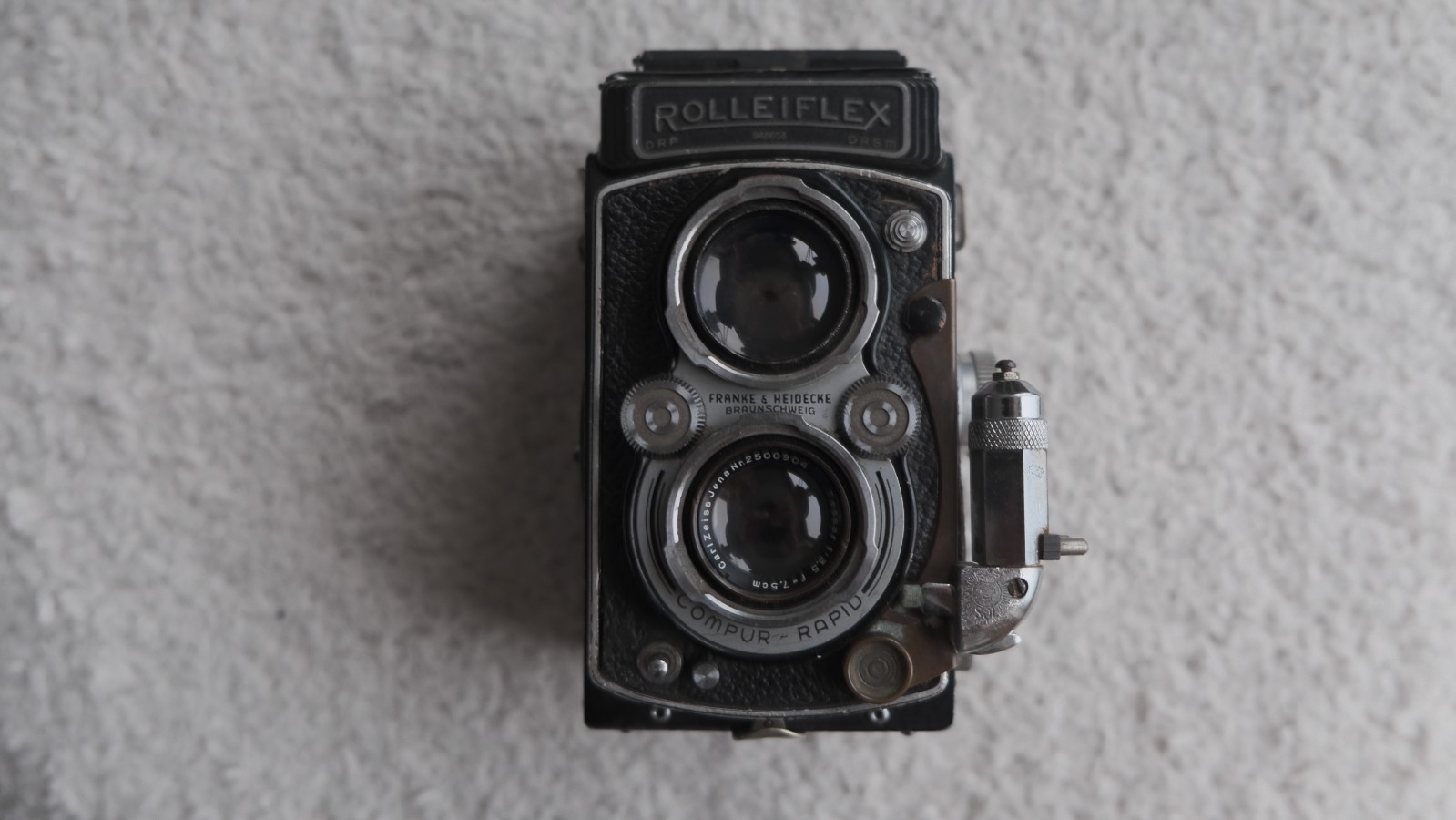
The Rolleiflex Automat is a twin-lens reflex (TLR) medium format camera introduced in 1937 as the first Rolleiflex TLR to feature automatic film advance with frame spacing via a pre-wound spool system. It marked a significant advancement in TLR design, streamlining the photography process by eliminating the need for manual frame counting via red window, a common source of exposure errors in earlier rollfilm cameras.
Overview
The Rolleiflex Automat, officially designated as the Model K4 or "Rolleiflex 621," was manufactured by Franke & Heidecke in Braunschweig, Germany, and represented a major innovation in medium format camera engineering. Released during a period of rapid advancement in 35mm and rollfilm camera technology, the Automat was designed to appeal to professional photographers and serious amateurs who demanded precision, reliability, and ease of use. Its defining feature—automatic frame spacing—was achieved through a sophisticated film transport mechanism that advanced the film to the correct starting position for the next exposure after each winding stroke, using a pre-wound take-up spool system unique to 120 rollfilm.
The Automat succeeded the original Rolleiflex Standard (Model K1/K2) and laid the foundation for the entire postwar Rolleiflex TLR lineage. It was offered with a range of high-quality lenses, including Carl Zeiss Tessar and Schneider Xenar options, typically paired with the reliable Compur-Rapid or Synchro-Compur shutters. The viewing lens remained fixed, while the taking lens was coupled to the shutter mechanism, ensuring accurate focus transfer. The camera’s all-metal construction, precision engineering, and ergonomic improvements over its predecessors solidified Rolleiflex’s reputation for excellence in medium format design.
Specifications
| Specification | Value |
| Type | Twin-Lens Reflex (TLR) |
| Film Format | 6x6 cm on 120 rollfilm (12 exposures) |
| Years Produced | 1937–1949 |
| Lens Mount | Fixed lens assembly (non-interchangeable) |
| Taking Lens | Carl Zeiss Tessar f/3.5 or f/3.8, 75mm (early models); later models with Schneider-Kreuznach Xenar f/3.5, 75mm |
| Viewing Lens | Heidosmat 75mm f/2.8 |
| Shutter | Compur-Rapid or Synchro-Compur leaf shutter |
| Shutter Speeds | 1 sec to 1/500 sec, plus B (bulb) |
| Aperture Range | f/3.5 to f/22 for f/3.5 lenses; f/3.8 to f/22 for f/3.8 lenses |
| Focusing | Rack-and-pinion via knob on right side; minimum focus distance ~1m |
| Metering | None (uncoupled); later variants may accept external meter |
| Exposure Modes | Manual only |
| Viewfinder | Ground glass focusing screen with pop-up hood; integrated Fresnel lens; waist-level design |
| Film Advance | Automatic frame spacing via pre-wound take-up spool; single stroke lever wind |
| Frame Counter | Automatic reset via film insertion; no manual reset needed |
| Sync | PC flash sync socket (on later Synchro-Compur models) |
| Dimensions | Approx. 10 x 10 x 19 cm (H x W x D) |
| Weight | ~1.5 kg (3.3 lbs) without film |
Key Features
- Automatic Frame Spacing: The first TLR to implement automatic film spacing via a pre-wound take-up spool system—loading the film automatically positioned the first frame, and each wind advanced precisely to the next.
- Precision German Optics and Shutters: Equipped with Carl Zeiss Tessar or Schneider Xenar 75mm f/3.5 lenses and high-quality Compur-Rapid/Synchro-Compur shutters for reliable exposure control.
- Robust All-Metal Construction: Die-cast aluminum and steel body with precision-machined components, ensuring durability and long-term alignment stability.
- Integrated Film Transport Mechanism: Eliminated reliance on red window for frame alignment, reducing exposure errors and enabling faster shooting.
- Waist-Level Viewfinder with Magnifier: High-quality ground glass with pop-up hood and built-in magnifier for critical focusing.
Historical Context
The Rolleiflex Automat was introduced in 1937 at a time when medium format rollfilm cameras were gaining popularity among press, portrait, and studio photographers. Competitors such as the Kodak Reflex, Wirgin Edinex, and later the Yashica Mat series had not yet achieved the mechanical sophistication or optical quality of the German-made Rolleiflex. The Automat’s automatic frame spacing eliminated the need for a red window by mechanically advancing the film to the correct starting position after each exposure, reducing the risk of overlapping frames.—a flaw that plagued even experienced users.
This innovation gave Rolleiflex a decisive edge in the professional market. The camera was marketed as a tool for efficiency and accuracy, particularly suited for photojournalism and studio work where consistent frame registration was essential. During World War II, production was limited due to material shortages and factory disruptions, but postwar models (from 1945 onward) resumed with minor refinements, including updated shutter designs (Synchro-Compur with flash sync) and improved focusing mechanisms. The Automat remained in production until 1949, when it was succeeded by the Rolleiflex 2.8 series, which introduced coupled exposure metering and brighter viewing screens.
Collectibility & Value
The Rolleiflex Automat is a highly collectible camera, particularly models in excellent working condition with original lenses and unblemished exteriors. Early pre-war examples (1937–1939) are especially rare and sought after, with values ranging from $800 to $1,800 depending on lens type, shutter functionality, and cosmetic condition. Postwar models (1945–1949) are more commonly found and typically sell for $600–$1,200. Cameras equipped with the f/3.5 Tessar or Xenar lenses command a premium over f/3.8 variants.
Collectors should inspect several key areas when evaluating an Automat: shutter accuracy across all speeds (particularly 1/500 and 1 sec), lens condition (absence of haze, fungus, or separation), focusing smoothness, and integrity of the automatic film advance mechanism. The spring-loaded take-up spool system is prone to wear or failure if the camera has been stored with film loaded. Light seals are almost always degraded and should be replaced for optimal performance. Original cases, manuals, and accessories further enhance value. Due to its mechanical complexity and age, professional servicing is recommended before regular use.
Similar Cameras
- Kodak Reflex III (1939–1949): American-made TLR with similar 6x6 format but manual frame spacing and lower build quality.
- Yashica Mat-124G (1970s): Later Japanese TLR with built-in CdS meter, but mechanically simpler than the Automat.
- Minolta Autocord (1958–1967): High-end Japanese TLR with automatic film advance, though introduced much later.
- Wirgin Edinex (1930s): German TLR contemporary with manual winding and lesser optical quality.
- Rolleicord II/III (1939–1950s): Lower-cost sibling to the Automat, lacking automatic spacing in early models.
Repair & Maintenance
The Rolleiflex Automat requires no batteries, as it is fully mechanical. However, its Compur-Rapid and Synchro-Compur shutters are complex leaf shutter mechanisms that benefit from periodic cleaning, lubrication, and speed calibration—especially if the camera has been stored for decades. Common issues include sticky shutter blades, inaccurate speeds (particularly at 1/500 and 1 sec), and worn film pressure plate springs. The automatic film advance mechanism relies on a calibrated spring in the take-up spool; if overwound or damaged, it may fail to space frames correctly. Light seals degrade over time and should be replaced to prevent light leaks. Due to the camera’s precision engineering, repairs should be performed by technicians experienced with vintage German TLRs. Replacement parts are scarce but sometimes available through specialist suppliers or donor cameras. Regular use and proper storage in a dry, temperature-stable environment will preserve functionality.
eBay Listings


As an eBay Partner, we earn from qualifying purchases. This helps support our independent vintage technology research.
Related Models
- Rolleiflex 2.8F (1960–1981)
- Rolleiflex 3.5F (1956-1975)
- Rolleiflex T (1958-1976)
- Lubitel 166 (1976-1990)
- Lubitel 2 (1955–1979)
- Mamiya C220 (1968-1975)
- Mamiya C330 (1969-1974)
- Mamiya C330f (1975-1983)
- Mamiya C330S (1983–1994)
- Rollei 2.8F (1960-1981)