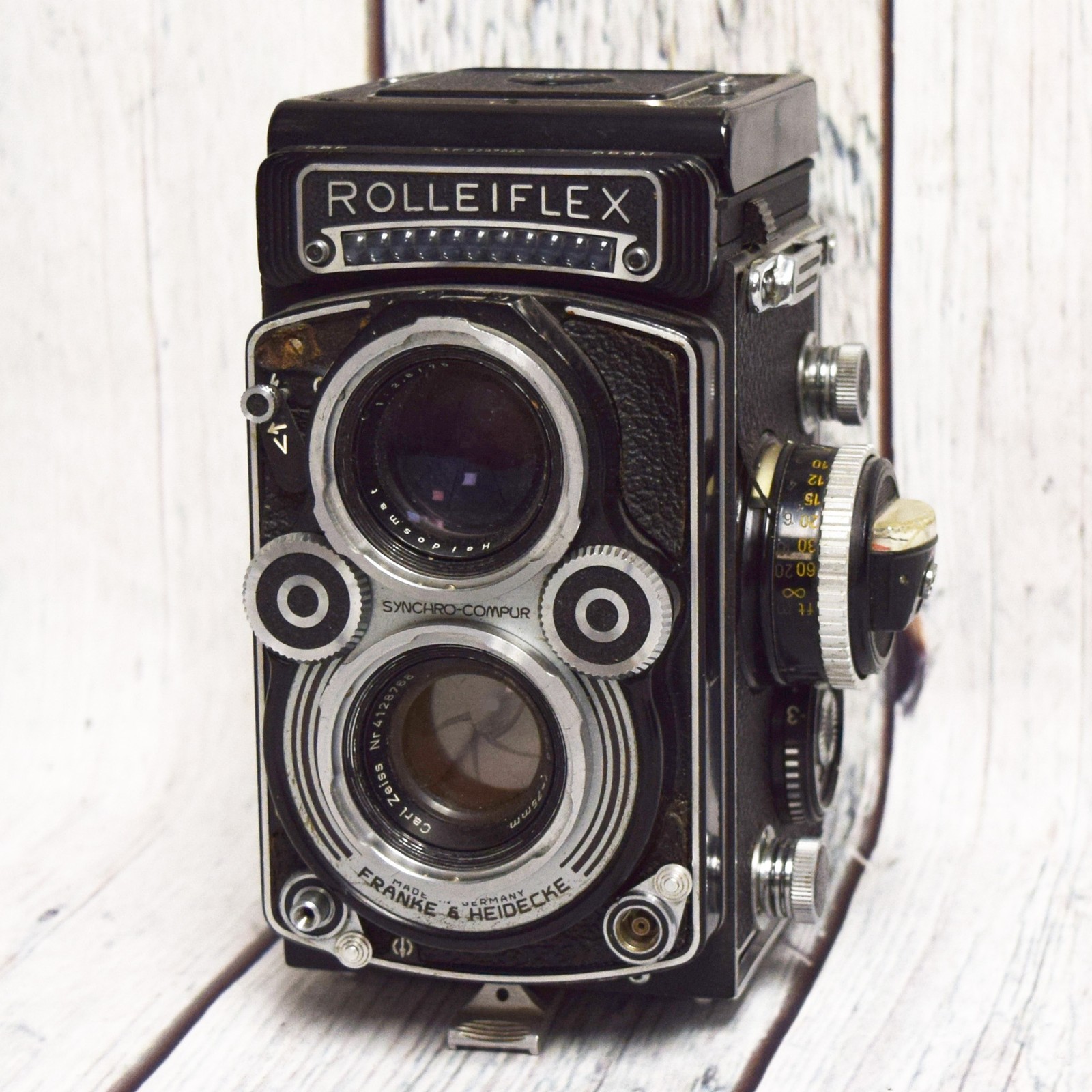
ROLLEIFLEX 3.5F
The Rolleiflex 3.5F is a premium twin-lens reflex (TLR) medium format camera produced by Franke & Heidecke under the Rolleiflex brand from 1956 to 1975. Renowned for its precision engineering, high-quality optics, and exceptional build quality, the 3.5F represents the pinnacle of TLR development before the rise of SLRs diminished the format’s dominance in professional photography.
Overview
Introduced in 1956, the Rolleiflex 3.5F was designed as a top-tier medium format TLR for professional photographers and serious amateurs seeking exceptional image quality and mechanical reliability. It succeeded earlier models in the Rolleiflex F series, incorporating refinements in lens design, focusing mechanism, and shutter operation. The "F" designation denoted a series of improvements over previous Rolleiflex models, including a larger f/3.5 maximum aperture, a redesigned taking lens, and enhanced film transport with a double-exposure prevention mechanism.
The 3.5F was positioned above the more common 2.8F model in terms of lens speed and optical performance, although both shared the same core mechanical platform. It featured the legendary Carl Zeiss Planar 75mm f/3.5 lens as its taking lens, paired with a matching 75mm f/2.8 Heidosmat viewing lens. This combination delivered outstanding sharpness, contrast, and color rendition, making the 3.5F a favorite among portrait, studio, and architectural photographers. The camera's all-metal construction, precision-ground focusing helicoid, and smooth film advance contributed to its reputation for durability and operational excellence.
Throughout its 19-year production run, the 3.5F underwent only minor changes, reflecting its mature design. It remained in production until 1975, when declining demand for TLRs due to the rise of 35mm SLRs and more versatile medium format systems led to the discontinuation of most Rolleiflex TLRs. Despite its age, the 3.5F remains highly regarded in the analog photography community for its optical performance and mechanical refinement.
Specifications
| Specification | Value |
| Type | Twin-Lens Reflex (TLR) |
| Film Format | 6x6cm (120 roll film) |
| Years Produced | 1956–1975 |
| Lens Mount | Fixed lens assembly (non-interchangeable) |
| Taking Lens | Carl Zeiss Planar 75mm f/3.5, 6 elements in 4 groups |
| Viewing Lens | Heidosmat 75mm f/2.8, 6 elements in 4 groups |
| Aperture Range | f/3.5 to f/22 |
| Shutter | Compur-Rapid MXV Leaf Shutter |
| Shutter Speeds | 1 sec to 1/500 sec, plus B (bulb) |
| Flash Sync | X and M contacts at 1/30 sec |
| Metering | None (manual exposure) |
| Exposure Modes | Manual only |
| Viewfinder | Ground glass focusing screen with Fresnel lens, pop-up hood, magnifier |
| Focusing | Helical focusing mechanism, rack-and-pinion drive |
| Film Advance | Knob advance with automatic frame counter and double-exposure prevention |
| Frame Count | 12 exposures per 120 roll |
| Dimensions | 10 x 10 x 12.5 cm (approx.) |
| Weight | ~1,350 g (without film) |
Key Features
- Carl Zeiss Planar 75mm f/3.5 lens: One of the finest medium format lenses of its era, offering exceptional sharpness, minimal distortion, and beautiful rendering.
- Precision Compur-Rapid MXV shutter: Reliable leaf shutter with speeds up to 1/500 sec and accurate timing across all settings.
- Helical focusing mechanism: Superior to the rack-and-pinion systems of earlier models, providing smooth, precise focus control.
- Double-exposure prevention: Integrated film advance mechanism prevents accidental double exposures unless manually disengaged.
- High-quality construction: All-metal body, precision-machined components, and meticulous assembly ensure long-term durability and reliability.
Historical Context
The Rolleiflex 3.5F was launched during a golden era for medium format photography, when TLRs were the preferred tools of portrait, press, and studio photographers. At the time, the 3.5F competed with other high-end TLRs such as the Mamiya C series and the Yashica Mat line, but distinguished itself through superior optics and build quality. Its f/3.5 Planar lens offered a balance between speed and optical performance that was unmatched in the TLR market, particularly when compared to the more common f/3.5 or f/3.8 lenses on competing models.
Despite its excellence, the 3.5F was a niche product even in its prime. It was significantly more expensive than the Rolleiflex 2.8F and other TLRs, limiting its appeal to professionals who demanded the best. The camera’s lack of built-in metering (a feature introduced later on the 2.8F “S” and “T” models) also made it less convenient for on-the-go shooting. Nevertheless, its reputation for optical fidelity ensured a loyal following, particularly in Europe and Japan. By the 1970s, the rise of 35mm SLRs like the Nikon F and Canon F-1, along with advancements in medium format SLRs such as the Hasselblad 500C, eroded the TLR’s market share, leading to the 3.5F’s eventual discontinuation.
Collectibility & Value
Today, the Rolleiflex 3.5F is a sought-after collector’s item, prized for its optical performance and historical significance. Well-maintained examples in working condition typically command prices between $1,200 and $2,000 USD, with mint-condition or low-serial-number units occasionally fetching higher sums at auction. The camera’s value is heavily dependent on lens condition—haze, fungus, or scratches on the Planar or Heidosmat lenses can significantly reduce worth.
When purchasing a 3.5F, collectors should verify shutter functionality across all speeds, check for smooth film advance, and inspect the focusing mechanism for play or stiffness. Light seals should be replaced, as original ones are nearly 70 years old and likely degraded. Common issues include sticky shutters (often due to dried lubricants), inaccurate aperture blades, and worn focusing gears. While repairable by skilled technicians, parts availability can be limited, and servicing is costly. Cameras stored in humid environments may suffer from internal corrosion or lens fungus, so careful inspection is essential.
Similar Cameras
- Rolleiflex 2.8F – Slightly slower f/2.8 Planar lens, but otherwise nearly identical mechanically; more common and slightly less expensive.
- Mamiya C330 – Interchangeable lens TLR with excellent optics and robust build, popular with studio photographers.
- Yashica Mat-124G – Affordable TLR with built-in CdS meter, good optics, and reliable mechanics.
- Hasselblad 1600F – Early medium format SLR with interchangeable lenses, representing the next evolution in professional medium format.
- Kowa Six Super – Japanese TLR with high-quality lenses and compact design, less common but well-regarded.
Repair & Maintenance
The Rolleiflex 3.5F requires no batteries, as it is fully mechanical with no electronic components. This makes it reliable in the field but also means all functions must be manually set. Regular maintenance includes cleaning, lubrication, and adjustment (CLA) by a specialist familiar with vintage TLRs. Common problems include shutter timing inaccuracies, especially at higher speeds, and aperture blades sticking due to old grease. The focusing helicoid may develop play over time, affecting precision. Replacement light seals are essential for proper light-tightness, and the ground glass should be cleaned carefully to avoid scratches. Due to the camera’s complexity and precision engineering, DIY repairs are not recommended unless the user has extensive experience with vintage medium format cameras.
eBay Listings


As an eBay Partner, we earn from qualifying purchases. This helps support our independent vintage technology research.
Related Models
- Rolleiflex 2.8F (1960–1981)
- Rolleiflex Automat (1937-1949)
- Rolleiflex T (1958-1976)
- Lubitel 166 (1976-1990)
- Lubitel 2 (1955–1979)
- Mamiya C220 (1968-1975)
- Mamiya C330 (1969-1974)
- Mamiya C330f (1975-1983)
- Mamiya C330S (1983–1994)
- Rollei 2.8F (1960-1981)